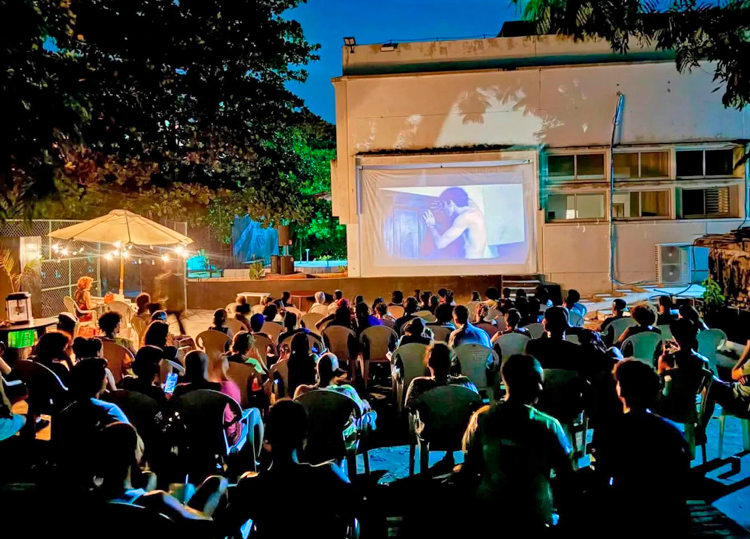
Working people in Cuba are coming together to take initiatives to combat the effects of the U.S. rulers’ brutal oil blockade and crippling sanctions. An important part of this effort is the re-launching of mobile cinemas around the country by the Cuban Institute of Cinematographic Art and Industry (ICAIC.) They’ve managed to find a way around the unending power outages caused by Washington’s blockade to maintain some access to entertainment, as well as Cuban, Caribbean, African and world culture.
Gloria Rolando, an internationally known documentary filmmaker, helped to set up a mobile cinema in her neighborhood in Colón, Havana. She secured a special screen from Cuba’s Ministry of Culture and began inviting her neighbors to gather together for weekend film screenings in the street.
“Anything that brings culture to the community is good, because people are already suffering enough,” she told Belly of the Beast, a group of U.S. and Cuban journalists dedicated to providing accurate coverage of Cuba. “So this is a small contribution to making life a little easier.”
Among the films screened in Colón has been the animated classic “Elpidio Valdés,” about a fictional Cuban independence fighter battling Spanish colonial rule in the 19th century.
In a 1996 interview, Rolando, a leader of ICAIC, described the “responsibility we have to conserve culture and pass something on to the younger generation.”
Lack of repairs and frequent blackouts have led many regular movie theaters to shut down, and many Cubans don’t have enough reliable electrical supply to watch TV at home.
Last year ICAIC figured out how to create mobile cinemas in these conditions, setting up portable projectors and screens on streets in Havana and, following the success there, out to rural areas, town squares and former sugar-mill settlements across the island. Together with the Rueda Producciones film collective, the institute developed technology that allow screenings using batteries charged by solar panels.
In areas of Old Havana, members of the Cuban Youth Network have helped transform open-air spaces into cinemas. The program of films there has been supplemented to include live musical performances, theater and dance.
In Villa Clara, inflatable screens are being used to bring movies to more remote rural communities.
The use of mobile cinema in Cuba goes back to the early years of the revolution. “Mobile cinemas were transported by truck,” Rolando said. Projectionists installed generators, projectors and beds in their vehicles and then traveled across the island, bringing cinema to isolated rural areas where many peasants had never seen a TV screen or a film.
ICAIC was founded just months after workers and farmers, led by Fidel Castro, conquered power in 1959. It was tasked with bringing cinema to working people far and wide, from historical documentaries to Hollywood films. A short 1967 documentary, “For the First Time,” by Octavio Cortázar, captures the delight of Cuban peasants and their children who are attending their first ever movie screening. It can be seen at https://www.youtube.com/watch?v=GFKKW4XY2v0