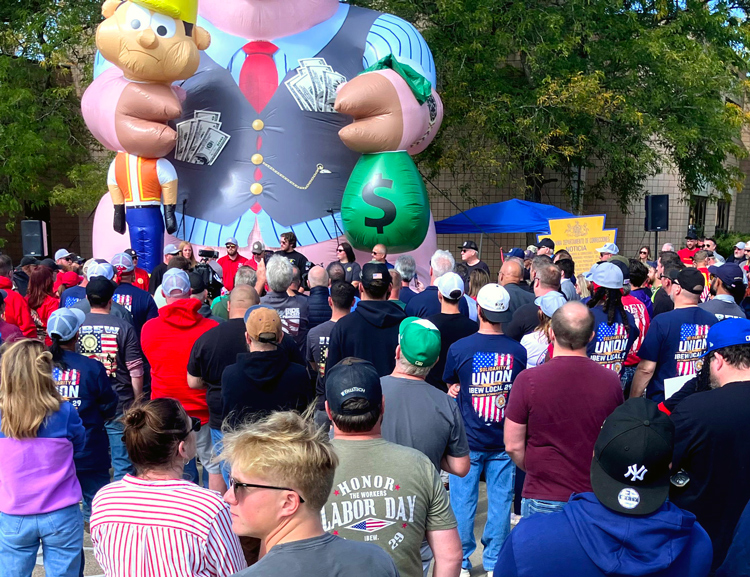
PITTSBURGH — Some 1,000 International Brotherhood of Electrical Workers Local 29 members returned to work at Duquesne Light Co. after an eight-day strike, the first walkout in over 50 years. Details of the contract have not come out publicly, but after the contract vote the local leadership put up an Instagram post saying, “A huge thank you to everyone that supported us and all of our members for standing with us.”
WTAE News reported Local 29 business manager Josh Ewing said the new contract features “additional staffing, technology advancement, enhanced benefits and nonunion workers being allowed to organize.”
The contract came days after a successful and spirited strike rally at Duquesne Light’s Woods Run facility. As picketing continued at other locations, around 400 members of the union blocked off access to the plant here. Local 29 President Nicole Greb told the crowd, “I’m overwhelmed by the support today and on the picket lines.” Speakers were interrupted by chants of, “Union strong. DLC is wrong!”
Passing motorists honked horns as they drove by picket lines along the two Duquesne Light facilities on Beaver Ave.
The rally and the strike had quite an impact in this area near downtown Pittsburgh, where other union-organized utilities and services are located. When the strike began Oct. 1, hundreds of pickets set up and greeted the shift walking out of the plant. “That night was unbelievable,” a picket captain told the Militant. “It was complete solidarity!”
“We went out as employees, but we’ll go back as Local 29,” Mike Goodwin, transmission and distribution representative, told the rally. “We are a family. They are a company.”
Union say-so over safety and introduction of new technology were big issues in the strike. Ewing told radio station KDKA the “humongous workload of 60, 70, 80 hours a week” imposed by the bosses is a dangerous safety question for both workers and customers.
“The company is trying to take away our ability to negotiate” over the introduction of new technology, Ewing added. He said the company had tripled the size of its nonunion workforce, put restrictions on the union’s right to organize and put a heavy reliance on contractors. “We need full-time union workers.”
“This strike is not about money, it’s about safety, staffing, the use of nonunion contractors and company refusal to allow organizing them,” John Galuska, president of the Allegheny-Fayette Central Labor Council, told the Militant. “And it’s about equalizing pensions among workers.”
Kathie Fitzgerald contributed to this article.