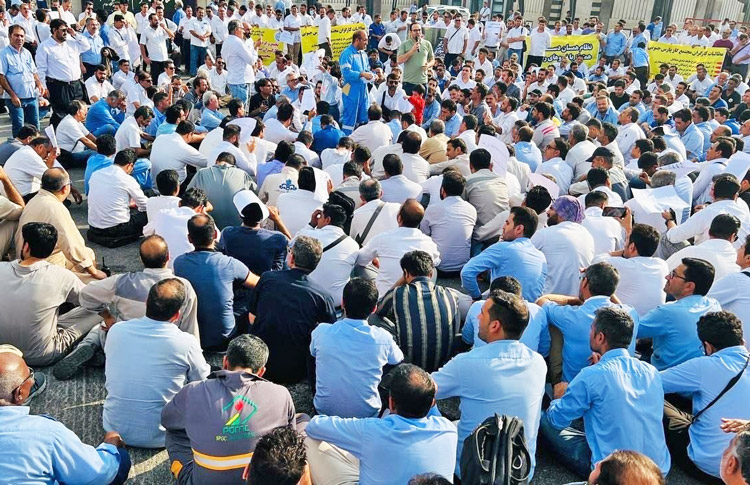
“Our pay slip is a mark of slavery,” several hundred temporary workers from the Fajr Jam gas refinery in Bushehr province in southern Iran chanted during a work stoppage and march Nov. 10. “Enough with promises, our table is empty.”
This is just one example of boss-labor conflicts across Iran today.
Just 60 miles away, 3,000 workers and their families from 12 refineries were marching through the streets of Asaluyeh, at the South Pars Gas Complex. They were demanding to be hired directly by the company instead of through the super-exploitative contract system. They were also demanding wage increases, more humane work schedules and other improvements.
Four days later, oil workers from at least nine refineries who are employed directly by the oil companies held protests throughout the southern oil and gas fields, demanding wage hikes, an end to a cap on their wages, improvements in retirement pay and measures to protect their retirement funds. They have been holding weekly protests for over a year.
That same week hundreds of nurses took to the streets in front of the University of Medical Sciences and Akbar Hospital in Mashhad in northeastern Iran for three days in a row. “Inflation is in dollars, our wages are in rials,” they chanted. “Our rights are only won in the streets.” Inflation on basic necessities is now running at over 40% a year.
The Union of Retirees reports that the cost of “the simplest vegetables have increased several times.” It says people are asking angrily, “Have we reached a point where fruit has become a family’s dream?” adding, “if this path continues, tomorrow bread and eggs will also be considered luxury goods.”
Weekly protests across the country by retirees have grown a little bigger and more boisterous over the last several months.
Miners at the Zarshouran Gold Mine in West Azerbaijan, a mostly Kurdish province in the northwest, protested in front of the mine offices Nov. 13. “We all work in the same complex, but our wages and benefits are half those of the factory workers,” one said. In addition, the miners are owed back wages.
These are just some of the dozens of labor protests and strikes taking place every week in Iran amid a crippling water shortage, a deepening economic crisis and widespread opposition to the regime’s military interventions abroad aimed at extending its power and at destroying Israel, the only refuge for Jews in the world.
Severe water shortage
“A whopping 19 dams — up from nine three weeks ago — are on the verge of drying out, filled to less than 5% capacity,” Al Jazeera reports. In Tehran a drop in pressure between midnight and 5 a.m. essentially cuts off water nightly.
Iranian authorities have depleted so much of the water in underground aquifers that over 800 towns and villages, including Tehran, face land collapses due to subsidence. In September 40 schools and a residential complex were evacuated because of imminent collapse.
While the shortages were triggered by six years of low rainfall, it’s estimated that about a third of all water is wasted due to antiquated infrastructure and irrigation practices, as well as bureaucratic mismanagement. Many believe that a “water mafia,” under the control of businesses run by the regime’s Islamic Revolutionary Guard Corps, builds dams and diverts water to companies and areas it favors.
A recent incident in Ahvaz highlights the deep class tensions. After police physically evicted his family from their small food stall in a park, Ahmad Baledi, a 20-year-old student, set himself on fire in protest. The small business had sustained eight members of his family for two decades, but city authorities decided to give the location to someone else. Baledi is a member of Iran’s oppressed Arab nationality.
Witnesses say the cops made fun of him before he set himself on fire, asking him if he wanted “matches or a lighter.”
Relatives of Baledi, fellow merchants and other working people began protesting outside the hospital where he was taken with catastrophic burns.
When he died nine days later, authorities were so worried that the protests would spread, they ordered the family to immediately hold the funeral without announcing it in advance. But hundreds of people showed up anyway turning it into a demonstration against the regime’s injustices. After the funeral, municipal officials there were arrested and Iranian President Masoud Pezeshkian ordered an investigation as the regime sought to save face.