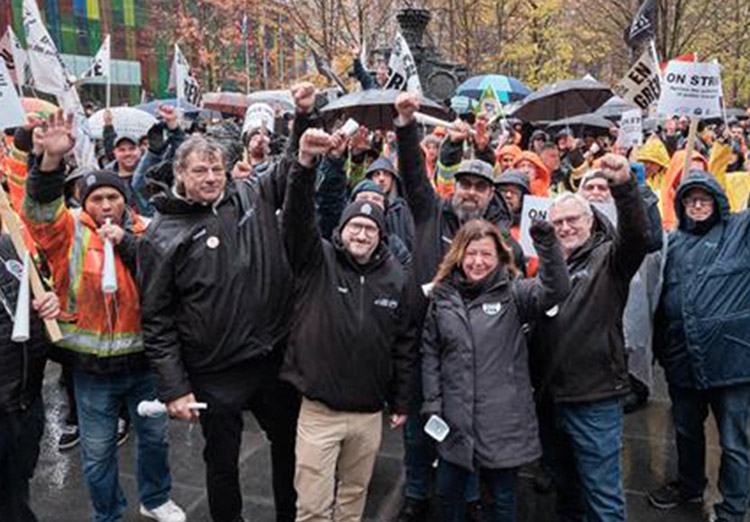
MONTREAL — In response to a serious escalation of the Quebec government’s attacks on union rights and democratic freedoms, all four Quebec union federations and five other unions have called for a demonstration here Nov. 29. Thousands are expected to attend.

The focus of the action is a series of laws adopted or proposed by Premier Francois Legault’s Coalition for the Future of Quebec (CAQ) government, which give it the power to outlaw strikes, expand its interference in union affairs and restrict unions’ rights to engage in political activity.
As the laws are being discussed, four unions representing 9,000 maintenance workers, bus and subway drivers, and office workers at the Montreal Transport Society (STM) have been conducting or plan to conduct strikes for better wages, schedules and working conditions.
Under the government’s threat to declare its strike illegal, the maintenance workers’ union suspended its four-week action Nov. 12. Two days later the bus and subway drivers’ union called off a strike scheduled over the next two days after reaching a tentative agreement.
The adoption of Bill 2 ended negotiations between the government and the federation of doctors. It imposes conditions that force doctors to meet quotas for the number of patients they see or face major financial penalties.
Some 13,000 doctors and medical students took part in a boisterous Montreal protest rally against the law Nov. 9, a week after a similar action in Quebec City.
At the rally, George Michaels, a family doctor for 40 years, told the Montreal Gazette that its “negative impact on health care” for patients will be similar to the 1990s cutbacks “that closed several hospitals in the province and thousands of doctors and nurses were let go.”
Under penalty of fines up to 20,000 Canadian dollars ($14,200) a day, the government ordered the doctors to end their protests.
Against the right to strike
Law 14, formerly Bill 89, authorizes the Minister of Labor to end strikes and impose mandatory arbitration. It’s set to come into force Nov. 30. The law is explicitly based on similar powers in the federal Labor Code that Ottawa has used since the summer of 2024 to force railway, port and postal workers, as well as Air Canada flight attendants, to end strikes. The flight attendants set an example by defying the law and making gains in the contract they reached.
Bill 3 aims to restrict the ability of unions to fund “political action,” such as building solidarity with workers in struggle and speaking out and acting on political questions. It’s “an anti-worker, anti-union, pro-business law designed to weaken unions,” the United Steelworkers union in Quebec said.
The CAQ has explicitly stated the bill targets the Autonomous Federation of Teaching (FAE), a teachers’ union federation, which is challenging Quebec’s Bill 21 in the Supreme Court of Canada. The bill prohibits teachers from wearing religious symbols. Many FAE members are Muslim and wear a headscarf.
Bill 3 requires unions submit their financial records for annual audits by the government. It imposes mandatory minimum quorums for union meetings and other intervention in internal union affairs.
“We will stand up and fight against this law of political interference and control. It is time to mobilize,” the Steelworkers’ statement said.
Gov’t seeks to divide working class
The CAQ government has also passed laws or introduced bills to divide workers based on their language or religion. On Oct. 9, it filed a bill to establish a Quebec “constitution,” that would take precedence over any existing or future laws.
It incorporates Law 96, passed in 2022, which restricts access to services and education in English in a province where close to 20% of the population speaks that language regularly at home. Protests have been organized against it by English-language rights organizations.
The bill incorporates the “notwithstanding clause” of the Canadian Constitution, which allows provincial and the federal governments to exempt laws they pass from any challenge in court. The governments of Ontario and Alberta have used the clause to pass anti-strike laws.
Finally, on Oct. 30, the government passed Bill 94. It extends previous legislation prohibiting anyone who works in a public school from wearing religious symbols, such as Muslim head scarves, Sikh turbans and Jewish kippahs. Among those targeted are care providers, secretaries, volunteer librarians, janitors and cafeteria staff.
Under the pretext of combating what the government claims is a decline of the French language, Bill 94 also requires school staff to communicate in French with each other and with students, even if they have another language in common.
The CAQ’s assault on democratic freedoms aims to foster divisions in the working class in the interests of the bosses. It’s part of an offensive by the bosses, backed by Ottawa and provincial governments, to try to break ongoing working-class and union resistance amid a deepening capitalist economic and social crisis.