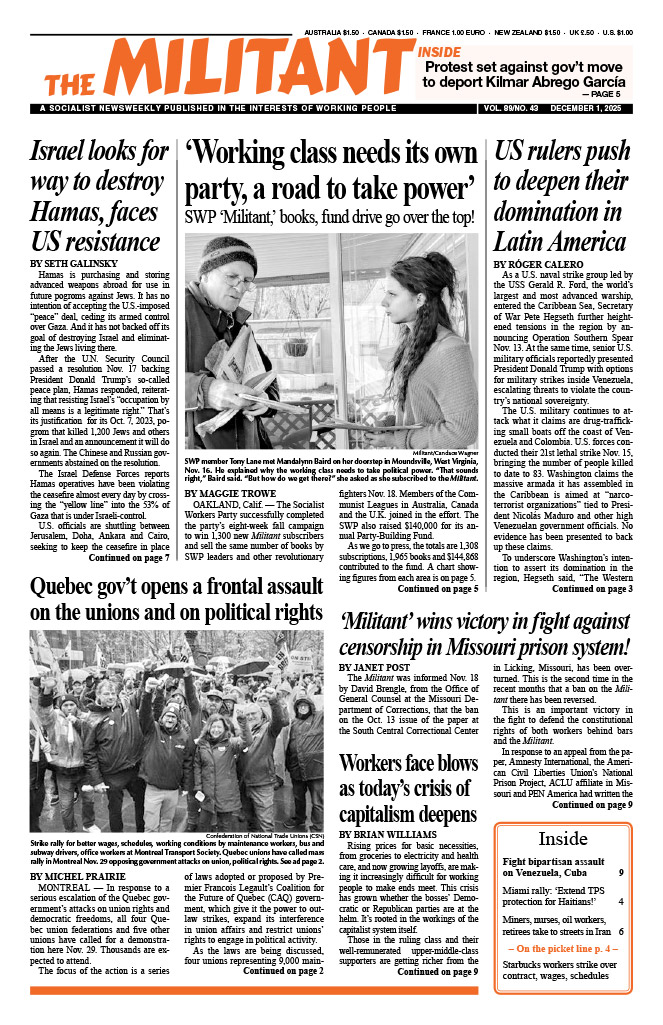
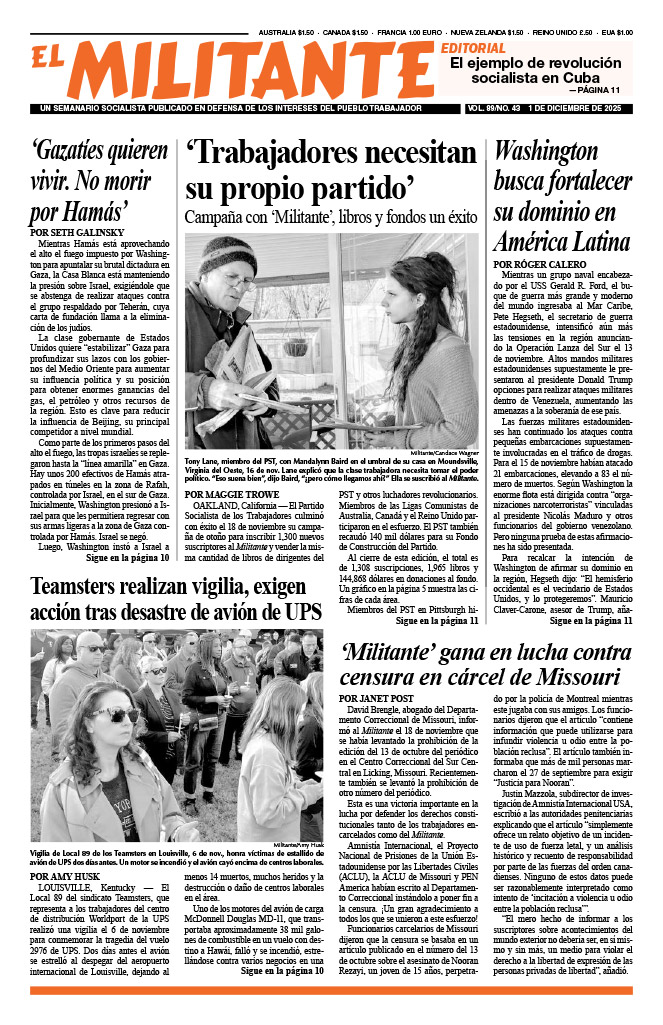
One of Pathfinder’s Books of the Month for November is Speeches to the Party: The Revolutionary Perspective and the Revolutionary Party by James P. Cannon, who was the national secretary of the Socialist Workers Party. The book covers the prospects for working-class revolutionary struggle coming out of the Second World War, won by Washington. The excerpt is from the SWP’s 1946 political resolution, “Theses on the American revolution.” It explains why the working-class battle to take political power in the U.S. is decisive for all humanity, as Washington attempts to wield its military power to offset its weakened place as the last capitalist empire. Copyright © 1973 by Pathfinder Press. Reprinted by permission.
The United States, the most powerful capitalist country in history, is a component part of the world capitalist system and is subject to the same general laws. … The overwhelming preponderance of American imperialism does not exempt it from the decay of world capitalism, but on the contrary acts to involve it ever more deeply, inextricably, and hopelessly.
U.S. capitalism can no more escape from the revolutionary consequences of world capitalist decay than the older European capitalist powers. The blind alley in which world capitalism has arrived, and the U.S. with it, excludes a new organic era of capitalist stabilization. The dominant world position of American imperialism now accentuates and aggravates the death agony of capitalism as a whole.
American imperialism emerged victorious from the Second World War, not merely over its German and Japanese rivals, but also over its “democratic” allies, especially Great Britain. Today Wall Street unquestionably is the dominant world imperialist center. Precisely because it has issued from the war vastly strengthened in relation to all its capitalist rivals, U.S. imperialism seems indomitable. So overpowering in all fields — diplomatic, military, commercial, financial, and industrial — is Wall Street’s preponderance that consolidation of its world hegemony seems to be within easy reach. Wall Street hopes to inaugurate the so-called “American Century.”
In reality, the American ruling class faces more insurmountable obstacles in “organizing the world” than confronted the German bourgeoisie in its repeated and abortive attempts to attain a much more modest goal, namely: “organizing Europe.”
The meteoric rise of U.S. imperialism to world supremacy comes too late. Moreover, American imperialism rests increasingly on the foundations of world economy. … But the world foundation is today shot through with insoluble contradictions; it suffers from chronic dislocations and is mined with revolutionary powder kegs.
American capitalism, hitherto only partially involved in the death agony of capitalism as a world system, is henceforth subject to the full and direct impact of all the forces and contradictions that have debilitated the old capitalist countries of Europe.
The economic prerequisites for the socialist revolution are fully matured in the U.S. The political premises are likewise far more advanced than might appear on the surface. …
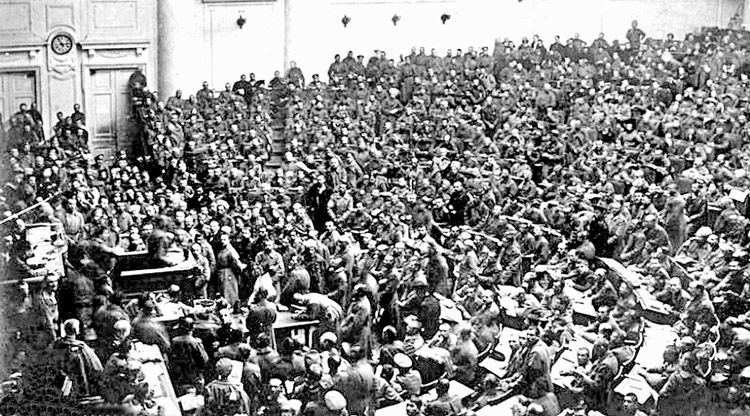
Given an objectively revolutionary situation, a proletarian party — even a small one — equipped with a precisely worked out Marxist program and firm cadres can expand its forces and come to the head of the revolutionary mass movement in a comparatively brief span of time. This too was proved conclusively — and positively — by the experiences of the Russian Revolution in 1917. There the Bolshevik Party, headed by Lenin and Trotsky, bounded forward from a tiny minority, just emerging from underground and isolation in February to the conquest of power in October — a period of nine months.
Numerical weakness, to be sure, is not a virtue for a revolutionary party but a weakness to be overcome by persistent work and resolute struggle. In the U.S. all the conditions are in the process of unfolding for the rapid transformation of the organized vanguard from a propaganda group to a mass party strong enough to lead the revolutionary struggle for power.
The hopeless contradictions of American capitalism, inextricably tied up with the death agony of world capitalism, are bound to lead to a social crisis of such catastrophic proportions as will place the proletarian revolution on the order of the day. In this crisis, it is realistic to expect that the American workers, who attained trade union consciousness and organization within a single decade, will pass through another great transformation in their mentality, attaining political consciousness and organization.
If in the course of this dynamic development a mass labor party based on the trade unions is formed, it will not represent a detour into reformist stagnation and futility, as happened in England and elsewhere in the period of capitalist ascent. From all indications, it will rather represent a preliminary stage in the political radicalization of the American workers, preparing them for the direct leadership of the revolutionary party.
The revolutionary vanguard party, destined to lead this tumultuous revolutionary movement in the U.S., does not have to be created. It already exists, and its name is the SOCIALIST WORKERS PARTY. It is the sole legitimate heir and continuator of pioneer American Communism and the revolutionary movements of the American workers from which it sprang. Its nucleus has already taken shape in three decades of unremitting work and struggle against the stream. Its program has been hammered out in ideological battles and successfully defended against every kind of revisionist assault upon it. The fundamental core of a professional leadership has been assembled and trained in the irreconcilable spirit of the combat party of the revolution.
The task of the SOCIALIST WORKERS PARTY consists simply in this: to remain true to its program and banner; to render it more precise with each new development and apply it correctly in the class struggle; and to expand and grow with the growth of the revolutionary mass movement, always aspiring to lead it to victory in the struggle for political power.