As a U.S. naval strike group led by the USS Gerald R. Ford, the world’s largest and most advanced warship, entered the Caribbean Sea, Secretary of War Pete Hegseth further heightened tensions in the region by announcing Operation Southern Spear Nov. 13. At the same time, senior U.S. military officials reportedly presented President Donald Trump with options for military strikes inside Venezuela, escalating threats to violate the country’s national sovereignty.
The U.S. military continues to attack what it claims are drug-trafficking small boats off the coast of Venezuela and Colombia. U.S. forces conducted their 21st lethal strike Nov. 15, bringing the number of people killed to date to 83. Washington claims the massive armada it has assembled in the Caribbean is aimed at “narco-terrorist organizations” tied to President Nicolás Maduro and other high Venezuelan government officials. No evidence has been presented to back up these claims.
To underscore Washington’s intention to assert its domination in the region, Hegseth said, “The Western Hemisphere is America’s neighborhood — and we will protect it,” as he announced a Joint Task Force. Mauricio Claver-Carone, an adviser to the U.S. president, added, “You can’t be the preeminent global power if you’re not the preeminent regional power.”
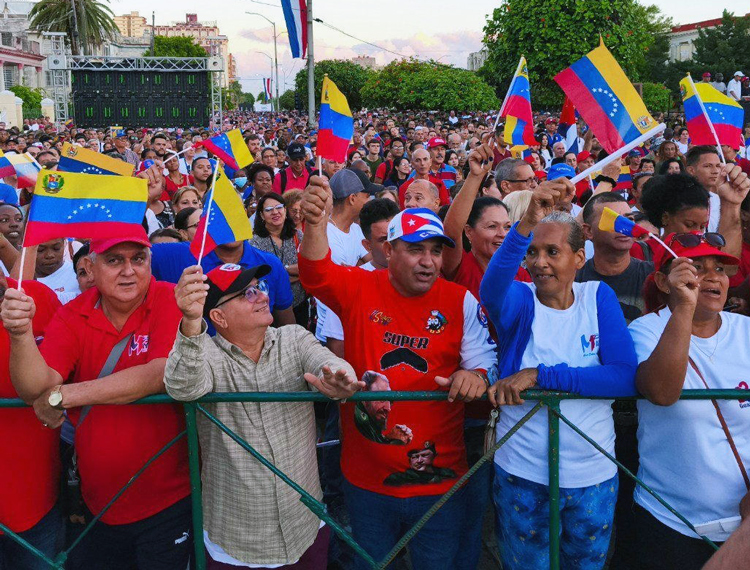
The government in Caracas denies the U.S. accusation of drug trafficking, denouncing Washington’s violation of its sovereignty, and has mobilized tens of thousands of troops and volunteer militias against possible U.S. military intervention. Governments in the region have warned of the danger of an invasion.
The arrival of the Ford and its accompanying battle group brings the total deployment of U.S. troops in the area to approximately 15,000. This includes Marines and troops in Puerto Rico and aboard eight other warships in the Caribbean, as well as fighter bombers now based in the area.
U.S. imperialist interests
The U.S. Southern Command explains the new Joint Task Force will advance its counternarcotics operations by adding unmanned systems on the land, sea and air. At the same time, it will be “learning lessons for other theaters.” In other words, practicing for future wars to come.
This show of force in the Caribbean is part of broader moves by Washington to confront rival powers seeking to expand their influence in the Americas.
It goes hand in hand with reactivating and reviving military bases in the region it had been forced to abandon or deactivate earlier.
The U.S. rulers are pressing for greater military presence in the Panama Canal, and the Pentagon is renovating the Roosevelt Roads naval base in Puerto Rico. They had been forced to abandon this base under the pressure of mass mobilizations by working people in Puerto Rico against their bombing practice on the island of Vieques.
The Pentagon is also building new radar and communication systems at civilian airports in Puerto Rico and the U.S. Virgin Islands, as well as adding space to base aircraft, and refueling installations. Through a series of “security cooperation” agreements, the U.S. military maintains additional installations in Aruba, Curacao and Colombia.
For decades it has kept a strategic outpost at the Soto Cano Air Base in Honduras. Also known as Palmerola, the base was used in the 1980s as part of U.S. interventions in Nicaragua and El Salvador.
Washington is pressing governments in the region to back its economic, military, and political aims, offering aid to those who agree and retaliation against those who refuse.
Broader target: Beijing
In its efforts to curb Beijing’s growing economic and military footprint in Latin America, Washington has scored two significant gains in Argentina. In July 2023 it pressured Buenos Aires to purchase 24 used F-16 fighter planes from Denmark, instead of taking Beijing’s offer of brand new JF-17 fighter jets. More recently the Trump administration extended a $20 billion financial-rescue plan to bolster the Javier Milei government, which has faced severe economic pressure.
The loan came with conditions. “You can do some trade,” President Trump told Milei during his Oct. 14 visit to the White House, but you “certainly shouldn’t be doing anything having to do with the military with China.”
The U.S. government has expressed its strong opposition to Beijing-Buenos Aires infrastructure projects, including the existing Espacio Lejano space-tracking facility located in Patagonia. Washington views the station as part of Beijing’s strategy to enhance its global surveillance capabilities aimed at the U.S.
Washington wants Beijing out of Argentina. But China is Argentina’s second-largest trade partner after Brazil. Some 80% of Argentine meat and soy exports go to China. Joint infrastructure projects in Argentina have included construction of two hydroelectric dams, as well as a contract to build a nuclear power plant. Chinese companies and banks are major lenders and investors in Argentinean telecommunications, railway, mining and other industries.
Beijing has used its Belt and Road Initiative to become South America’s largest trading partner.
These are part of the bigger stakes in the U.S. rulers’ operations today in the Caribbean and throughout the Hemisphere.