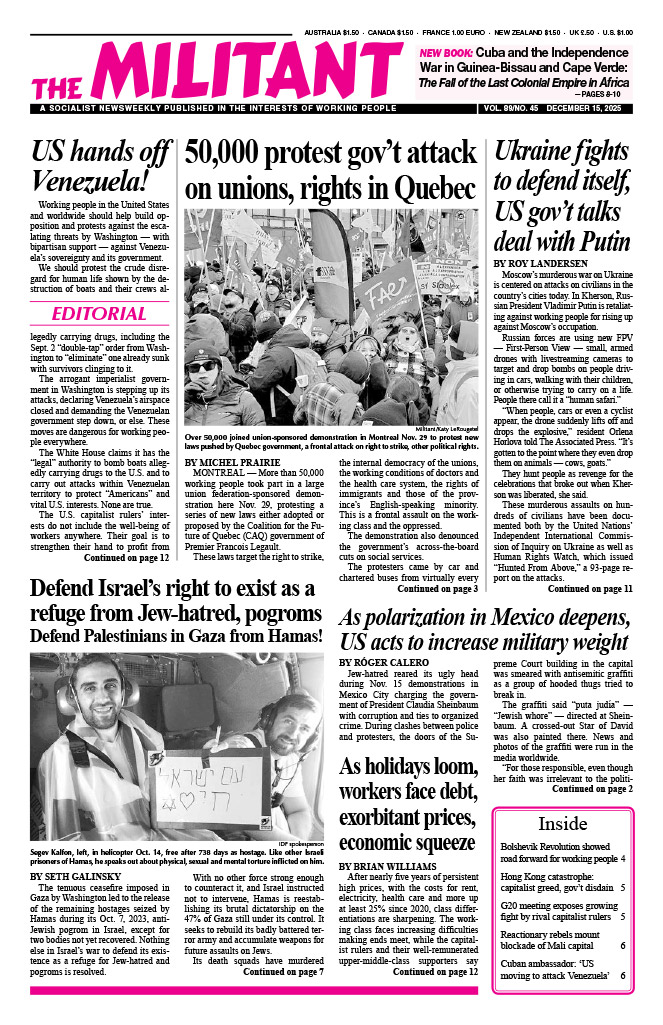
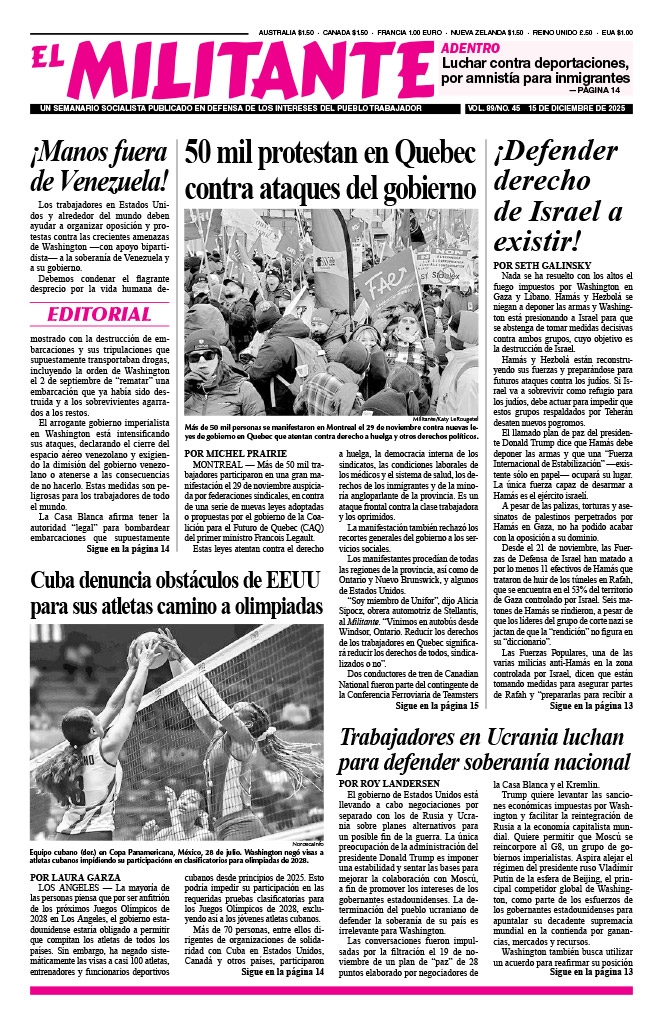
After nearly five years of persistent high prices, with the costs for rent, electricity, health care and more up at least 25% since 2020, class differentiations are sharpening. The working class faces increasing difficulties making ends meet, while the capitalist rulers and their well-remunerated upper-middle-class supporters say things are just swell today.
This deepening economic and social crisis profoundly affects the lives of millions of working people. “I work two jobs, my partner works two jobs, and it feels like we are like scraping for crumbs here,” Anissa Camacho, a 26-year-old florist in Bethlehem, Pennsylvania, told the Financial Times. She has moved in with her grandparents because her rent went up out of reach.
Demetri Nash, a 32-year-old driver at a local Bethlehem warehouse, works as many as 72 hours some weeks to try and get by. “It’s not optional. It’s mandatory for me to work the hours that I work because of the rise in cost of living,” he said.
Since January the average monthly cost of electricity has risen 11% nationally. In Missouri, it’s up 37%. Power cutoffs by utility companies are rising as more working-class households can’t keep up. In New York City, for example, Con Edison reported it’s cut the power off in 111,000 households so far this year, up from 30,000 in all of 2024.
In Sheffield Lake, Ohio, Jason Ross and his wife both work three jobs to try to keep up with their bills, including for electricity. It has more than doubled in the past year, to about $350 a month.
“For the first time, we’re behind on all of our utilities,” Ross, a special education coordinator for charter schools who also delivers for DoorDash and does some freelance work, told the Washington Post. “I’m 40 years old, and I’ve never been behind on anything, until now.”
Medicare boosts premiums
Also rising through the roof are health care costs, with average annual insurance premiums in 2026 projected to jump by over $1,000. In November, Medicare officials announced premiums will rise 9.7% next year, to $202.90 a month. The annual Part B deductible is going up to $283, an increase of 70.5% over the past 10 years. Meanwhile, Social Security, which automatically deducts Medicare payments from your check each month, is rising by a measly 2.8% next year.
The biggest U.S. retail outlets, which depend on the Thanksgiving-to-Christmas holiday shopping season to rake in a third of their annual profits, face a situation where working-class households are cutting back on what they can buy, or they’re going deeper into debt to try to have a happy holiday for their families.
Growing numbers of workers are turning elsewhere in search of bargains. Thrift-store owners are now holding Black Friday sales. To attract more customers, Goodwill is seeking to become “more glamorous,” opening larger stores in more affluent neighborhoods. Traffic to its stores this year has been overall more than double that of other clothing stores, the Wall Street Journal reported Nov. 24.
They say relocating stores near potential donors, as opposed to the neighborhoods of their more downtrodden clientele, means they get better merchandise to sell. Some have opened drive-up windows, so more upscale donors don’t even have to enter the store. One storeowner in West Virginia told the Journal they’ve had Tiffany jewelry dropped off there, as well as designer clothing from Gucci and Chanel.
One problem is a lot of this “better” merchandise never makes it to working people. The Journal reports there is a whole new class of purchasers visiting Goodwill, looking for cheap but classier items they can profit off reselling online.
The capitalist media — which works overtime trying to cover up class divisions — reported retail sales were up just 0.2% in September. But much of this spending is by the wealthy and their hangers on, who have been getting richer off speculative investments in the stock market. The top 10% of households today account for nearly half of all consumer spending.
And retail giants like Walmart now cater more and more to the wealthy to boost profits. “We continue to benefit from higher-income families choosing to shop with us more often,” Doug McMillon, Walmart’s chief executive, told the New York Times.
Sharpening class divisions
And these class divisions are getting sharper. The net worth in the hands of the wealthiest 0.1% of U.S. households reached $23.3 trillion in the second quarter this year. The amount held by the 50% of working-class households at the bottom is one-sixth of this.
Black Friday sales online hit a record $11.8 billion, Adobe Analytics reports, while admitting the most popular items were luxury apparel and accessories bought up by the rich.
High home prices and daunting mortgage rates are preventing many young people from moving out of their parents’ place in hopes of being able to raise a family. Median home prices have risen by more than one-third since 2021, to just under $400,000 today. And foreclosures are increasing.
“We see a lot of people who have been evicted because they couldn’t pay their rent, because they had a car accident and then couldn’t pay their medical bills,” Marc Rittle, executive director of the New Bethany food pantry in Bethlehem, told the Financial Times. “I think that’s the sort of homelessness that we’ll start to see a lot more of.”
The rising homelessness in New York City is having a huge impact on students. An all-time high of 154,000 children in the city’s public schools, nearly one in seven, were homeless during the past school year. In some neighborhoods, including East Harlem and the Bronx’s Concourse, student homelessness is as high as one in five. Nationwide, over 1.3 million students have no steady place to live.