Mounting conflicts between the world’s rival capitalist powers over economic supremacy, political domination and the threat of new wars were exposed at the Nov. 22-23 G20 summit.
Washington refused to attend, while the governments of Brazil and host nation South Africa used the gathering to puff up their claims to be an ascending counterweight to the U.S. rulers. Joined by Beijing, Moscow and others in the BRICS bloc, they put a fight to address a global “inequality emergency” at the center of the meeting.
The G20 was set up by the main capitalist powers worldwide in 1999 on the heels of what was known as the Asian financial crisis, to try to restabilize their system. They set yearly meetings of financial ministers to discuss ways to keep things on an even keel.
After the even deeper 2008 crisis broke out, the meetings were led by the presidents and prime ministers of the member countries, and the new body was convened by President George W. Bush.
In 2025, “growing geopolitical tensions further strain the group’s ability to reach consensus,” the U.S. Council on Foreign Relations said in fluent diplomatize. “Strategic rivalry between the United States and China, sharp divisions between Group of Seven members and Russia over the war in Ukraine, and wider conflicts such as the Israel-Hamas fighting have complicated efforts to reach unified outcomes.”
In plain English, the G20 is being torn apart as today’s capitalist crisis and conflicts deepen worldwide and the threat of fascism and war inevitably grows.
The BRICS bloc was established by Beijing and Moscow in 2009. It includes the rulers in Brazil, India and South Africa. They challenge Washington’s worldwide supremacy, claiming to speak for the downtrodden in the “Global South.”
Days before the G20 summit convened, the presidents of Brazil, Luiz Inácio Lula da Silva, and South Africa, Cyril Ramaphosa, along with Spanish Prime Minister Pedro Sánchez, issued a self-serving statement of their intentions for the G20. Published prominently in the Financial Times Nov. 20, it declared, “High levels of inequality lie at the root of our economic, political, societal and environmental crises,” and this “threatens democracy itself.”
They said the road to eradicating inequality lies in “enlightened cooperation,” as opposed to “unilateralism,” by which they mean Washington’s position as the world’s dominant imperialist power.
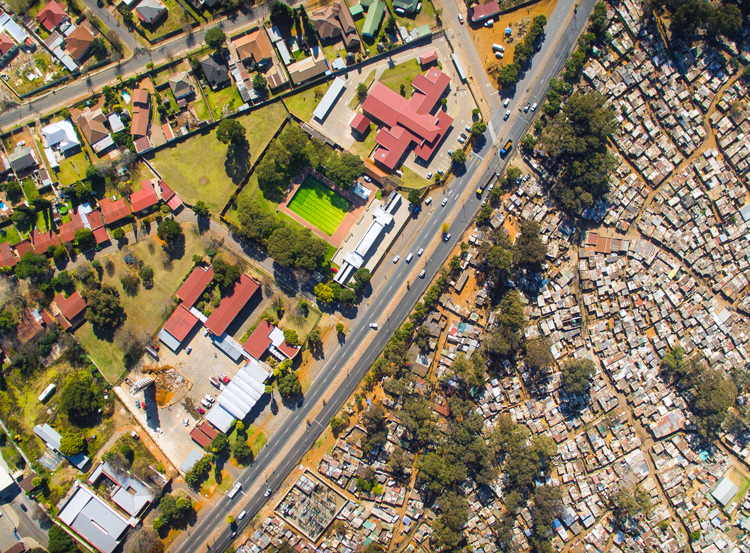
But Lula, Ramaphosa and Sánchez are all millionaires who govern weaker capitalist nations where inequality and class polarization are rising, an inescapable consequence of profit-driven capitalist exploitation. Ramaphosa, who was a leader of the miners’ union during the fight to overturn apartheid, has since made a vast fortune off the backs of the toilers in South Africa and features regularly in lists of the continent’s wealthiest individuals.
‘Experts’ weigh in on ‘inequality’
A study presented to the summit by an “Extraordinary Committee of Independent Experts on Global Inequality” said “inequality” is dangerously high and has only fallen, “due largely to economic development in China.”
Beijing’s state-capitalist rulers are seeking to extend their clout and secure allies to counter the supremacy of U.S. imperialism. They present trade and other ties with China as the path for less developed capitalist nations. Both Beijing and Moscow backed the summit’s final declaration, which condemned “unilateral trade measures,” a reference to President Donald Trump’s tariffs. In a break with previous practice, the declaration was adopted on the first day of the meeting, as if what was to follow was just a show.
Reflecting the interests of Russia’s capitalist rulers, the statement made only passing mention of the war in Ukraine, without any reference to the Kremlin’s murderous invasion and attempt to conquer the Ukrainian people.
The statement also calls for peace in “the Occupied Palestinian Territory,” a reference to what is in fact Israel. Ramaphosa claimed this statement was adopted unanimously. But in fact Argentina voted against and the Trump administration, which wasn’t represented, made clear it disagreed with this and other parts of the document.
South African Foreign Minister Ronald Lamola told the meeting, “The G20 is not about the U.S.,” adding haughtily, “those of us here have decided this is where the world must go.”
But none of these rulers are capable of replacing the military and economic clout of U.S. imperialism, whatever its relative decline. Nor will a meeting of capitalist powers trying to paper over their own conflicting national interests chart a new way forward for what Lamola calls “the world.”
The Trump administration, which after the meeting became head of the G20, says it will ban South Africa’s delegation from next year’s summit. And it will exclude United Nations officials and cut invitations to non-G20 member states. All the usual workshops on “climate change” and other “woke” issues will be eliminated and the agenda stripped down to “emphasizing economic growth.”
Capitalist exploitation is root of crisis
All G20 summits are used by rival governments as forums to jockey for position. None issue declarations that are binding, let alone address the social and economic devastation facing working people. The fakery that marks these get-togethers was highlighted by the “inequality” agenda presented by Ramaphosa. The only concrete proposal emanating from the “inequality” report was a call to set up a permanent panel to further investigate “inequality”!
The crisis facing working people is deepening. The World Health Organization reports the number of people living without access to electricity grew in 2024 to 730 million, 55 million more than in 2021. One in four of the world’s population, 2.1 billion people, still lack access to safe drinking water.
None of the governments represented at the G20 meeting, nor the U.S. rulers, are interested in or capable of addressing this. In fact, their system is the cause.
“Those who live in a palace do not think about the same things, nor in the same way, as those who live in a hut,” Thomas Sankara, the communist leader of the 1983-87 revolution in Burkina Faso, explained.
It will take socialist revolutions to end the intolerable conditions working people face under capitalism.