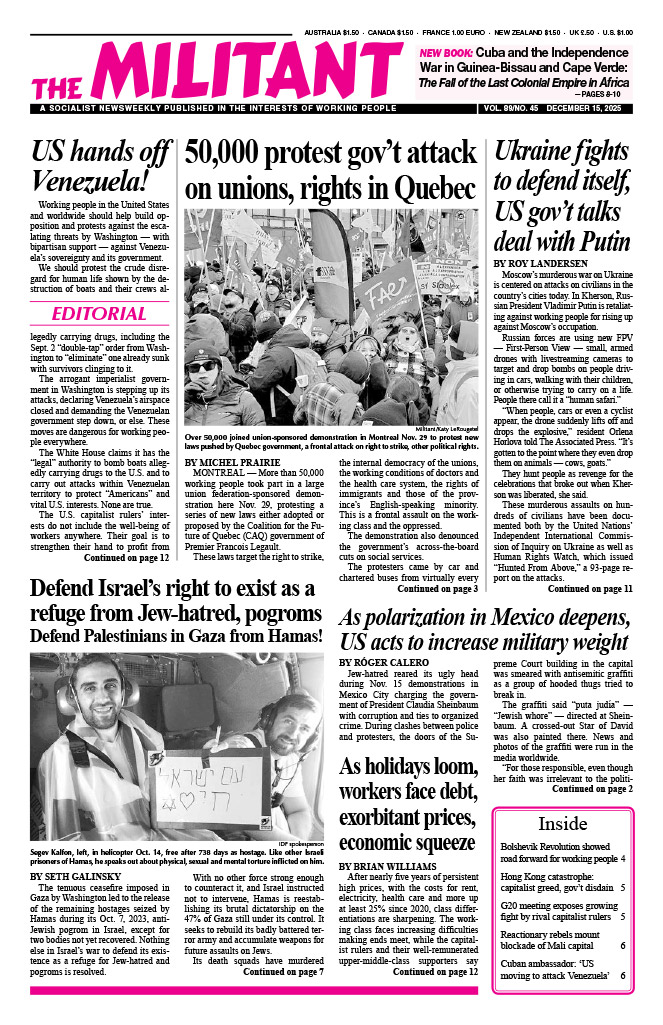

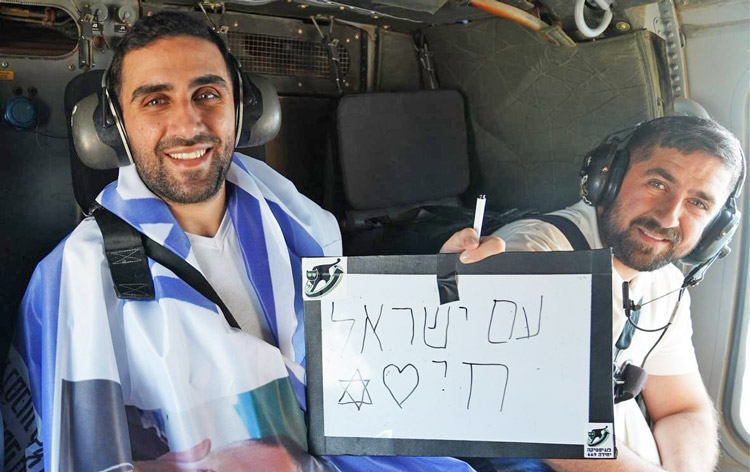
The tenuous ceasefire imposed in Gaza by Washington led to the release of the remaining hostages seized by Hamas during its Oct. 7, 2023, anti-Jewish pogrom in Israel, except for two bodies not yet recovered. Nothing else in Israel’s war to defend its existence as a refuge from Jew-hatred and pogroms is resolved.
With no other force strong enough to counteract it, and Israel instructed not to intervene, Hamas is reestablishing its brutal dictatorship on the 47% of Gaza still under its control. It seeks to rebuild its badly battered terror army and accumulate weapons for future assaults on Jews.
Its death squads have murdered more than 80 people in Gaza since the start of the ceasefire, many of them accused of being “collaborators” with Israel. No one knows how many people have had their legs or other limbs broken by Hamas thugs as a warning.
The group has also begun “taxing” civilians, including reportedly charging as much as 500 shekels a month ($155) for a tiny beach plot to pitch a tent.
Gazan residents say Hamas is once again using three hospitals as “interrogation centers” to torture and threaten its opponents and their families.
Despite this, Palestinians in Gaza are still speaking out against the reactionary Tehran-backed group. “Everyone is angry and resentful toward them,” an elderly man says in a video recorded in a Gaza tent camp.
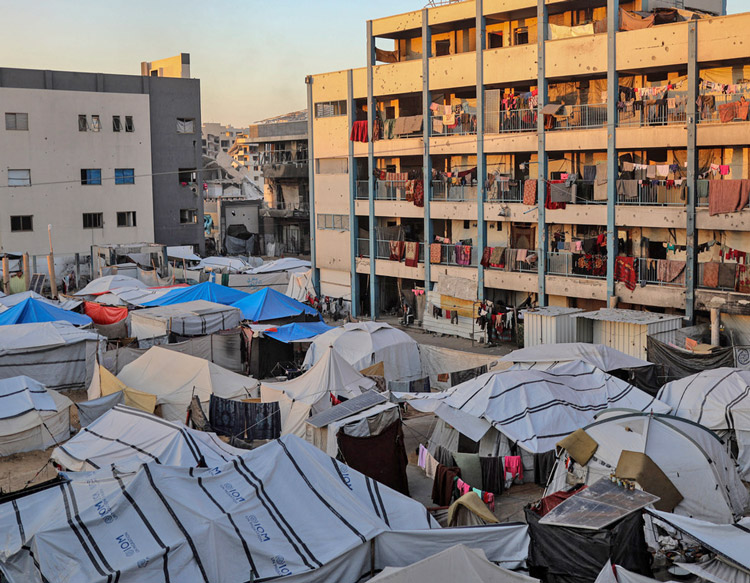
“The resistance should be here, on the home front,” another man in a tent city flooded by recent rains says. “They should provide food, drink and necessities. Well? Where are they?”
The majority of people in Gaza are living in difficult conditions, with nearly half relying on food handouts from international aid agencies. Most homes and businesses were damaged as a result of Hamas’ policy of setting up its command posts, weapons stores and tunnels underneath and in homes, mosques, schools and hospitals, drawing fire from Israel and intentionally making “martyrs” of thousands of Palestinians.
Gaza remains class divided and those with money can find fancy restaurants to eat at, or buy food at inflated prices.
One restaurant and coffee shop, which rebuilt after the Jan. 19 ceasefire in Al-Rimal — once one of Gaza City’s wealthiest neighborhoods — is offering all kinds of “luxurious” treats. But its Instagram page includes a message to “those who make the decisions” — a reference to Hamas. “We are humans who are killed and our dreams are made homeless. Have mercy on us,” it says, concluding with a plea “to stop this madness.”
“There will be a moment when we will have to decide, we are going in” to Hamas-controlled parts of Gaza, Israeli Brig. Gen. Amir Avivi said Dec. 1. Israeli forces currently hold 53% of the territory, but a minority of Gaza’s population currently lives there.
‘Axis of resistance’ still a threat
Though weakened by Israeli blows over the last two years, the Tehran-led “axis of resistance” is still a serious threat. Besides Hamas and Islamic Jihad in Gaza and the West Bank, the “axis” includes Hezbollah in Lebanon, the Houthis in Yemen and militias in Iraq.
Like in Gaza, the U.S.-imposed ceasefire in Lebanon is marked by Hezbollah’s attempts to rebuild its forces and missile stores and Israeli attacks to prevent it from doing so.
Hezbollah is smuggling large numbers of short-range rockets from Syria, setting up new military outposts north of the Litani River and still has operatives in southern Lebanon in violation of the ceasefire accord, despite some moves by the Lebanese government to reel it in. Israel has warned the Lebanese government that if it does not stop Hezbollah, Israel will.
For the first time in decades representatives of the Lebanese and Israeli governments met face to face Dec. 3 — pressured by the White House, which is worried that a resumption of full-scale fighting with Hezbollah would throw a wrench in Washington’s plans for the region.
The U.S. imperialist rulers are not concerned about Jews, Arabs or working people of other nationalities. They want stability in the Middle East so they can advance their own interests, reaping profits from their plunder of oil, gas and other natural resources.
There have been clashes between Israeli troops and Islamist groups in Syria. After the fall of the Bashar al-Assad dictatorship, Israel expanded its buffer zone along the Syrian border to ensure that groups set on Israel’s destruction could not open up a new front.
Just days after Israeli troops clashed with an Islamist terror group near the buffer zone Nov. 28, President Donald Trump warned Israel to not “interfere with Syria’s evolution into a prosperous State.”
An ‘imperial’ Israel?
The New York Times ran articles Nov. 30 and Dec. 2 implying that an “Imperial Israel” is making “peace impossible” and “disarmament [of Hezbollah] much more difficult.”
The Times editors blame Israel for refusing to recognize a Palestinian state. That’s what they claim has ignited war “at regular intervals.”

This explanation turns the cause of the conflict on its head. There was a de facto Palestinian state — in Gaza — for more than a decade. Instead of seeking economic development and a course to advance Palestinian interests, Hamas — backed by Tehran — used that state to oppress Palestinians there and prepare the Oct. 7 massacre of 1,200 people in Israel, the worst anti-Jewish pogrom since World War II.
Tehran, Hamas, Hezbollah, the Houthis and others in the so-called axis of resistance are not interested in two states. Hamas’ pogrom announced a renewed drive to destroy Israel and eliminate or expel Jews from the region.
Defeating and dismantling of Hamas will remove a huge obstacle to common struggle by working people of all religions and nationalities. Like in every capitalist country, working people in Israel need to organize to defend their class interests against the bosses and overcome divisions between Jewish, Arab workers and immigrant workers.
Former hostages speak out
Many former hostages are speaking out, touring the U.S. and other countries, to let the world know the truth about Hamas’ brutal treatment of Jews, from physical and psychological torture to sexual abuse.
Segev Kalfon, who survived 738 days in captivity, is one of the last hostages freed. His captors broke his teeth, starved him and pressured him to convert to Islam. He was given so little food that at times it was difficult to even stand up.
He told the press how the thugs played mind games, like telling six hostages held together to pick three of them to be executed and three to be shot in the leg. When they refused, the thugs chose lots, though they didn’t carry out the threats.
Edan Alexander spoke to a group of 1,000 Christian supporters of Israel in early December at an event at the site of the Nova festival near the Gaza border. For the first time since his release he appeared in public wearing his Israel Defense Forces uniform. He told the crowd that he asked to reenlist in the IDF. “I wanted to show them that although they hurt me, I am returning to stand strong.”