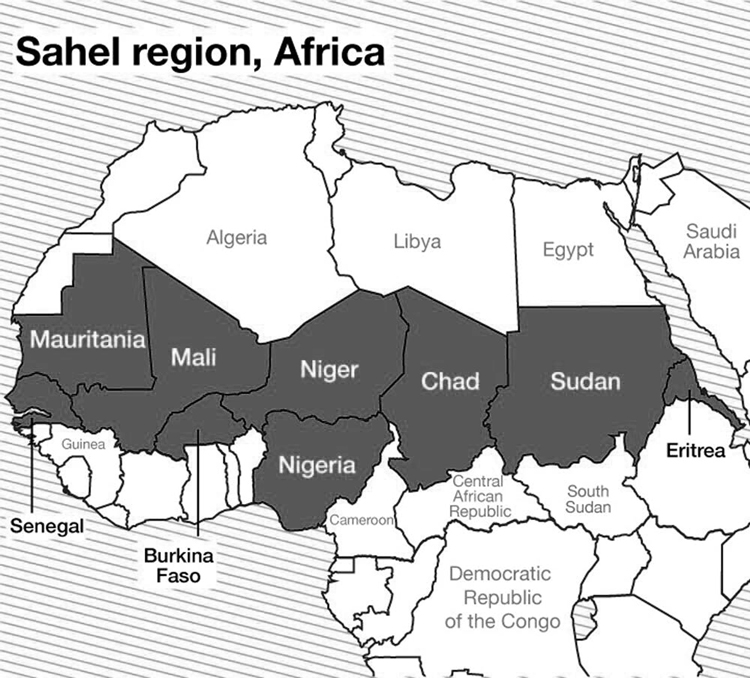
Bamako, the capital of Mali, with 4 million people, is being choked off by a blockade imposed by Islamist rebels, preventing fuel, food and other goods from getting to the city, in an effort to bring down Mali’s military government.
The Jama’at Nusrat al-Islam wal-Muslimin, or JNIM, affiliated with al-Qaeda, is now within 30 miles of the capital. It also has targeted convoys bringing fuel from neighboring Senegal and Ivory Coast, including setting fire to tankers stranded along Mali’s borders.
The result has been blackouts, school closures, a medical care crisis, inflationary food costs and dayslong lines at gas stations. Fuel, when any gets through, has risen more than 400%, from $6 to $32 a gallon.
Along with Burkina Faso and Niger, Mali is one of three nations in West Africa run by military dictatorships, which have formed a bloc, the Alliance of Sahel States. They present themselves as anti-imperialist rulers, with support from Moscow, but do little to aid the workers and peasants.
The U.S. and other countries have urged their nationals to leave Mali immediately.
The JNIM, which is also active in all three countries, was formed in 2017 as a coalition of jihadist factions, including Algeria-based al-Qaeda in the Maghreb and three Malian armed groups — Ansar al Dine, Al-Murabitun and Katiba Macina. It’s led by Iyad Ag-Ghaly, an ethnic Tuareg, who founded Ansar al Dine with the goal of imposing Islamic law in the region.
“JNIM presents itself as an alternative to the government, which it calls ‘puppets of the West,’” Al Jazeera reported Nov. 6. It seeks to recruit from the oppressed ethnic minorities of Mali, including the Tuareg, Arab, Fulani and Songhai peoples.
JNIM aims to “capture and control territory and to expel Western influences in its region of control,” Al Jazeera said. It “destroys infrastructure, such as schools, communication towers and bridges, to weaken the government.”
“This summer it embarked on a campaign of economic warfare in western Mali,” attacking factories and gold mining sites, CNN reported. JNIM is funded by profits extracted from artisanal gold miners, taxation in towns it controls, cattle rustling, drug and weapons smuggling and kidnappings for ransom.
The government of President Assimi Goita, who seized power in two coups in 2020 and 2021, is unpopular among working people for enriching itself on their backs. The army itself is faction ridden and has been unable to push back the jihadist forces.
In 2013 France increased the number of its troops in Mali, seeking to stabilize the capitalist government, but the French forces were no more effective in halting the Islamist expansion. Working people in Mali rightly blame much of their condition and the divisions between ethnic groups on centuries of French colonialism in the Sahel.
In 2019 protesters in Bamako carried signs reading, “Get out, France! We don’t want to see you here.” Despite its desire to continue siphoning wealth from Mali’s rich resources, Paris had to contend with the military coup and was forced out in 2022, with U.N. “peacekeeping” forces leaving in 2023.
To fill the vacuum, the junta brought in the Russian mercenary Wagner Group, which began a reign of terror over working people. Moscow took over the operation directly after dispatching the Wagner forces to support its invasion of Ukraine. It set up an Africa Corps, which includes some remnants of the Wagner Group. Africa Corps mercenary forces have also been accused of abuses, including torture and rape. “Rather than bolstering state forces, the mercenaries have spent years extracting resources to fund Moscow’s war in Ukraine,” wrote the New York Sun.
With a deepening crisis facing the military government today, Washington reached out to see if there was an opening for U.S. imperialism to intervene. “The U.S. commends the armed forces of Mali in their fight against Islamic extremist militants,” Deputy Secretary of State Christopher Landau said Nov. 4. He said he’s been in touch with Mali’s foreign minister and looks “forward to greater cooperation.”
Working people are the victims
Workers, farmers and seminomadic herders in this majority agricultural country face constant threats. If suspected by JNIM of supporting the government, they can be killed. If suspected by the army of supporting the jihadists, they will be killed.
Residents of the village of Balle have been under JNIM domination for years. “We pay the zakat [Islamic tax] every year,” one man told Human Rights Watch. “If there are disputes, the jihadists settle them. There are no soldiers, no gendarmes, no police here.
“As a result, the army assumes we’re JNIM fighters. The army doesn’t differentiate between us and them.”
Mali has vast resources of gold, lithium, iron, bauxite, uranium, phosphates and manganese. But because of imperialist intervention and military corruption, working people face one of the highest poverty rates in the world. Between 2020 and 2022 only 45% of Malians had access to basic sanitation, 48% had access to electricity and 40% to clean drinking water, most in the capital. As of September 2024, 378,000 people had been displaced due to the violence, with 50,000 fleeing across the border to Mauritania.