Nov. 7 marked the 108th anniversary of the 1917 Bolshevik Revolution, led by V.I. Lenin. That powerful revolution showed workers can take political power into our own hands, and showed the kind of revolutionary working-class political party that is needed.
As working people in the U.S. and around the world confront today’s wars and deepening capitalist crises, studying the lessons of the Russian Revolution is indispensable.
The outbreak of World War I in 1914 demonstrated that capitalism had exhausted its former progressive historic mission. Lenin’s Bolshevik Party led the revolutionary forces in splitting from the Socialist International when its reformist and centrist leaders sided with their “own” imperialist ruling classes at the outbreak of the slaughter.
In February 1917 a revolutionary upsurge of workers and peasants overthrew the Russian monarchy. The revolution was driven by deep opposition to the imperialist world war, lack of basic democratic rights, widespread hunger, landlessness and the subjugation of oppressed nationalities in the czarist empire.
Capitalist politicians patched together a Provisional Government, which continued the war and ignored the demands of working people.
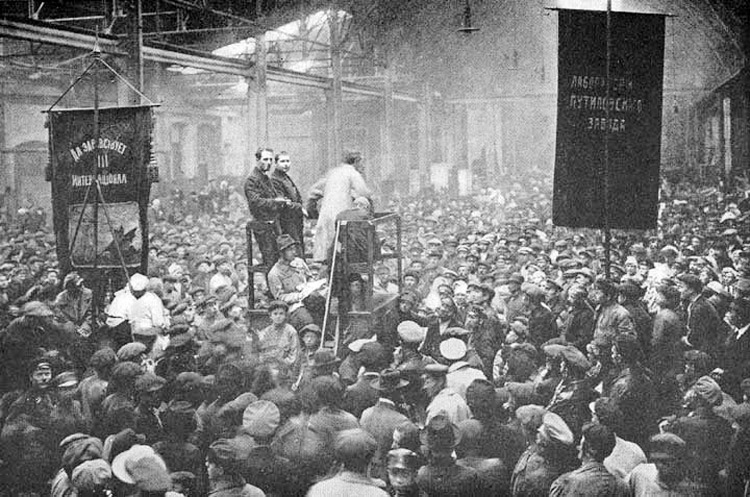
During the uprising workers formed their own councils, called soviets in Russian. These bodies were a vastly more democratic form of workers rule and a parallel government to that established by the capitalist rulers. Representatives were freely elected by workers in the factories and other workplaces, by peasants and by soldiers. The soviets debated policies and elected delegates to an All-Russian Soviet of Workers’ and Soldiers’ Deputies.
At first, the parties of class collaboration — the Mensheviks and Social Revolutionaries — held a majority in the Soviets. They handed authority over to the Provisional Government. But over time the Bolsheviks won growing numbers of workers to the demand, “All power to the Soviets.”
Such a highly unstable dual power could not last. Eight months of war and privation impelled working people toward another revolution. By the end of October the Bolsheviks gained a majority in the Soviets. The All-Russian Congress of Soviets met and voted to take power, and did so, establishing a workers and farmers government.
Proletarian parties can lead fight
The experiences of the Russian Revolution in 1917 proved conclusively that given a revolutionary situation, a proletarian party can lead workers to fight for power. The cadres of the Bolshevik Party were forged in struggle and had acquired habits of discipline. They were equipped with a Marxist program and theory, and had deep ties to the broadest layers of workers, peasants and the oppressed. After the October Revolution, the Bolsheviks led working people to take control over the land, factories and banks, creating the world’s first workers state.
The dictatorship of the proletariat in Russia broke the chain of world imperialism at its weakest link. It signaled the beginning of the international proletarian revolution and opened the door to the founding of the Communist International.
In early 1918, as imperialist and domestic procapitalist forces unleashed a bloody civil war against the revolutionary government, the Red Army, led by Leon Trotsky, organized to defend Soviet power. It took firm measures to crush the counterrevolutionary forces led by former landlords and capitalists.
And despite the hardships caused by imperialist invasion and civil war, the Soviet workers state acted to advance the emancipation of women, bring electricity across Russia to strengthen the alliance of workers and peasants, guarantee the rights of oppressed nationalities to self-determination and end anti-Jewish pogroms.
The Soviet republic during these years found itself isolated, facing tremendous obstacles. The revolutionary workers movement suffered defeats in Hungary, Italy and Germany. A restabilization of world capitalism, the imperialist blockade of Russia, the economic toll of the civil war, and the loss of hundreds of thousands of lives, including many Communist Party members and vanguard workers, led to a retreat.
Stalin led counterrevolution
These pressures and the death of Lenin in 1924 led to the consolidation of a bureaucratic caste, which had a petty-bourgeois outlook and increasingly promoted its power and relative material privileges against the interests of the working class. Joseph Stalin presided over the degeneration of the Communist Party and the rise to power of this parasitic layer. On the back of this counterrevolution, he organized the betrayal of revolutionary struggles worldwide.
For Stalin, “the historic mission of the Soviet bureaucracy was to build socialism in a single country,” Trotsky explained. He answered this “theory” in The Revolution Betrayed, explaining that a “prolonged isolation of the Soviet Union would not end in national communism but in a restoration of capitalism.”
In 1923 Trotsky formed the Left Opposition to continue the fight to revive Lenin’s course — a battle he led over the next 17 years, consolidating and helping build proletarian parties worldwide. He was murdered by a Stalinist agent in Mexico in 1940.
In November 1928 the first issue of the Militant, the paper of Lenin’s revolutionary course in the U.S., ran a statement hailing the 11th anniversary of the Russian Revolution.
The revolution “broke forever the unity of the world and divided it into two hostile camps — the camp of imperialist exploitation and the camp of social revolution. At one polar extreme stands America, the strongest imperialist world power. At the other stands the USSR, the land of the workers’ rule. The antagonism between them, and the systems they represent, is irreconcilable. They cannot live together permanently side by side.
“The victory of the Soviet system on a world scale means the liberation of enslaved humanity and its ascent to heights of culture and achievement beyond our dreams — to socialism and beyond that to communism. The victory of imperialism would hurl civilization into the abyss. Such is the issue of the epoch of wars and revolutions in which we live and fight.”