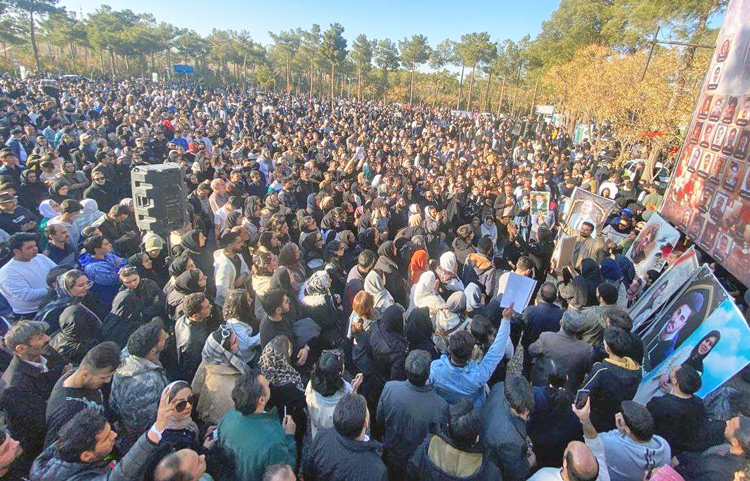
Tens of thousands protested across Iran Feb. 17-18 to mark the 40-day commemoration of the massacre of more than 7,000 protesters at the hands of the bourgeois clerical regime. “This flower that was cut down has become a gift to the homeland” and “if one person is killed, 1,000 will take their place” were among the chants at the actions.
Thousands of high school students heeded the call of the Coordinating Council of Iranian Teachers Unions and dozens of university student groups, who called on teachers and students to strike and boycott classes Feb. 18 and join the 40-day commemorations.
Thousands of people filled the Behesht Zahra Cemetery in Tehran Feb. 17, despite a large police presence. Many chanted, “We swear by the blood of our comrades; we will stand until the end” and “Death to the tyrant!”
Thousands gathered in Najafabad, Isfahan province, the same day to honor those killed by the regime, marching and protesting into the night.
In Abdanan, Ilam province, a mostly Kurdish town and the site of some of the worst violence by the regime, thousands took to the streets, releasing balloons into the air in honor of those slain. The regime’s forces clashed with protesters and blocked the entrances to its cemetery with military vehicles.
Videos show protests of thousands, including in small towns like Hashtgerd in Alborz province and Bandar Genavah in Bushehr province.
Regime covers up deaths
The Iranian regime has published a list of some 3,100 people killed during the 11 days of protests. Human rights groups say they have lists of more than 7,000 and are investigating thousands more. The regime continues to slander the protesters as “terrorists” and “rioters” working for Israel.
The protests began Dec. 28 when merchants and capitalist traders at Tehran’s Grand Bazaar took to the streets to protest the declining value of Iran’s currency and rising prices that were driving them out of business. Like previous waves of protests since late 2017, workers and students across the country joined the actions to oppose the regime’s trampling on democratic rights and its backing of proxy forces like Hamas and Hezbollah. Its war moves are aimed at destroying Israel and eliminating the Jews there.
The overwhelming majority of deaths took place Jan. 8 and 9 when the regime ordered the Islamic Revolutionary Guard Corps, paramilitary Basij, and the police — with the help of thugs brought in from Hezbollah in Lebanon and Tehran-organized militias in Iraq — to crush the protests.
Some 50,000 people were arrested during and after the actions, including workers, union activists, university students and at least 82 children, as well as 19 lawyers and more than 100 doctors and nurses.
The regime has also stepped up its use of the death penalty. “Tens of thousands of those arrested in the recent protests are now under pressure and torture, and plans are being made to issue execution sentences and long prison terms for them,” the prisoner-based campaign called “No to Executions Tuesdays” said in a Feb. 17 statement. Since late January, the group said, more than 300 prisoners have been hanged.
“Many of those who were in favor of the death penalty for whatever reason until yesterday, will reconsider today,” the Iranian Pensioners Council said, “given the large number of detained juveniles and the serious risk of them being given the death sentence.”
Regime can’t stop protests
Instead of quelling the protests, the deadly crackdown is deepening opposition to the regime and exposing its growing weakness.
Asiyeh Touhidnezhad, a reporter for Iran’s Ensaf newspaper, recently visited the Behesht Zahra Cemetery. The reporter noted that the names on many of the newly dug graves do not appear on the government’s list.
At one graveside a woman tells her, “May we avenge the blood of our youth.”
Another woman told her, “During the war [with Israel], when everyone struggled, the main owners of our company just got richer. We’re the ones who become poorer.”
In an unprecedented challenge to the regime’s media censorship, the popular news site Bartarinha published the poster announcing the 40-day ceremony at Tehran University of Medical Sciences for medical student Aida Heidari, killed during the protests.
One of the regime’s biggest worries is the participation of workers in oil and gas production — Iran’s key industry.
Some 200 oil workers were arrested after striking for back pay and better conditions in Asaluyeh in southern Iran simultaneously with the recent protest wave. According to the Council for Organizing Protests of Contract Oil Workers, detained workers are still being held in a warehouse belonging to Khatam al-Anbiya construction, a company owned by the Islamic Revolutionary Guard Corps.
The council called Feb. 16 for the immediate release of the workers “and all those arrested in the revolutionary events of January.”
Meanwhile, the Donald Trump administration is sending a second aircraft carrier group led by the USS Gerald R. Ford, the world’s largest warship, to join the USS Abraham Lincoln in waters near Iran. In the middle of negotiations with Iran’s foreign minister, Washington sent another 50 fighter jets to bases in the region.
Vice President JD Vance said Iran had failed to acknowledge “core U.S. demands,” but Washington agreed to give Tehran two more weeks to bring in a new proposal. Implicit is the threat of a U.S. military attack. The Trump administration has dropped its pretense that it’s concerned for victims of Tehran’s repression.
Washington’s intervention, like its bombardment of Iran last year, is aimed at advancing its place as the dominant imperialist power in the region, and to further the U.S. capitalists’ drive for markets, resources and labor to exploit.