
“Hiring rebounded in January,” proclaimed a headline in the Feb. 12 Wall Street Journal, hailing the Labor Department’s announcement that 130,000 jobs were created that month. This “blew past expectations,” the Financial Times enthused, “signaling that the labour market is healthier than economists had feared.”
But this rosy description in the big-business media skews the reality of what happened and falsely argues things will now get better for the millions of working people that every day have to fight to make ends meet.
These weren’t industrial jobs that point to a robust expansion of the U.S. economy. Nearly all of these new jobs are in health care. Many are for home health aides, who get low pay, few benefits and who are working long hours. Far from being overjoyed at this situation, nurses and other health care workers have been going on strike to fight for more jobs, staffing that allows for better care for patients, and decent working conditions. Thousands are on strike today, from California to Hawaii to New York City. These struggles need support from all workers and our unions.
While the capitalist media hails the government’s “job creation” report, the bosses are laying off more workers. Over 108,000 jobs were cut in January, more than any other January since 2009. This included UPS’s decision to eliminate 30,000 jobs after severing ties with Amazon, and Amazon’s decision to cut 16,000 jobs.
Bosses cut jobs, press speedup
The Bureau of Labor Statistics released revised figures showing that during the last year of President Joseph Biden’s administration, and then under Donald Trump’s, jobs have been shrinking.
Just 181,000 new jobs were created in 2025 — that’s 15,000 a month — the report says. From April 2024 to March 2025 there were 862,000 fewer jobs created than the government initially reported. And this hiring slowdown has continued since then, hitting workers in manufacturing, transportation and retail.
Factory workers have been particularly hard hit. Last month there were 285,000 fewer industrial workers in the U.S. than there were in January 2024. While showing workers the door, the bosses are pushing speedup on the remaining workers to increase their profits at the expense of workers’ lives and limbs.
And, if you’re unemployed, it’s getting much harder to get a decent-paying full-time job. The average amount of time for workers to get hired again is almost half a year. And many of these jobs are at significantly lower pay.
Meanwhile, working-class households face increasing pressure to cover the rising cost of basic necessities, from groceries, transportation, health care, rent and much more. Mortgage delinquency rates in working-class areas reached a 10-year high, reports the Federal Reserve Bank of New York, while debts owed on credit cards and for auto loans continue to climb.
The consumer price index climbed 2.4% in January from a year earlier. While this pace of price rises has slowed from what it was earlier, it’s still going up, as it has over the past five years, putting a huge burden on the working class. The January CPI showed ground beef rose by 17.2%; home health care by 12.7%; hospital care, 6.6%; and public mass transit, 4.9%.
An estimated 200,000 people a day are resorting to selling their blood to try to make ends meet. “Everything’s just so much more expensive,” Erin Ragnetti, who lives in Fresno, California, told NBC News. “To make ends meet, I’ve got to find a way to make more money.” She started selling her blood to pay off debts and bills not covered by her cleaning jobs.
Jill Chamberlain in Phoenix works up to 80 hours a week, but still needs to sell her blood to get by. “I was ashamed at first, but now I’m angry,” she told NBC.
‘Big money is going to capital’
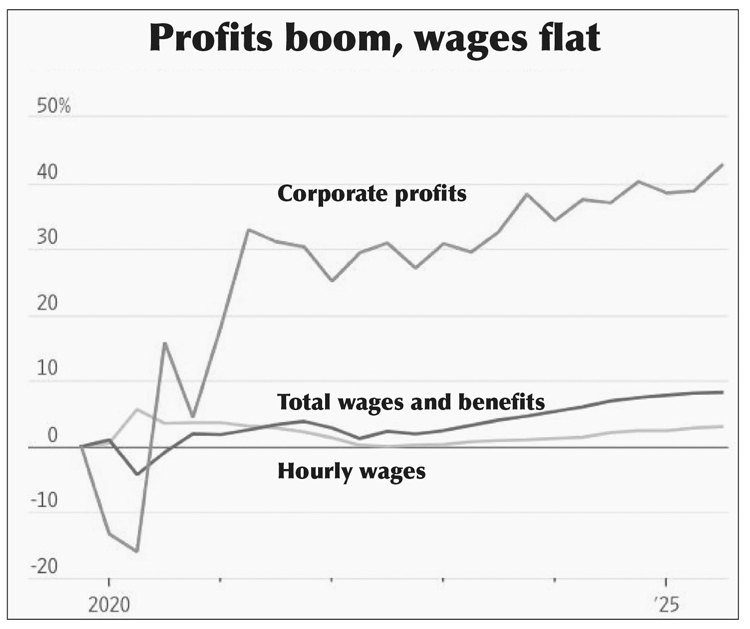
“The big money in today’s economy is going to capital, not labor,” admitted a Feb. 9 Journal article. In 1980 “labor received 58% of the total proceeds of economic output,” the article says. But “by the third quarter of last year that had plummeted to 51.4%. Profits’ share, meanwhile, rose from 7% to 11.7%.”
“Profits have soared since the pandemic,” the big-business daily admits. “The result: Capital, which includes businesses, shareholders and superstar employees, is triumphant, while the average worker ekes out marginal gains,” or more accurately, doesn’t.
Over the past six years average hourly wages rose by 3%. But “averages” are dangerous. Some workers may fight and win higher wages that help curb the disastrous impact of inflation. But many don’t, and fall further behind. At the same time profits climbed 43%!
The 10% of households with the highest incomes now account for nearly half of all U.S. consumer spending.
The class-divided impact of the deepening capitalist economic crisis shows the need for a union-led fight for jobs with wages and conditions that make it possible for workers and families to survive.