
Understanding History: Marxist Essays by George Novack is one of Pathfinder’s Books of the Month for February. The excerpt is from the article “From Lenin to Castro: The role of the individual in history making.” In it Novack deals with a disagreement raised by Isaac Deutscher in his biography of Leon Trotsky, a leader of the Russian Revolution and the fight against its Stalinist degeneration. Deutscher challenged Trotsky’s view that V.I. Lenin was decisive to the success of the October Revolution and of the role of the individual in history in general. Copyright © 1972 by Pathfinder Press. Published by permission.
Marxism does teach that no individual, however talented, strong-willed or strategically situated, can alter the main course of historical development, which is shaped by supra-individual circumstances and forces. Therefore, reasons Deutscher, the revolution would have triumphed in 1917 with other leaders even if Lenin had been removed from the arena by some accident. Trotsky himself, or a team of other Bolshevik chiefs, might have filled his place. …
The leadership, collective and individual, embodies the conscious element in history. The influence of an individual in determining a course of events can range from negligibility to totality. The extent of his effectiveness in action depends upon the stage of development of historical conditions, the correlation of social forces, and the person’s precise connection with these at a given conjuncture. …
The conscious factor has a qualitatively different import over an entire historical epoch than it has in a specific phase or situation within it. …
Time is an all-important element in the conflict of contending social forces. The indeterminate phase when events can be diverted in either direction does not last long. The crisis in social relations must be resolved quickly one way or the other. At that point, the activity or passivity of dominant personalities, groups, parties and masses can tip the scales on one side or the other. The individual can enter as the ultimate factor in the total process of historical determination only when all the other forces in play are temporarily equalized. Then the added weight can serve to tip the balance. …
Lenin’s imperishable contribution was the push he gave to opening an entirely new path for Russian and world history, redirecting it from the dead end of capitalism onto the beginning of socialism. …
The type of leadership was very different in the two revolutions of 1917. The February Revolution was not planned or directed from above. Trotsky pointed out in the chapter of his History of the Russian Revolution, “Who Led the February Revolution?” that it was led “by conscious and tempered workers educated for the most part by the party of Lenin.” As educator and organizer of these key workers, Lenin was to that extent necessary to the February overturn, even though he was not on the spot in person.
Between February and October he became more and more decisive because of his resolute and farsighted positions at a series of crucial moments, starting with the reorienting of the Bolshevik cadres in April and culminating in his insistence on insurrection in October. According to Trotsky, Lenin’s role could not have been duplicated. This was not simply because of his personal gifts but even more because of his exceptional standing in the Bolshevik party, which was largely his creation.
The question of leadership in the Russian Revolution had a dual aspect. While the Bolsheviks led the workers and peasants to victory, Lenin led the Bolshevik party. His paramount role came from the fact that he led the leaders of the revolution.
Trotsky knew better than anyone else how Lenin could sway the higher echelons as well as the ranks of his party. His authority was a considerable help from April to October in getting the correct proposals adopted over the resistance of other Bolshevik chiefs. This accumulated capital of prestige was not at the disposal of others, including Trotsky, who had a different organizational history and relations. That was the objective basis for his opinion that the October Revolution would most likely not have taken place unless “Lenin was present and in command.” …
Trotsky viewed the Bolshevik party as one of the components of this historical necessity, and Lenin as the most conscious exponent and skilled practitioner of the political science of Marxism based on these laws. It was not purely fortuitous that Lenin was able to play the role that he did. He was no chance comer. “Lenin was not an accidental element in the historic development, but a product of the whole past of Russian development.” For years he had prepared himself and his party for the task of steering the expected revolution to victory. …
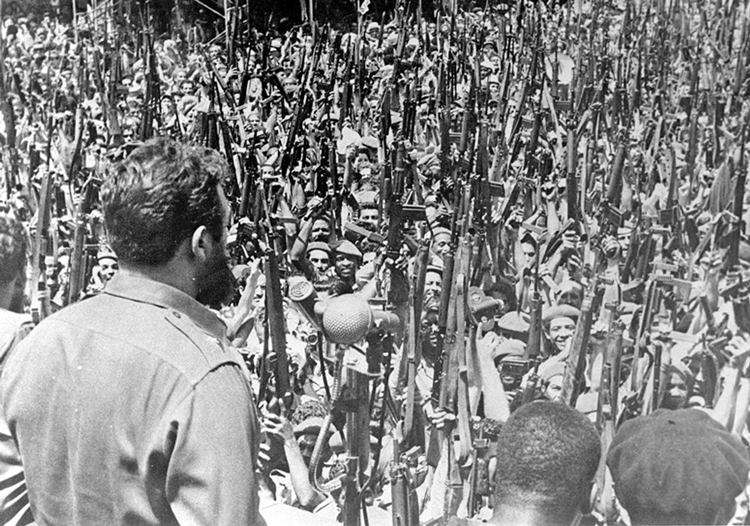
This dialectical unity of the objective and subjective factors in the making of a revolution has been both exemplified and theorized by Fidel Castro and his close associates. If ever an historic event could be considered the work of one man, that was — and is — the Cuban Revolution. Castro is truly its “lider maximo” [main leader].
Castro has explained, notably in his December 21, 1961, speech on Marxism-Leninism, that the founders of the July 26 Movement did not wait for all the objective conditions required for revolutionary success to emerge spontaneously. They deliberately set about creating the still missing revolutionary conditions by fighting. Their guerrilla warfare did bring about the moral, psychological, political changes needed to overthrow Batista’s tyranny.
The transformation of the balance of forces in favor of the progressive side by the initiative of a small band of conscious revolutionary fighters in Cuba dramatically demonstrates how decisive the subjective factor can be in making history. Yet Castro’s intentions would have miscarried and his combatants would have been rendered powerless without the response they received, first from the peasants in the mountains and then from the masses in the rural and urban areas.