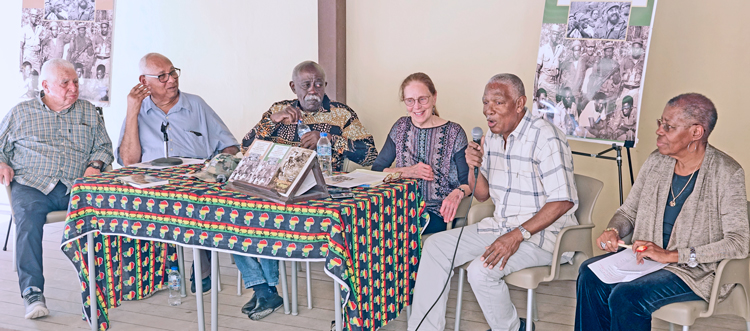
The following is the talk by Mary-Alice Waters to the Feb. 18 presentation in Havana, Cuba, of the new book, Cuba and the Independence War in Guinea-Bissau and Cape Verde: The Fall of the Last Colonial Empire in Africa by Víctor Dreke (Commander “Moja”). The event was held at the Casa de África Museum in Old Havana (see accompanying news article).
Waters is co-editor of the book and wrote its introduction. She is president of Pathfinder Press and a National Committee member of the Socialist Workers Party. Copyright © 2026 by Pathfinder Press. Reprinted by permission.
Before anything else, I want to thank both the Office of the Historian of the City of Havana as well as Alberto Granado, director of Casa de África, for hosting this presentation of Cuba and the Independence War in Guinea-Bissau and Cape Verde: The Fall of the Last Colonial Empire in Africa.And to express my heartfelt thanks to “Comandante Moja” and to our moderator, Ana Morales, program director of Casa de África.
We are not here only to celebrate the publication of a book. We’re here to celebrate decades of revolutionary action by compañeros like Víctor Dreke and Ana Morales, and the rich lessons for today and tomorrow that this book conveys.
We’re especially honored to have with us on the panel Ambassador Oscar Oramas. We would have also been joined by Brigadier General Gustavo Chui Beltran had his car not broken down a half hour ago as he was on his way here. One of the many transportation challenges each of you successfully vanquished in order to be present. So, thank you to all. It is a real pleasure to greet so many friends and comrades we’ve had the priceless opportunity to work alongside for many years.
Before going on I want to recognize two other individuals without whose contributions this project might never have come to fruition. One is compañera Iraida Aguirrechu, now deceased, who for many years was the senior editor at the publishing house of the Central Committee of the Communist Party of Cuba, Editora Politica. The other compañero, who is with us here today, is Martín Koppel, the co-editor of this Pathfinder book.
A book needed now
All of us are eager above all to hear from the author and others who had a role in making the history this book brings to life. So I will limit my remarks to three points.
First. There could have been no more important moment than today for Víctor Dreke’s book to be published.
No better moment to learn about — and to study — the example of Amílcar Cabral and the humble men and women he led to victory over the Portuguese colonial empire.
There could be nothing more timely than spreading — and studying — this example of the Cuban people and their practice of proletarian internationalism, led by Fidel, and led by Che.
In the last weeks we have witnessed Washington’s ruthless, murderous assault on the people of Venezuela, together with Yankee imperialism’s abduction of President Nicolás Maduro along with his wife, Cilia Flores. That is an arrogant, imperial, violation of the national sovereignty and the right to self-determination of the oppressed and exploited nations of the world.
We’ve seen the escalating threats and actions by Washington aimed at denying the people of Cuba the most basic necessities of life because — inspired by the necessary political leadership — you had the audacity to open the socialist revolution in the Americas.
And it is important to add, these events are also a flagrant assault by Washington on the desire of working people in the U.S. — native-born and immigrant alike — to live in peace. To live in peace with each other, and with our brothers and sisters around the world.
All this and much more has come as a shock to most of those who have been born since the people of our hemisphere were last subjected to such murderous events. The most recent such moment, which many of you here do remember well, was Washington’s invasion of Grenada in October 1983, following the cold-blooded murder of Prime Minister Maurice Bishop by a small minority of his own colleagues. It was, as Fidel said, an act that handed the Grenada Revolution to US imperialism on a silver platter.
What is unfolding in the world today is not a series of isolated events. Nor is it due to the actions of a rogue, deranged president of the United States, drunk on his own enormous power and envisioning himself emperor of the world. These actions are not deranged. They are the deliberate course of an imperialist government to advance the bipartisan state policy of the ruling capitalist families.
What is unfolding today is the product of the powerful historical dynamics of capital itself. It is the product of sharpening interimperialist, intercapitalist competition for natural resources, markets, and profits. It’s the laws of capital at work — the only “international law” that’s real, not imaginary.
That is what inexorably drives the US rulers, and drags us with them, as they try to settle accounts through spreading wars that, sooner or later, will become a far more devastating future for all humanity — a nuclear World War III.
The only force that can ultimately prevent this future we are being marched into is the power of united, class-conscious workers leading the toilers of the world. That is to say, the only future for humanity is to make, defend, explain, and extend the socialist revolution.
Revolutionary leadership
To bring together the forces necessary to achieve that objective, however, demands revolutionary leadership of the highest caliber. It demands revolutionary leadership like that of Fidel Castro, Che Guevara, Amílcar Cabral, Malcolm X. Many people will tell us that’s impossible, nothing but a pipe dream. Because you and many others have lived it, however, you know that such leadership can and will be forged by the objective conditions and the class battles ahead of us.
That’s why the example of the humble toilers of Guinea-Bissau and Cape Verde and of the Cuban Revolution is indispensable.
As Fidel expressed it in his magnificent tribute to Che in 1987: “Che believed in man. And if we don’t believe in man, if we think that man is an incorrigible little animal, capable of advancing only if you feed him grass or tempt him with a carrot, or whip him with a stick — anyone who believes this . . . will never be a revolutionary . . . will never be a socialist . . . will never be a communist,” Fidel said. “Our revolution triumphed because we believed in man.”
Those words summarize — in the clearest possible way — Fidel’s political strength and his course as a leader of the working class and its exploited allies, his communist course. He described the road necessary and the challenge before all of us in following that road today.
Cabral’s political clarity
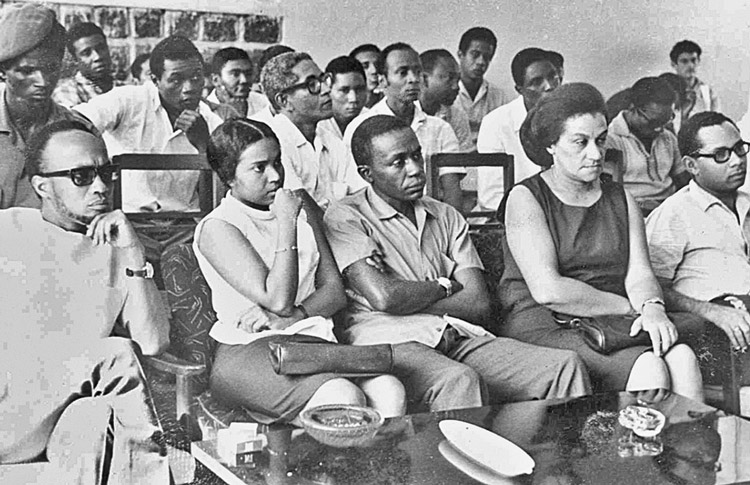
Second. One of the most important things that shines through Víctor Dreke’s account of the liberation struggle in Guinea-Bissau and Cape Verde is precisely the political and leadership qualities of Amílcar Cabral.
Dreke begins the rescue of the real Cabral, the political leader of Guinean and Cape Verdean working people, the Cabral whose qualities Che and Fidel recognized and identified with.
When we started working on this book, like many others, I knew Cabral by name only. I knew vaguely that he stood out among the African leaders of independence struggles in the post-World War II epoch.
Preparing this manuscript gave me and others of us at Pathfinder Press the opportunity to see him as the working-class leader he was, a leader who started with the world.
Cabral rejected the idea, widely prevalent on the “left” of his time, that armed struggle alone could replace — supersede — the political battle to win the support of broad sectors of the toilers.
Before initiating the armed struggle, he sent young cadres of his party into the bush for months to learn firsthand the real conditions under which the majority of the population lived, to organize them as the protagonists forging their own future.
He fought to counter the tribal antagonisms used by the Portuguese to foster division.
He refused to accept the falsehood that the color of one’s skin unchangeably defines one’s enemies or friends.
He led the education of the movement he built, teaching them that the enemy was not the Portuguese soldier, or the Portuguese people, or even the fascist Portuguese president. It was the colonial system they were fighting to destroy. They were fighting for all oppressed and exploited peoples of the world. They were, in his words, “humanity’s soldiers.”
Captured Portuguese troops were treated with dignity and humanity, and turned over to the Red Cross, not the Portuguese military when released.
Cabral understood and helped lead in the fight against women’s oppression and pushed open the door of leadership for women. At the same time, he explained to those who became impatient with the pace of the struggle that women’s second-class status could not be abolished by decree. It would only be eliminated with economic and social development that would, in turn, help men and women toilers both to bring changes in social relations.
He urged young people, irrespective of religious beliefs, to study science. To overcome their fear of nature.
Cabral was a historical materialist. He not only read and studied works of Marx, Engels, Lenin, and other communists. He absorbed them, made them his own. He drew on them to guide his own course of action and to educate others.
The list could go on. But it’s not necessary. The political course Cabral led was one that would have been familiar to Fidel and the cadres of the Rebel Army. They marched in the same boots. And the party Cabral built on these foundations proved strong enough to survive his assassination in January 1973.
A book to be read
Third. I want to finish with a few words about the reception Víctor’s book has already received, even though it has been off the press, in English and in Spanish, for only six weeks.
The first review came in just days ago. It began with the words: This book is “informed and informative, eloquent, engaging and of immense interest for students, academia, historians, political activists, and non-specialist general readers . . .”
As if those words of praise in the Midwest Book Review were not enough, the writer adds the book is “singularly extraordinary” and “quite unique.”
We regret that we were not able to have Dreke’s book available for everyone at this meeting. That’s one of the casualties of Washington’s latest assault on Cuban working people and the emergency measures the Cuban government has had to take to conserve resources, which included, as you know, the necessity to postpone the Havana International Book Fair. That’s why we prepared the brochure reproducing a few pages from the book that everyone here today can take with them to read and share with others.
You’ll be pleased to know that the book has already reached Africa, where friends of Pathfinder in Burkina Faso are working with us to rapidly finish translation to French.
One of them, a professor in the city of Bobo Dioulasso, the second-largest city in Burkina Faso, told us that in reading the book in English, he had really understood for the first time the immense contribution of the Cuban people to the independence struggle in Africa. And that the independence struggle of Africans had served to help working people in Portugal rid themselves of their own dictatorship.
He also commented that the Cuban revolutionaries who came to fight alongside them — unlike other so-called “friendly” powers — didn’t tell Africans what to do. “They aided and collaborated with us,” he said, “and weren’t in Africa for themselves. They were humble and identified with all humanity.”
The parallel next step is to get the book translated to Portuguese, and all suggestions are welcome.
The book is not only being reviewed in the U.S., it is beginning to circulate as well, including in the substantial Cape Verdean communities along the northeast coast of the United States. Some of those communities date back to the great days of whale-hunting sailing ships, some two centuries ago.
The book is being sold not only through big capitalist distributors such as Amazon. But especially among working people whom Pathfinder supporters are able to reach directly. One report we received two days ago is typical.
A supporter who works in a major food service establishment at the Philadelphia airport wrote that since the book came off the press, fellow workers there had bought 16 copies from him. Of those 16 new readers, 8 were U.S.-born, 4 were Haitian and the others originally from Ethiopia, the Philippines, South Africa, and Tunisia.
I mention that fact because it provides a snapshot of a typical industrial workplace in the U.S. The composition not only tells you something important about the interest this book generates. It gives you food for thought about the class struggle in the U.S. today and why immigrant workers have been selected by the capitalists and their government as a focus of the rulers’ attack on the working class.
* * *
We have no doubt this will become one of most widely read books Pathfinder has published in recent years. Because it conveys the heart and soul — the lessons — of the Cuban Revolution, lessons that are so badly needed in today’s world.
For that gift we say Thank You to the Cuban people.