
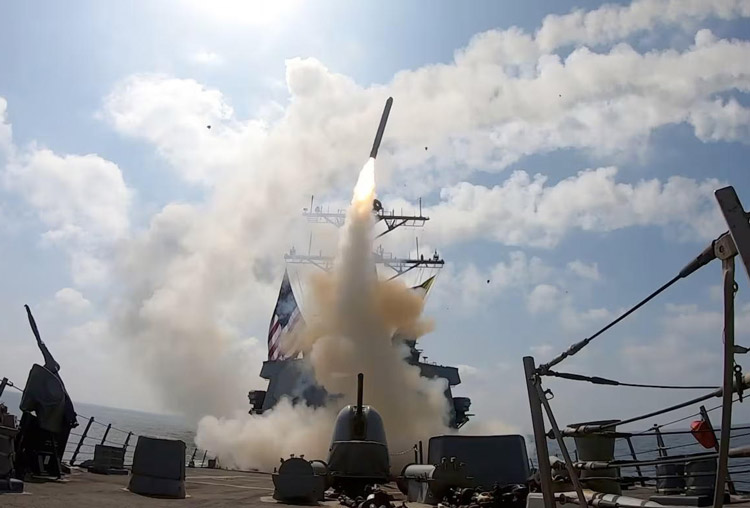
Washington’s actions make clear that its massive use of air and naval power against Iran has nothing to do with aiding the peoples of that country nor defending Israel as a refuge for Jews and has everything to do with advancing the economic, political and military interests of the U.S. ruling class.
President Donald Trump arrogantly declared he was demanding Tehran’s “unconditional surrender” and that any replacement for Iran’s slain Supreme Leader Ali Khamenei would need his personal approval. A few days later CNN asked Trump if he was insisting that Iran have a “democratic” state.
“No, I’m saying there has to be a leader that’s going to be fair and just,” Trump said, and “treat the United States and Israel well” along with other countries in the Middle East.
In fact it is only the U.S. capitalist rulers he wants treated “well.” Trump said that the governments of Saudi Arabia, the United Arab Emirates and Qatar are now “fighting for us” in the war. He boasted his administration had succeeded in getting these regimes to turn away from growing ties to Beijing and toward Washington. The Chinese regime is U.S. imperialism’s main rival in plundering the oil, gas and other resources and labor in the Middle East.
Once the war is over, Trump threatened March 9, “If Iran does anything that stops the flow of Oil within the Strait of Hormuz, they will be hit by the United State of America TWENTY TIMES HARDER than they have been hit thus far.”
U.S. forces reported March 11 that Tehran had placed mines in the strait, and they had responded, destroying 16 Iranian mine-laying vessels. Still, the conflict means oil transport there has virtually closed.
Proving ground for World War III
The assault on Iran is also a proving ground for future wars as the U.S. rulers prepare for bigger conflicts, dragging humanity toward a third world war.
The U.S. military has deployed a range of new and more lethal weapons, including its new High-Energy Laser with Integrated Optical Dazzler and Surveillance system that takes out drones, and the LUCAS, a new low-cost drone based on Iran’s Shahed drone.
For the first time since World War II, a U.S. submarine fired a torpedo to sink an Iranian ship March 4, killing over 100 crew members. Many of the 32 survivors have shattered legs. The 3,700 pound Mk 48 struck the Iranian warship IRIS Dena while it was more than 2,000 miles away from Iran and nowhere near a combat zone. It was in international waters off the coast of Sri Lanka, and was split in half in seconds.
The IRIS Dena had just participated in an annual military exercise in India along with dozens of other navies, as did the U.S. military.
The brutal assault was “an incredible demonstration of America’s global reach,” boasted Gen. Dan Caine, chairman of the Joint Chiefs of Staff. “To hunt, find and kill an out-of-area deployer is something that only the United States can do at this type of scale.”
That’s a message not just to Iran but to any nation that comes into conflict with the U.S. capitalist rulers.
Israel-Washington schism
While Washington’s goal is a regime that guarantees stability for U.S. interests in the Middle East — and won’t threaten oil shipments and profits — Israel’s war against the regime in Tehran is an entirely different question.
Israeli forces are striking as many targets as fast as they can, worried that Washington will force Israel to end its war — like it did during the 12-day war with Iran last June — before eliminating all of Tehran’s ballistic missiles, attack drones and nuclear weapons sites that are aimed at wiping out Israel. Israel is now carrying out nearly three times as many strikes in Iran than the U.S. forces.
“The United States and Israel have seen a public divergence,” the Times of Israel noted March 10, because Washington does not share “Israel’s long-term goals.”
After Israel destroyed 30 fuel depots in Iran, a U.S. spokesperson “told Israel not to do it again,” the Wall Street Journal reported. Another Trump adviser told Axios that Trump “wants to save the oil.”
Regime keeps threatening opponents
Tehran still has some ballistic missiles and a large number of drones it uses to attack U.S. radar stations in the region, threaten oil tankers heading to the Strait of Hormuz and to keep targeting Israel.
The regime continues to threaten working people, oppressed nationalities and other opponents in Iran with as much or more ferocity than it shows to Washington. And many of the regime’s drone attacks are directed at armed groups based in the Kurdish region of Iraq. Kurds are an oppressed nationality across Iran, Iraq, Syria and Turkey.
“Our struggle is for the self-determination of the Kurdish people in Iranian Kurdistan,” said Mohammad Saleh Qadri from the Democratic Party of Iranian Kurdistan. “We do not want to replace this regime with another dictatorial regime.”
In Tehran, “the streets are emptier than ever,” the Coordinating Council of Iranian Teachers’ Trade Unions reported March 9. “The wheels of life and the economy are no longer turning here; the only concern is surviving until tomorrow.” Prices of necessities have skyrocketed.
The regime provides no bomb shelters for the Iranian people nor warning sirens, but “in the main squares and intersections, vehicles of repression and the heavy barrels of machine guns are prominently on display,” the union notes. “Numerous checkpoints throughout the province cast a heavy shadow of fear over the few weary and worried passersby. Before worrying about the sky above, we must first fear the streets of our own city.”
The regime’s need to intimidate working people amid Washington’s brutal war is a sign of its weakness and its fear that protesters will once again take to the streets, like they were doing in the tens and hundreds of thousands before the war to fight to get the regime off their backs and to fight for a better life.