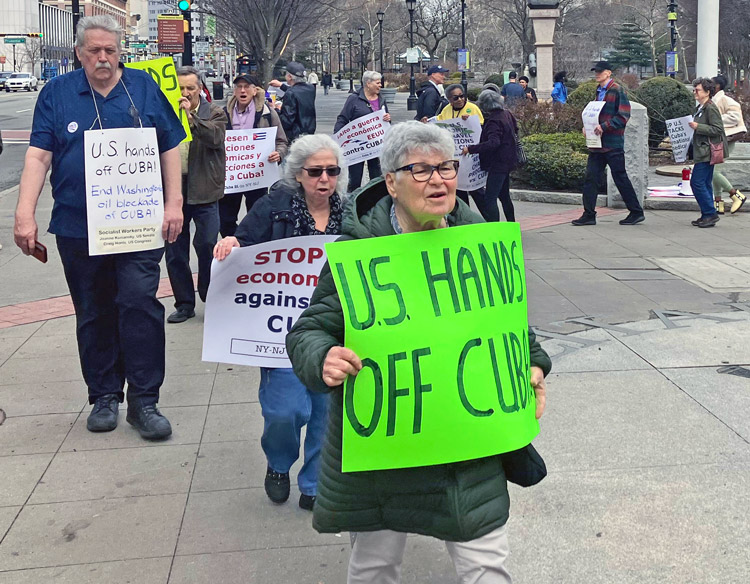
NEWARK, N.J. — Chanting “U.S. hands off Cuba!” and “Cuba sí, bloqueo no!” some 35 people joined a picket line at Military Park here March 8. The action — one of a growing number across the country and around the world — was called by the New York/New Jersey Cuba Sí Coalition and co-sponsored by a range of organizations whose representatives spoke. Protesters called for an end to Washington’s oil blockade of Cuba.
“Cuba unites us, whatever our differences, because it sets an example of what true internationalism is all about,” César Sánchez, a co-chair of the National Network on Cuba, said to open the speak-out.
“Why has every U.S. administration, Democratic and Republican alike, tried to destroy the Cuban Revolution since its victory in 1959?” Joanne Kuniansky, Socialist Workers Party candidate for U.S. Senate from New Jersey, asked. “It’s because the workers and farmers of Cuba, 90 miles from U.S. shores, threw off a U.S.-backed dictator, made a socialist revolution, and set an example for working people everywhere, especially for us here in the U.S.”
Cuba is “a beacon of internationalism,” Larry Adams, vice chairman of the People’s Organization for Progress, said. The people of Cuba “have a right to self-determination to choose their form of society and their leaders.” He pointed to the hundreds of thousands of Cuban volunteers who served in Angola, helping to “defeat the apartheid regime in South Africa,” which had repeatedly invaded that newly independent country between 1975 and 1988.
“As we live through another war in the Middle East,” Ellen Whitt, from the Central Jersey Coalition Against Endless War, said, Washington is escalating its blockade of Cuba, hoping “to completely collapse the Cuban economy by starving it of oil.”
“Let’s not let them succeed!” she concluded.
Karl Schwartz read a message from the North Jersey Democratic Socialists of America. He called for “an end to this cruel blockade against the Cuban people, who want to build a brighter future for their country.” And he noted the U.S. economic war against Cuba “hurts workers here too.”
Numerous passing drivers honked their horns and some cheered in support of the protest. A woman who works at Newark airport stopped and spoke to a Militant reporter. She said she was originally from Jamaica and disagreed with the move by the government there two days earlier to buckle under to pressure from Washington and end the decadeslong Cuban volunteer medical missions there.
 A Cuban man on his way to work waved his thanks to the demonstrators. He told this reporter he has worked here three years, but all of his family are still in Cuba facing increasingly difficult conditions.
Bob Miller, from Cuba Sí in New Jersey and an organizer of the picket, chaired the speak-out. He announced the premiere of a documentary on well-known local Black artist Ben Jones, a fellow opponent of Washington’s attacks on Cuba, will be screened at the Montclair Art Museum March 15.
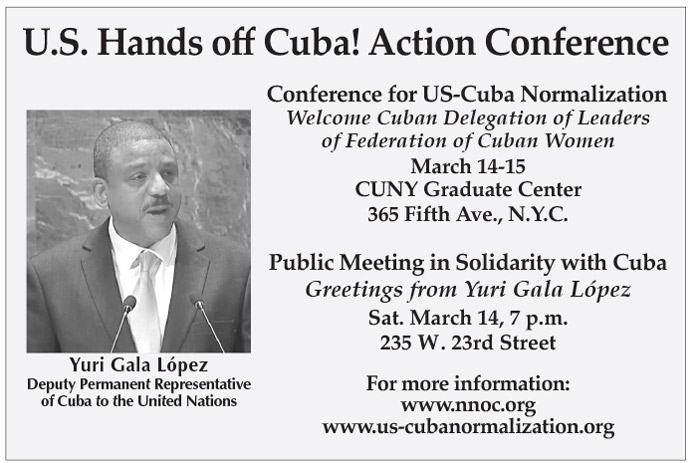
Ike Nahem, from Cuba Sí in New York, invited protesters to attend the March 14-15 Action Conference for US-Cuba Normalization at the CUNY Graduate Center in New York. He noted a delegation from Havana, including leaders of the Federation of Cuban Women, will be participating.
* * *
SYDNEY — Over 50 people welcomed Gilma Moreira Lino, the new Cuban ambassador to Australia, and joined in discussing the situation Cuba faces today at a meeting organized by the Australia Cuba Friendship Society here March 5.
“The humanitarian impact of the oil blockade is huge,” Moreira Lino told the meeting, scoring President Donald Trump’s move to block all shipments of oil to the country. “It has had an impact on all aspects of society, on almost everything. Power is out in half the country” right now, she said.
“The Cuban people will defend their country,” she added. After facing Washington’s economic war for over 60 years, “We have had a lot of preparation.”
In response to a question on how Cuba’s working people were responding to the crisis, Moreira Lino said, “We know the difference between living in Cuba and the rest of the world.” In Cuba “there is a lot of solidarity. We help each other.”
Led by Fidel Castro, working people in Cuba overthrew the U.S.-backed dictator Fulgencio Batista in 1959 and carried out a socialist revolution. Washington responded by launching an economic war against the revolution, but the new social relations conquered by the revolution have prevailed, despite the continuing attacks of every U.S. government since.
During what Cubans call the “Special Period” following the collapse of the Soviet Union in 1991, “many thought Cuba wouldn’t last a week,” Moreira Lino said. “U.S. presidents have come and gone, but we are still here,” and “we intend to continue.”
After the talk and a lively discussion period, Marx del Rosario reported on a recent solidarity brigade to Cuba he had been on, noting that Cuba is a society that is “not organized for profit.” The meeting wrapped up with music, food and informal discussion.
The Australia Cuba Friendship Society is part of a coalition of groups here calling a protest March 21 to demand an end to the U.S. oil blockade of Cuba.
— Bob Aiken
* * *
CHICAGO — Forty people joined a spirited rally and press conference calling for an end to the U.S. oil blockade of Cuba at the Federal Plaza here March 4. The event was initiated by the Chicago Cuba Coalition and endorsed by 16 additional organizations.
Speakers included 25th Ward Alderman Byron Sigcho-Lopez; Lyra Spencer, from the Democratic Socialists of America; Jhonathan Gomez, from the Chicago Religious Leadership Network; and Cuban American filmmaker Eric Torres Alvarez. Cathy Gutekanst, a retired nurse, read excerpts from the National Nurses Union statement calling for an end to the U.S. blockade of Cuba.
Other endorsing organizations spoke after the press conference. Naomi Craine, Socialist Workers Party candidate for U.S. Senate from Illinois, said every U.S. president since 1959, Democrat and Republican alike, has tried to overthrow the Cuban Revolution. “What the U.S. rulers fear is the moral and political example of the Cuban working class taking power,” she said. “The oil blockade is an act of war that can quickly escalate. It is an attack on Cuban sovereignty and a threat to workers and the oppressed in the United States and worldwide who want to live in peace.”
The protest was covered on WGN-TV News.
Craine and other speakers pointed to the importance of reaching out to churches, unions and other organizations to join further, broader actions defending Cuba from U.S. attack.
—Amy Husk
* * *
LOS ANGELES — A spirited action at the intersection of Hollywood Boulevard and Highland Avenue here March 8 demanded “U.S. hands off Cuba!” and “End Washington’s economic blockade against Cuba!”
With banners, signs, flyers, and speaking over a bullhorn, the two dozen participants explained why workers and others should oppose the continuous U.S. economic war against Cuba, in place since working people there made their revolution in 1959, and that has sharply escalated today.
Several passersby expressed support for the action. Some driving by honked in support, while a few disagreed with us.
“The protest today is part of international days of protest against the U.S. blockade of Cuba, especially the strangulation of the oil blockade, and as part of the week of solidarity March 8-15,” Mark Friedman, a steering committee member of the LA US Hands Off Cuba Committee, told the Militant. “It was called by the National Network on Cuba and Cuba’s Institute for Friendship with the Peoples.
“In four days we’ll be loading a truck with hundreds of thousands of dollars in medical aid to take to Miami and then fly to Cuba,” he added.
Ainsly Rivera, a young substitute teacher and member of the Hands Off Cuba Committee, told the Militant, “We have been fighting to remove the blockade against Cuba, to get the U.S. military base out of Guantánamo, and to remove Cuba from Washington’s State Sponsors of Terrorism list. The Cuba coalition also demands that the government ‘Let Cuba Play!’ in the baseball competition in the upcoming Olympics, demanding the U.S. grant visas that have been denied to athletes and coaches.”
— Deborah Liatos