Capitalism’s World Disorder: Working-Class Politics at the Millennium by Jack Barnes is one of Pathfinder’s Books of the Month for March. Barnes is the national secretary of the Socialist Workers Party. The excerpt is from the section “Capitalism and fascism” in chapter 4. Today, as liberals and middle-class radicals demagogically label their bourgeois opponents “fascist,” it is vital for class-conscious workers to understand the deadly threat that a real fascist movement in the future will pose. Copyright © 1999 by Pathfinder Press. Reprinted by permission.
The communist movement has written a great deal about “fascism, what it is and how to fight it,” to use the name of a very valuable pamphlet by Leon Trotsky that is published by Pathfinder. But the person from whom I learned the most about fascism concretely was Farrell Dobbs. Farrell was the national secretary of the Socialist Workers Party from 1953 until 1972, and in the 1930s was a central leader of the strikes and over-the-road organizing campaigns that built the Teamsters in the upper Midwest into a fighting industrial union movement. I learned from Farrell both directly, in the course of our work together for nearly a quarter century until his death in 1983, and from his four-volume series on the Teamsters struggles published by Pathfinder.
In the third volume, Teamster Politics, Farrell explains how small fascist outfits began to grow in this country in response to the deep economic and social crisis and the rise of workers’ struggles in the 1930s. …
[F]ascism is precisely a movement set in motion and financed by sections of the ruling class in desperate circumstances in order to maintain capitalist rule. It is not an alternative to “democratic capitalism”; it is bred by “democratic capitalism.” When workers understand what fascism really is, then the enormity of the responsibility to get rid of capitalism — a task only the working class can organize and lead — becomes that much clearer. …
[F]ascism is not a way of organizing capitalism. Instead, it is a radical petty-bourgeois movement in the streets — the most horrible, malignant such movement in history. Banal, mediocre, figures — but ones adept at radical demagogy, nationalism, phrase-mongering, and organization — rise to leadership in these movements. Thugs rise among the cadres. The fascists ape much of the language of currents in the workers movement. “Nazi” was short for National Socialist German Workers Party.
These movements never begin with broad ruling-class support. At first, the rulers in their majority alternately scorn and fear this rowdy “rabble”; only handfuls of capitalists back them at the outset. But as the bourgeoisie become convinced they confront an irresolvable social crisis, and as the working class puts up an increasingly serious challenge to capitalist rule itself, growing layers of the exploiters start supporting, or tolerating, the fascists in order to try to smash the workers and their organizations. That is the job the fascists are finally enlisted to do by the bourgeoisie when the threat to capitalist rule reaches a certain threshold.
The fascists’ stock of “ideas,” encrusted with historical mystification, are borrowed from the sewers of the bourgeoisie’s own views, values, and attitudes. The things the capitalist rulers say privately among themselves, the subtle and not-so-subtle bigotry they promote, are taken up as the banners of a radical mass movement. The demagogues use these banners to mobilize and channel the energies of radicalized layers of the frightened, resentful, and ruined middle classes in bourgeois society.
The fascists initially rail against “high finance” and the bankers, lacing their nationalist demagogy with anticapitalist rhetoric. When they come to power with support from weighty sectors of finance capital, however, the anticapitalist rhetoric slacks off quickly. That is what happened in Italy under Benito Mussolini in the early 1920s after il duce also became premier. That is what happened in Germany under Adolf Hitler a decade later after the führer also became chancellor. Once these new regimes set about reviving industry, building roads, and preparing for war, radical diatribes against capital went into rapid decline.
SWP leader Joseph Hansen wrote quite a bit about the experience of the working class with fascist movements in this century. He pointed out that when a fascist movement conquers, its character rapidly changes. The new government demobilizes many of the most radical sectors on which the movement rose to power, bloodily suppressing some of its own cadres if need be, and begins functioning basically as a military-police dictatorship. In mid-1934, a year after he was appointed chancellor, for example, Hitler disbanded the Storm Troopers — the “Brownshirts” — that he had mobilized for more than a decade as the party’s radical, street-fighting squads against the workers movement. He summarily executed their chief, Ernst Röhm, and murdered dozens of other leaders of the Nazis’ longtime cadre.
The regimes that come to power on the back of fascist movements are capitalist governments. It is misleading to talk about “a fascist regime” for that reason. It is not something historically different in class terms from a capitalist regime. Once fascist movements come to power, they use the state and forms of capitalist economic planning to bolster the strongest components of the bourgeoisie against smaller rival capitalists and against the toilers. Historically, these governments are short-lived. They become more and more bureaucratized, corrupt, and brittle. But a horrible logic is played out — a drive toward war, a monstrously brutal crushing and atomization of the labor movement, a drastic reduction in the value of labor power, crimes such as the scapegoating and extermination of the Jews in Germany and others that challenge language to describe. This is how a declining capitalism, in an unplanned and pragmatic manner, attempts to restabilize itself. …
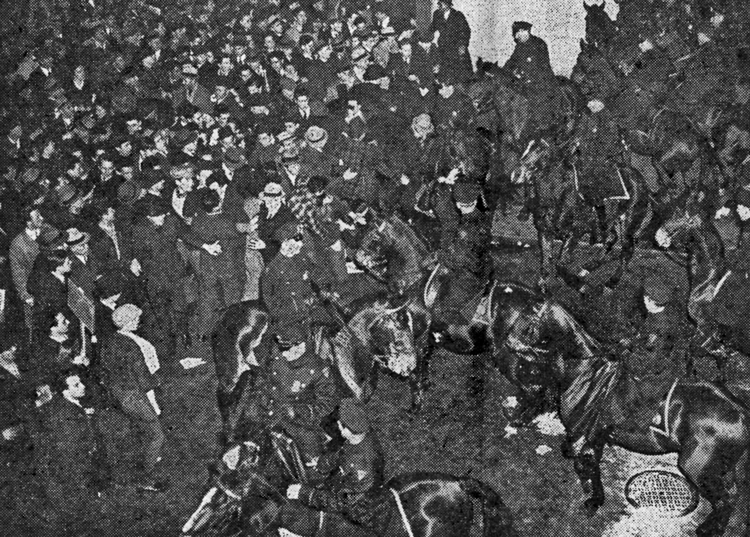
The workers vanguard must chart a course to mobilize and lead the working class and our allies to take power. Along the way, the labor movement will have to defend our organizations and those of other oppressed layers against fascist thuggery and murderous violence.