Unable so far to bring down or to stop the reactionary regime in Iran from retaliating against the U.S. bombardment, the imperialist rulers in Washington are sending 5,000 additional Marines and sailors to the region. They are traveling on warships equipped with helicopters and landing craft, suitable for occupying parts of Iran.
Despite being badly battered by airstrikes, Tehran continues attacking ships in the Arab-Persian Gulf and launching missiles and drones — although at a rapidly declining rate as their arsenal is depleted — at military installations and oil facilities in Saudi Arabia, Oman, the United Arab Emirates, Qatar and Bahrain, as well as targeting civilians in Israel.
Maritime traffic through the Strait of Hormuz is down from 3,000 a month to just a trickle. Just 21 miles at its narrowest, the strait carries some 20% of the world’s gas and oil traffic.
At least 16 vessels in the region have been struck by Iranian weapons since the war started Feb. 28. The strait “is only closed to the tankers and ships belonging to our enemies,” said Iranian Foreign Minister Abbas Araghchi.
The U.S. military has not attempted to block ships carrying Iranian oil from sailing.
U.S. ‘allies’ say no to joining war
President Donald Trump appealed to his imperialist allies — including London, Sydney, Paris, Berlin, Athens and Tokyo — to send warships to protect vessels passing through the Strait of Hormuz. All turned him down.
That’s another indication of the deepening rivalries between capitalist powers as each competes and maneuvers to gain the most for their respective ruling classes. They don’t support the bourgeois-clerical regime in Iran, but they don’t want to see U.S. imperialism strengthen its domination in the Middle East and better able to ice them out of the plunder of oil, gas and the region’s other resources.
“We will protect them, but they will do nothing for us,” Trump complained March 17, before declaring “we no longer ‘need,’ or desire the NATO countries’ assistance — WE NEVER DID!”
On March 13 U.S. forces destroyed military posts on Kharg Island, Iran’s main oil terminal, taking care not to damage its oil facilities. A key goal of the U.S. rulers is to convince a wing of the Iranian regime to cooperate with Washington to advance its political, economic and military goals in the region, while at the same time preventing working people from defending their own interests.
The goal of Israel’s capitalist government is counterposed to Washington’s. It’s defensive, seeking to eliminate Tehran’s capacity to produce or deploy a nuclear weapon to carry out the Iranian rulers’ decadeslong threats to destroy Israel along with the Jews and all who live there. It’s a life-or-death question for Israel.
U.S. strike killed 168 students
While the U.S. rulers were careful to safeguard their future oil profits on Kharg Island, they are not as scrupulous with other targets. It was a U.S. Tomahawk missile that struck an elementary school in Minab, Iran, Feb. 28, killing 168 children and 14 teachers. The school used to be part of a nearby base of the Islamic Revolutionary Guard Corps, but was separated from it a decade ago. U.S. official say they are investigating what the New York Times called an “accident.”
The reactionary Iranian regime deliberately places its bases in residential neighborhoods, stationing troops inside schools. That doesn’t stop the regime from claiming the U.S. military deliberately targeted the school in Minab. In January the regime itself slaughtered more than 7,000 protesters who it slandered as “terrorists.”
Along with targeting Tehran’s ballistic missiles, rocket launchers, drones and nuclear sites, Israel has been bombing the paramilitary Basij and Islamic Revolutionary Guard Corps forces, which were at the forefront of the slaughter and are widely hated by working people in Iran.
The attack killed Gholamreza Soleimani, the head of the Basij, March 16, as well as Ali Larijani, who was the regime’s central leader after the death of Supreme Leader Ali Khamenei.
Iran’s chief of police announced March 15 that 500 people had been arrested, accused of “collaborating with the enemy.” They join the more than 50,000 protesters arrested in January. The top cop warned that anyone who dares protest will be dealt with “the same way we deal with our enemies. All our forces are ready, with their hands on the trigger.”
But the regime has been unable to crush the opposition.
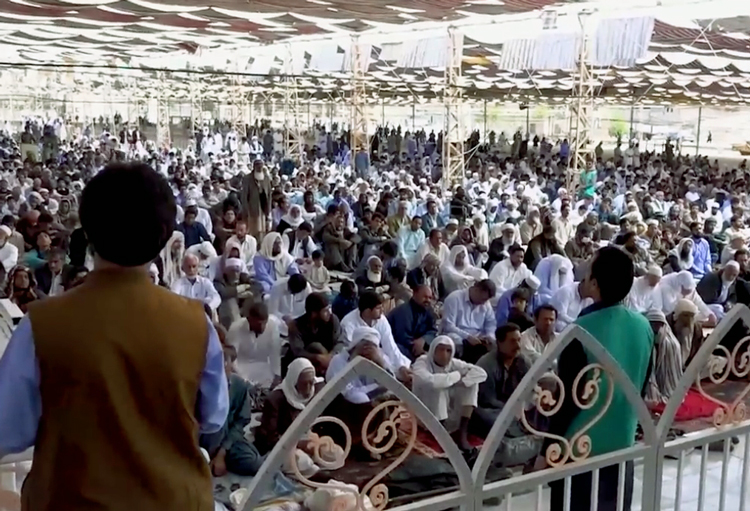
Sheik Abdul-Hamid, a prominent Sunni cleric and a leader of the oppressed Baluch nationality, continues to speak out every week at the Friday prayer service at the main mosque in Zahedan.
“I have said this many times and I repeat it again: release the political prisoners,” Abdul-Hamid told thousands March 13. “Those who protest or express opinions about what they believe is the right path should not be imprisoned.”
The Coordinating Council of Iranian Teachers Unions, one of the few unions that have found a way around the regime’s internet blackout, reported on unrest among soldiers March 13. Soldiers in the Iranian army are mostly draftees and unlike the regime’s main repressive apparatus — the Islamic Revolutionary Guard Corps, its voluntary Basij paramilitary thugs and the police — are not used to attack protesters.
The report said that after the bombing of an army base in Sanandaj in the Kurdish region, a low-ranking officer told some 40 soldiers under his command that they could leave the base, even after warning them such an action was illegal and he could not take responsibility for the consequences. The soldiers left.
On March 17 the Coordinating Council reported that union leader Masoud Farhikhteh, who was arrested when police raided a union meeting in Isfahan last year, has gone on a three-day hunger strike to protest conditions he and fellow prisoners face.