

Ukrainian working people are determined to continue fighting to defend their country’s sovereignty, despite Moscow’s airstrikes causing blackouts in cities across Ukraine during the depths of winter.
Four years after Russian President Vladimir Putin launched his war of conquest, Moscow is unleashing drone attacks to target miners and their union in eastern Ukraine. The office of the Independent Trade Union of Miners of Ukraine in the Dnipropetrovsk region was hit by a drone March 10. A unionist who appeared in the window was targeted and injured.
The same day a bus was attacked after it had just dropped off a group of coal miners to start their shift. This followed a “double tap” drone strike — designed to maximize casualties — by Moscow’s troops on a bus in the same region Feb. 1. It killed 12 and injured 16, both miners and rescue workers.
After devastating airstrikes on mining towns in the Donetsk region, Putin’s forces “are targeting the mining outskirts of Pavlohrad in the Dnipropetrovsk region,” Mykhailo Volynets, chairperson of the Confederation of Free Trade Unions of Ukraine, told the union magazine. This coal mine complex is the largest in the country.
Miners’ work is constantly interrupted by airstrikes and shelling, Volynets noted. Power disruptions cause dangerous gas accumulations and flooding of some mines. His union is seeking extra compensation from the mine bosses for the risks union members face “not only at their workplaces but also during transportation to and from their shifts.”
Russia casualties exceed recruitment
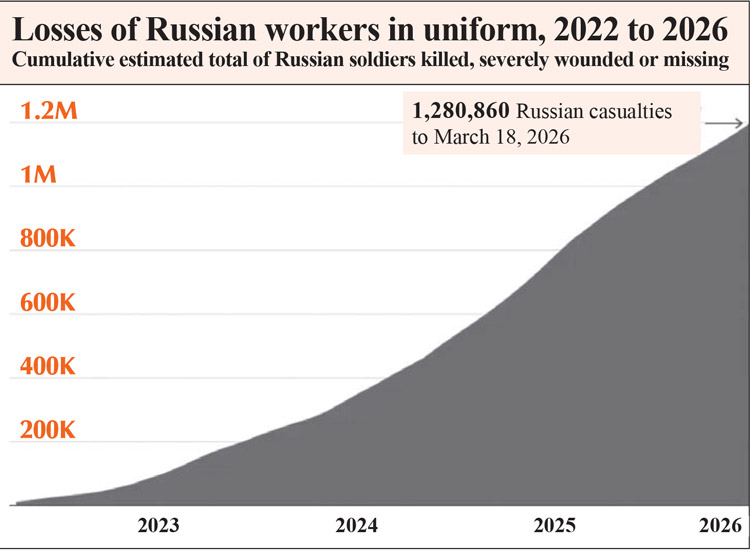
Despite Putin’s bluster, Moscow is facing mounting difficulties against both Ukrainian resistance and the growing sentiment across Russia against his war including among workers in uniform. Heavy losses suffered by Moscow’s forces from its “human wave” assaults on Ukrainian front lines have exceeded the number of new recruits who have signed up in the last three months.
The actual number of Russian casualties — deaths and severe injuries — is estimated to be over 1.2 million, “more than any major power in any war since World War II,” says the Center for Strategic and International Studies.
The names of over 200,000 Russian soldiers killed in battle or dying later from combat injuries were confirmed Feb. 24 in a joint study by the research group Mediazona, the BBC Russian Service and others.
The death toll reflects “stark social stratification,” with the largest, wealthiest cities mostly untouched, the report says. Casualties fall disproportionately on the poorest regions of the Russian Federation, with high numbers of volunteer recruits coming from southern Siberian territories near Mongolia or China. Bashkortostan, the predominantly Muslim region in the southern Ural Mountains, is the territory with the greatest losses.
Moscow “relies heavily on men from these economically depressed areas, where the financial incentives of military contracts offer a rare, if potentially fatal, lifeline,” the report concludes.
The Kremlin has also recruited tens of thousands out of its jails. If they join the military, convicts can have their criminal records expunged. Others facing criminal charges can have them dropped if they enlist. As a result, Russia’s prison population has plummeted by 70% to just over 300,000, a historic low.
More Russian soldiers are finding ways to surrender. Calls intercepted by Ukrainian military intelligence show collapsing morale in the ranks of the Russian army. With minimal training, Moscow’s soldiers are pushed into so-called meat assaults facing near-certain death or maiming. Some refuse to respond to radio commands to join these attacks, to try to avoid getting killed.
Profanity-laden tirades by Russian commanders reveal their utter contempt for the troops. In one, a Russian officer reports to his superior that his soldiers are leaving forward positions where they are pinned down. The chief screams that he will brand the entire group as deserters.
‘I Want to Live’ hotline
The battlefield in Ukraine has become dominated by drone warfare.
Kyiv is now using unmanned aerial vehicles and even ground robots to encourage Russian soldiers to surrender. A March 11 video shows Russian soldiers who survived a drone attack surrendering after being confronted by another drone with a camera and loudspeaker. Its operator broadcast instructions for the soldiers to raise their hands and follow. Four soldiers trail the drone until Ukrainian forces arrive to take them into custody.
Ukraine’s minister of digital transformation, Mykhailo Fedorov, said drone units have induced more than 100 Russian soldiers to surrender during the winter months alone.
“I Want to Live” is Ukraine’s surrender hotline, helping Russian soldiers make contact and surrender safely.
Workers in uniform in the Russian army are the most important potential allies of Ukraine’s fight to prevent Putin’s bloody attempt to conquer the country.