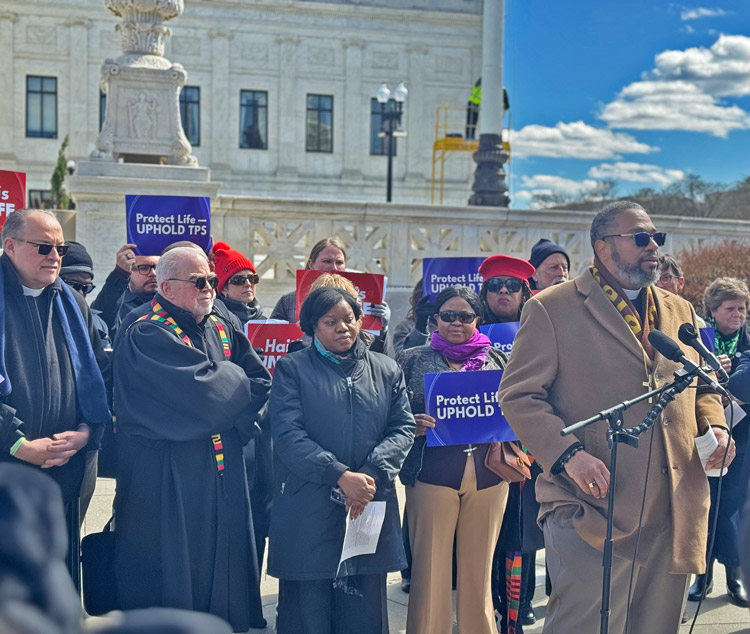
WASHINGTON — At a press conference and rally in front of the U.S. Supreme Court building here March 17, Faith in Action Executive Director Bishop Dwayne Royster, above, called for the court to uphold Temporary Protected Status for some 350,000 Haitians. Haitian community activists, religious leaders, Socialist Workers Party members and others joined the action.
Since the Donald Trump administration asked for an expedited ruling, the Supreme Court announced it will hear arguments over the removal of protected status in April. The Justice Department called for a ruling, even though two federal courts — in New York and Washington, D.C. — have ruled the TPS program for Haitians and Syrians in the U.S. should be continued. Hanging in the balance are the lives and status of 350,000 Haitians and 6,000 Syrians.
The Justice Department argues that the executive branch has the sole authority to decide the status of TPS programs. In an earlier ruling, the Supreme Court upheld the government’s cancellation of TPS protection for some 600,000 Venezuelans in the U.S.
“It’s a question of life and death because Haiti is not safe for people,” said Viles Dorsainvil, executive director for the Haitian Community Support Center who came from Springfield, Ohio. “My goal coming here is to send a message that human dignity should be upheld.”
Dorsainvil had spoken at a rally in Springfield of 75 March 16, introducing the contingent going to the Washington rally. There are some 15,000 Haitians there, a quarter of the city’s population.
If Haitians lose their legal status they could be forced to leave the U.S. They will face a brutal reality in Haiti. The country is in a long-standing crisis, with no effective government. Half the population goes without enough to eat every day, more than 1.4 million have been displaced by armed gangs, and kidnappings, rapes and killings are rampant. Here in the U.S., tens of thousands of families will be broken up.
The administration is pressing to end TPS protection for tens of thousands of others in the U.S., including immigrants from Ukraine, Afghanistan, Nicaragua, Yemen, South Sudan and nine other countries.