NEW YORK — What is the “Cuba problem,” as the Donald Trump administration calls it, that Washington has sought to destroy for more than six decades?
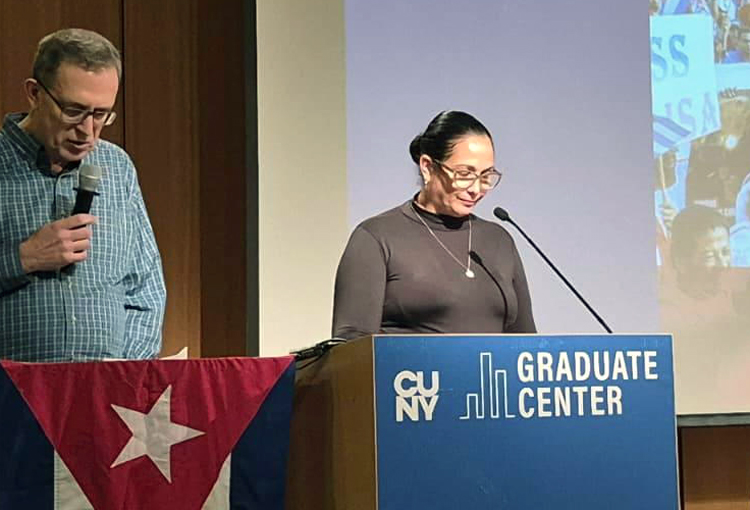
“It’s the example that the Cuban Revolution represents for many in the world,” said Osmayda Hernández, a leader of the Federation of Cuban Women (FMC), addressing more than 200 people at the March 14-15 Action Conference for U.S.-Cuba Normalization.
It’s Cuba’s “example of solidarity and internationalism in face of a destructive capitalist system that represents the opposite,” she said. “The fact that we continue to withstand the attempts to strangle us, that we don’t give in, is something the imperialists cannot comprehend.”
The conference was a rare opportunity to hear speakers from Cuba in person. The visiting delegation included Hernández, a member of the FMC’s national secretariat; Maybel González, regional coordinator of the Women’s International Democratic Federation; and Alexis Ginarte and Yamila González Ferrer, president and vice president of the National Union of Cuban Jurists. They were joined by Ernesto Soberón and Yuri Gala López, Cuba’s ambassador and deputy ambassador to the United Nations.
The Cuban delegation was in New York to participate in the 70th annual meeting of the U.N. Commission on the Status of Women.
Openings to tell truth about Cuba
The conference took place in the wake of the U.S. government’s Jan. 3 military assault on Venezuela and kidnapping of Venezuelan President Nicolás Maduro and his wife, followed by its imposition of a total oil blockade on Cuba. The Trump administration has escalated its threats, declaring its aim is to “take Cuba.”
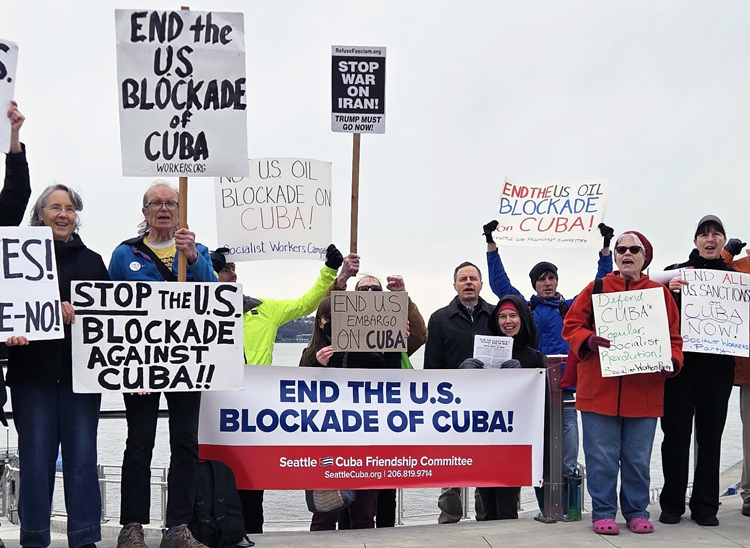
In response, over the past two months opponents of the U.S. economic blockade against Cuba have held protests, small but visible, in numerous U.S. and Canadian cities. They are finding that, with Cuba now prominently in the news and many people asking why Washington is so hostile toward it, there are greater openings today to tell the truth about the Cuban Revolution.
The Action Conference was sponsored by a range of Cuba solidarity groups in the U.S. and Canada. Most participants were from New York and New Jersey, and others came from Seattle, Los Angeles, Chicago, Vancouver and other cities, or watched online.
“The objective of the criminal policy of the United States is to exacerbate the suffering of a people subjected to an inhumane blockade and to force a social uprising that would fulfill the long-standing desire to destroy the revolution,” said Ambassador Soberón at the opening conference session.
The Cuban government, he said, has always been willing “to engage in serious, responsible dialogue with the U.S. government, based on sovereign equality, mutual benefit, noninterference in internal affairs, and absolute respect for the independence and sovereignty of states.”
Impact of U.S. economic blockade
At a conference workshop on women’s health care in Cuba, Maybel González noted that Cuba’s socialist revolution has made possible enormous advances in the fight for women’s equality and the integration of women into all aspects of social, economic and political life.
At the same time, she said, the impact of the U.S. economic blockade — which makes it extremely difficult for Cuba to import needed fuel, food, medicine and equipment — falls disproportionately on women and children. Survival rates for childhood cancer and kidney disease are down. Without power and equipment it’s difficult to do ultrasounds for pregnant women. Without gas, ambulances aren’t available.
Yamila González noted that the frequent blackouts caused by the oil blockade disrupt everything from cooking and refrigerating food to access to drinking water. In some areas, she said, people are cooking with charcoal.
In face of these conditions, “Cuba is not standing with arms crossed,” Hernández said at the opening session. “We are taking steps to prioritize essential services and accelerating projects for sustainable, renewable energy.” That includes connecting solar panels in social centers for the elderly in cities as well as in isolated rural homes, installing solar-powered water pumps to irrigate crops, and using wind and hydroelectric power.
Activities projected
Other conference workshops focused on different ways to defend Cuba’s sovereignty, from organizing solidarity trips to Cuba to collecting material aid.
Bob Schwartz, the executive director of Global Health Partners, reported they have helped organize campaigns providing millions of syringes, sending 60,000 surgical sutures and raising money to send pacemakers to the island.
Today, he said, the group is funding a project to provide equipment and diagnostic tests for two maternity hospitals in Havana that treat complicated neonatal and maternal cases, and to strengthen maternal care at local clinics.
The final conference session discussed an “action program” for 2026 to win broader support to the fight to end the U.S. blockade against Cuba. It projected stepping up a range of activities that local groups across North America have been carrying out. These include street protests against the U.S. economic blockade on Cuba; campaigns to send material aid to Cuba; lobbying efforts in the U.S. Congress; and organizing brigades and other solidarity trips to the island.
One projected theme of this work is to counter Washington’s lies about the Cuban medical brigades that have provided health care to hundreds of thousands around the world. The U.S. government, which falsely claims these medical volunteers are “slaves,” has been pressuring many governments, especially in Central America and the Caribbean, to end their medical cooperation agreements with Cuba.
The conference included a Saturday evening program to celebrate the centennial year of Fidel Castro’s birth. The featured speakers were Yuri Gala and Maybel González. Gala highlighted Castro’s leadership role in the Cuban revolution’s long record of internationalist solidarity. “We sent 380,000 volunteers to Africa to help defeat the South African apartheid regime and other colonial empires,” he said. “Fidel always taught us that internationalism means paying our debt to humanity.”
Addressing Washington’s attacks on Cuba today, Gala said, “The U.S. blockade is imposing on us a high level of austerity. But it’s also generating a high level of creativity. The Cuban people have shown their willingness to defend our sovereignty. And we will continue to defend it.”