The Great Labor Uprising of 1877 by Philip S. Foner is one of Pathfinder’s Books of the Month for April. After five years of economic depression, railroad workers in Martinsburg, West Virginia, went on strike against yet another wage cut. Despite state militia and U.S. army intervention, the strike rapidly spread to other rail lines and sparked support from workers and the unemployed in cities across the country. Within days, 100,000 workers were involved in a nationwide strike — the first in U.S. history. The excerpt is from the Preface and the Epilogue. Copyright © 1977 by Philip S. Foner, Pathfinder Press. Reprinted by permission.
BY PHILIP FONER
In 1876, as the nation prepared to celebrate the centennial of American independence, an economic depression was entering its fourth year; millions of Americans were unemployed, and for those who were still working, wages — already at starvation levels — were being cut in half. In New York City, where one-quarter of the work force was without jobs, meetings of the unemployed, called to “consider how we are to get work, food, clothing, and shelter,” were brutally attacked by the police. …
According to the Chicago Workingman’s Advocate, the centennial pointed up the need for “another revolution, as essential today as that inaugurated in 1776.”
In the hot mid-July of 1877, exactly one year after the celebration of America’s one hundredth birthday, with the nation prostrate, a general railroad strike developed into a national conflagration that brought the country closer to a social revolution than at any other time in its century of existence except for the Civil War.
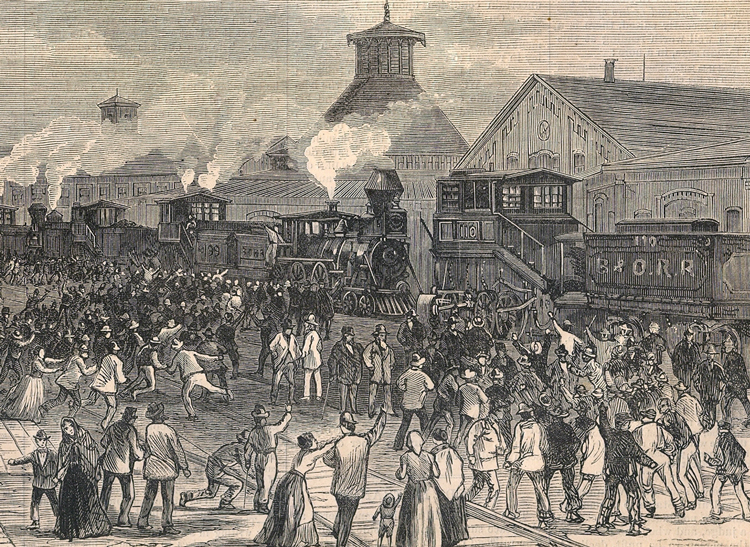
On Tuesday, July 16, 1877, railroad workers at Martinsburg, West Virginia, went out on strike against still another wage cut imposed by the Baltimore & Ohio Railroad.
As the militia was mobilized and violence broke out, the strike extended up the B & O line and spread rapidly to other lines. Other workers came to the support of the railroad strikers, and by the weekend angry crowds of workers were attacking the railroads and fighting with militia in the cities of West Virginia, Pennsylvania, and Ohio. The local militia generally sided with the strikers, and, for the first time since Andrew Jackson’s administration, federal troops were called in to suppress a strike.
Almost before the public was aware of what was happening, the huge contagion had spread as far as Chicago, St. Louis, Kansas City, and then on to San Francisco. Within a few days, one hundred thousand men were on strike in the first nationwide labor upheaval in history. All the main railway lines were affected, and even the employees of some Canadian roads joined the strike. …
The railroad strikes served as a fuse, carrying the spark of rebellion to other workingmen, who, if they were working, were suffering from wage cuts, and to the unemployed multitudes in the great cities. In several cities, the original strike on the railroads expanded to many other industries, and in St. Louis it spread into such a systematically organized and complete shutdown of all industry that it became the first truly general strike in history.
“the first uprising against the oligarchy of capital
which had developed since the Civil War.”
—Karl Marx, 1877
Although the Great Strike was spontaneous and unorganized — it had nothing in the nature of central leadership and direction — this first nationwide rebellion of labor frightened the authorities and the upper classes as nothing before in our history. …
During the Great Strike, the major part of the country’s transportation system and thousands of industries dependent on it were brought to a halt. …
It is becoming widely accepted that in most cases these actions were not mindless riots, but rather reflections of the economic, political, and social grievances, needs, and aspirations of the particular group of participants. …
[A] tendency that one must avoid is that of viewing the Great Strike as a full-blown insurrection which, but for a quirk of fate, would have produced a socialist America; or to insist that 1877 was a “mass strike” leading to virtual insurrection and with revolutionary potential. That there were distinct insurrectionary and revolutionary elements in the Great Strike will become abundantly clear below. But it will also become evident that this characteristic did not apply in many areas affected by the strikes, and that at no point did the workers have either the power or the leadership to have transformed the strikes into a revolutionary seizure of the economy or the state. …
***
Once the strikes were over, the Marxists insisted that the next immediate task was to create such a national federation of trade unions, with the eight-hour day as the unifying issue. Executive committees set up during the struggle, and scattered mass meetings were not enough, they argued. Strikers with hungry families to feed required swift relief payments, and hastily established committees could not meet this need. The strikes had demonstrated the indispensability of trade unions capable of holding out against the combined employer-government offensive.
The Marxists also maintained that the strikes had also proven that skilled and unskilled, employed and unemployed, Black and white, American- and foreign-born, men and women — all could join together in a common struggle against the common enemy. Thus, it was possible to build a labor movement that would unite these different sections of the working class for the first time in American history. …
Writing to Friedrich Engels, Karl Marx called the Great Strike “the first uprising against the oligarchy of capital which had developed since the Civil War,” and predicted that while it would be suppressed, it “could very well be the point of origin for the creation of a serious workers’ party in the United States.”