With the arrival of 2,000 soldiers from the U.S. Army’s 82nd Airborne Division, the U.S. rulers now have over 50,000 troops in the Middle East, poised to escalate the war against Iran.
How they will be used will unfold over the next days. However, this is far less than the close to 250,000 troops deployed in the U.S.-led “coalition of the willing” that invaded Iraq in 2003, a country with half the population of Iran and one-quarter its size. But the U.S. rulers — this time without the backing of their imperialist “allies” in Britain, France or Germany — have far more advanced and deadly weapons than existed in 2003, as does the regime in Tehran, although to a lesser degree. For instance, there was no drone warfare then.
While the U.S. forces confronted a demoralized conscript army in the brutal Saddam Hussein-ruled Iraq in 2003, Tehran’s main military force is the Islamic Revolutionary Guard Corps. It is a hybrid composed of both conscripts and volunteers — including some with combat experience in the regime’s expansionist military operations in Lebanon, Syria and Iraq — along with specialized fighters who are used to terrorize working people.
The Guard Corps owns key industries, including telecommunications, construction companies and oil contractors, profiting off the exploitation of labor. Their paramilitary thugs known as the Basij — which plays a big role in assaulting protesters — are especially hated by working people and oppressed nationalities in Iran. The corps’ cadre are schooled in the regime’s ideology of Jew-hatred and demonization of Israel.
Washington is waging war not to defend the Iranian people or to aid their challenges to the reactionary regime, or to defend Israel as a refuge for Jews, but to ensure U.S. imperialism’s dominant position in the Middle East, to be able to continue to plunder the oil, gas, labor and other resources there.
Battered by U.S. and Israeli strikes on its bases, weapons stores and military factories, the daily number of missiles and drones Tehran has been able to launch at Israel and Arab regimes in the region has dropped dramatically since the start of the war Feb. 28.
Some of those strikes still caused serious damage. On March 27, Iranian missiles and drones hit a U.S. base in Saudi Arabia, destroying an E-3 Sentry plane, a key part of the U.S. surveillance system warning of incoming projectiles.
Donald Trump and his administration have given contradictory statements on what they plan to do next.
On March 30, President Trump claimed that “great progress” had been made in negotiating an end to the war, then threatened that if Tehran does not accede to his demands, “we will conclude our lovely ‘stay’ in Iran by blowing up and completely obliterating all of their Electric Generating Plants, Oil Wells and Kharg Island.”
These are not military targets. Their destruction would be disastrous for working people in Iran, who have been fighting for years to get the boot of the reactionary bourgeois-clerical regime off their necks. Two months before the U.S. launched its attacks, Iranian workers, youth and members of oppressed nationalities joined a new wave of mass protests across the country.
Tehran has targeted ships that enter the Strait of Hormuz without its permission, sending economic shock waves worldwide. Some 20% of the world’s gas and oil passes through the strait, along with some 30% of chemicals needed to produce fertilizer. This is already having a significant impact on farmers in many parts of the world as planting season opens.
The U.S. imperialist rulers are once again learning that it is easier to start a war than to end it, as uncontrolled forces are set into motion.
Israel fights to defend its existence
Israel, while coordinating with U.S. forces, is fighting a qualitatively different war. Israel’s goal is not the plunder of the natural resources of the Middle East, but defending the existence of Israel as a refuge from Jew-hatred and pogroms.
Since Hamas murdered 1,200 people in Israel on Oct. 7, 2023, in the largest anti-Jewish pogrom since the Nazi Holocaust in World War II, Israel has been fighting a war on multiple fronts against Tehran’s so-called axis of resistance. This includes Hamas in Gaza, Hezbollah in Lebanon, the Houthis in Yemen, and Tehran-organized terrorist groups in Iraq.
Israel has dealt blows to Tehran, Hezbollah and Hamas over the last two years. But when Washington imposed a ceasefire and pressured Israel to back off further attacks, Hamas and others have been rebuilding and dealing blows to anyone who challenges them. They are planning new attacks aimed at destroying Israel and eliminating the Jews who live there.
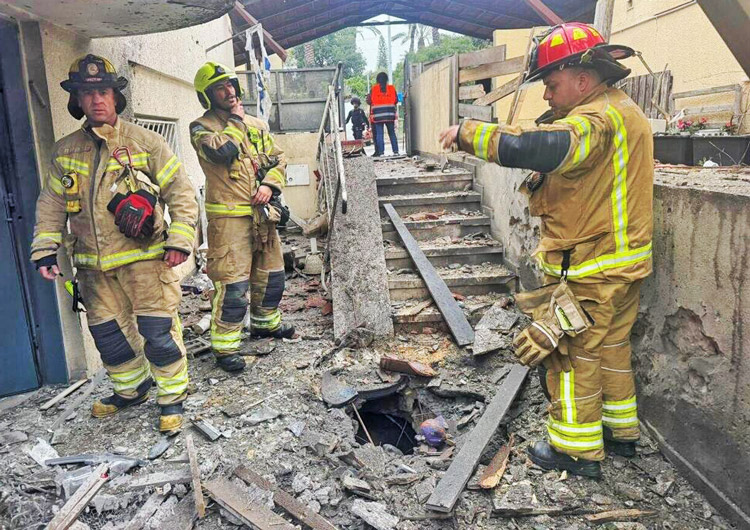
Tehran’s main targets in Israel have been civilian neighborhoods, favoring missiles with cluster bombs, which explode, sending deadly bomblets over a wide area, to maximize the number of casualties.
Iran workers face war, repression
The biggest fear of the bourgeois-clerical regime in Iran isn’t Washington, it’s the deep opposition to its rule among working people.
As soon as the war began, Basij thugs set up checkpoints to stop and interrogate passersby. Unable to find enough volunteers to staff the checkpoints, an indication of declining support, Fars News announced the organization will now accept volunteers as young as 12 years old.
The police and Islamic Revolutionary Guard Corps continue to arrest union activists. The Coordinating Council of Iranian Teachers Unions denounced recent arrests of union leaders in Aligudarz, Kermanshah and Tehran. On March 28 Siamak Sadeghi Chehrazi, a member of the Khuzestan Teachers’ Union, was arrested. The charge? Trying to bypass the regime’s blocking of internet access.
“Construction workers are penniless during wartime; we don’t even have insurance,” was the headline on a March 30 article in the government-funded Iranian Labour News Agency.
It quotes Davood Keshvari, head of the Qom Plasterers’ Association. Construction workers have always faced dangers from “falls from heights, structural collapses, and tool-related accidents, and the lack of proper insurance coverage,” as well as inflation, he said. The war has added new problems.
Because “workers have no alternative source of income” there should be a guaranteed minimum income when there are shutdowns due to wartime conditions, Keshvari said, but government officials just make empty promises.
The Council of Retirees of Iran is circulating an “urgent call” about the “necessity of protecting workers’ lives in wartime conditions.” The Islamic Republic has “launched attacks on energy infrastructure in the region,” meaning “workplaces have turned into a direct battlefield of this conflict.”
“Protecting human life must be an immediate and nonnegotiable priority,” the council said, despite bosses’ demands for workers to keep working. “In any workplace or industrial center where there is a risk of military attack, explosion, or contamination,” they said, “work must not continue.”
While the bombing and drone attacks make it difficult for Iran’s toilers to protest these conditions, opposition to the regime continues to spread.