In the midst of Washington’s economic and political war against Cuba, working people and medical and scientific institutions on the island are not only fighting to preserve the gains made through their socialist revolution, they’re finding ways to develop vital new medical treatments and advance social development for themselves and the rest of humanity.
Cuban President Miguel Díaz-Canel and scientists involved in research and development of NeuralCIM, a treatment that alleviates Alzheimer’s disease, met March 24 to take stock of the results so far. This could mark a turning point in combating a disease that robs the memory, independence and quality of life for millions of elderly people in the world. And they’re ready to share their discovery with others.
Developed by Cuba’s Center for Molecular Immunology (CIM) over the last 15 years, the drug, also known as NeuroEPO, has been through several years of clinical trials with extraordinary results.
A video produced by journalists for Belly of the Beast shows some of the 52 patients being treated by Bill Blanchet, a physician in Colorado. They travel to Cuba to receive the medication. Each describe their improvement. Another soon-to-be released video, “Teresita’s dream,” follows the work of Cuban scientist Teresita Rodríguez in finding the treatment.
Blanchet says that before taking the drug one patient “could not name her grandchildren. She could not tell me what day of the week it was.” Six months later, he spoke to the patient’s daughter about the impact of the treatment. Now “she’s so good,” the daughter said. “She dances, she’s socializing, she’s her old self again.”
The results of the first clinical trial are available on the U.S. National Institute of Health website. They show 54% of the people treated with the drug showed improvement and 30% were stable at the end of the first year. Blanchet said at the end of three years, the same groups still showed no advance of the disease. No other medication for Alzheimer’s has had similar results.
Alzheimer’s is the seventh leading cause of death in the United States. In Cuba, some 160,000 suffer from dementia, with 70% caused by Alzheimer’s disease. Last year NeuralCIM was approved by Cuba’s Ministry of Health for use in patients with mild to moderate Alzheimer’s.
“The production of NeuralCIM implies a big challenge,” Dr. Eliseo Capote said at the meeting. The key obstacle is the stepped-up economic sanctions the U.S. government has imposed on Cuba that prevent imports of equipment and materials for the development of medications. “It’s a dream we will try to make possible, finding all the mechanisms to guarantee the product to all the Cuban patients that need it,” Capote said.
Since the revolution overthrew capitalist exploitation, Cuba has made historic advances in the field of medicine, as well as medical research. It was the only underdeveloped country to develop, not one, but five vaccines against COVID-19, and to have vaccinated virtually its entire population. It has developed products like Heberprot-P, a treatment for healing diabetic foot ulcers, sharply reducing the number of patients who have to undergo amputations, among others. Because of Washington’s trade sanctions, however, none of the medicines produced in Cuba can be exported to the U.S., denying access to those who need it.
How has a small country like Cuba been able to make these achievements?
Working people in Cuba took political power in 1959 and set out to make the first socialist revolution in the Western Hemisphere. The abolishment of the profit-over-all operation of capitalism has opened the door to important cultural and scientific accomplishments. Cuba’s research and medical institutions collaborate with each other to produce treatments needed by millions.
U.S. rulers target Cuba’s example
Over the last seven decades, the U.S. capitalist rulers — under both Democratic and Republican administrations — have constantly pushed to discredit and destroy the example of Cuba’s socialist revolution. In their latest attempt, President Donald Trump’s administration has imposed an oil blockade that is causing severe shortages of fuel, food and medication aimed at forcing the Cuban people and government to bow to Washington’s demands.
“The embargo, and then the most recent, I don’t even want to call them restrictions,” said Ralph Gregory, one of Blanchet’s patients, “it’s just cruel.”
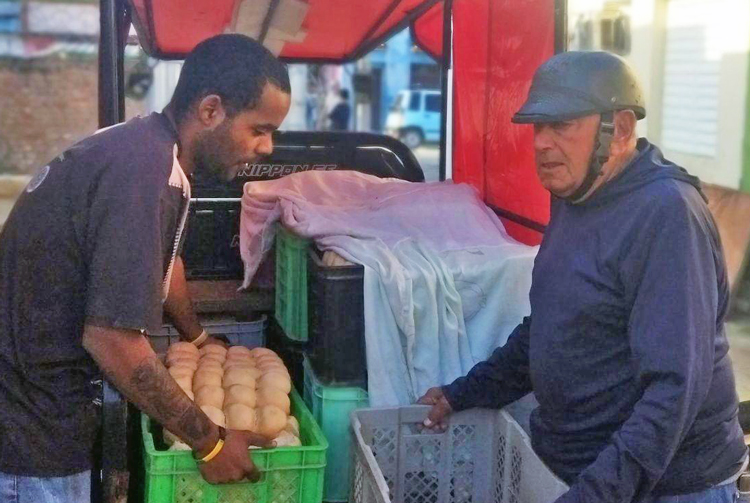
Working people in Cuba, however, are utilizing their creativity and solidarity to protect the most vulnerable from the effects of the brutal oil blockade. One example is Gerardo Díaz, a 92-year-old retired truck driver, who volunteers to help out at the José Martí Pediatric Hospital in Sancti Spíritus province. Riding his electric scooter he helps transport supplies and medical personnel.
“I bring the bread every day” to the hospital, Díaz told Radio Sancti Spíritus. He wakes up at 5 a.m. to go to any bakery that has bread that day. “Because of the situation we’re confronting,” Díaz says he has to travel to different ones. He volunteers for several hours at the hospital picking up whatever else is needed. Afterward, he “picks up a few fares to make a little money.”
“Gerardo does not work for glory or nostalgia,” wrote journalist Yosdany Morejón for Radio Sancti Spíritus. He does it because he feels useful. “He’s conscious that every bag of bread he delivers to the kitchen is part of a hospitalized child’s care.” He does it, and “doesn’t demand recognition. He just goes on doing it.”