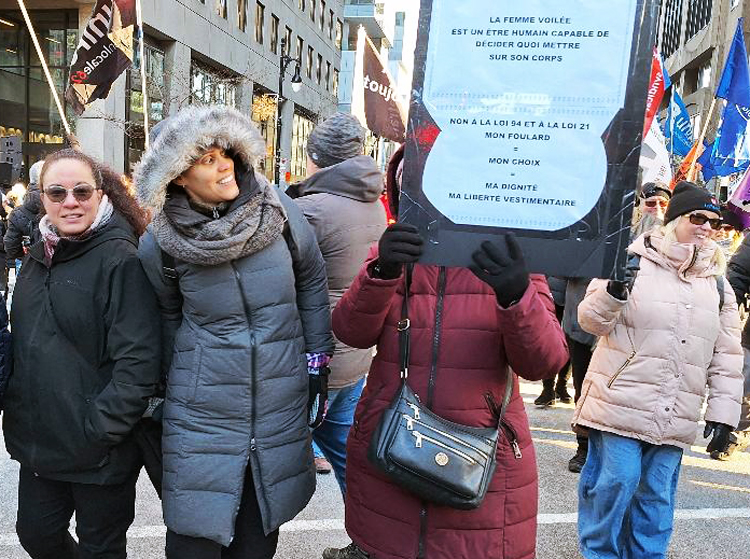
MONTREAL — On March 26 the Supreme Court of Canada concluded a four-day hearing, one of the longest in its history. It focused on challenges to Quebec’s use of the “notwithstanding clause” of the 1982 Canadian Constitution to prevent legal challenges to Law 21. The Quebec law prohibits many public workers from wearing religious clothing or symbols, such as Muslim women wearing head scarves, Jewish men wearing kippahs or Sikhs wearing turbans.
The “notwithstanding clause” was introduced by then Prime Minister Pierre Trudeau because the Constitution’s protections of basic freedoms in the Charter of Rights and Freedoms were “too powerful.” The clause allows the federal and provincial governments to vote to set constitutional rights aside, supposedly only to be invoked in the most unusual circumstances.
The Quebec government of Premier Francois Legault’s Coalition for the Future of Quebec passed Law 21 in 2019, claiming elementary and secondary school teachers and other municipal employees wearing religious clothing undermines “secularism.”
After what became Law 21 was introduced in Quebec’s National Assembly, several thousand people protested in the streets of Montreal calling for the bill’s withdrawal. The Autonomous Federation of Education, Quebec Federation of Women, Montreal Labor Council of the Quebec Federation of Labor, English Montreal School Board and others opposed this attack on democratic and religious freedoms.
In 2021 Judge Marc-Andre Blanchard of the Quebec Superior Court ruled that even if Law 21 does violate several “fundamental rights” in the Charter of Rights and Freedoms, the government has the legal right to invoke the “notwithstanding clause” to override them. In 2024 the Quebec Court of Appeal upheld Law 21 on the same basis.
In January 2025 the Supreme Court agreed to take up a challenge to Law 21 led by the Canadian Civil Liberties Association, and included the Canadian Labour Congress, Public Service Alliance of Canada and the Quebec League of Rights and Freedom.
Meanwhile, the Quebec government expanded its legal assault on democratic freedoms. Its Law 94 in 2025 extended the ban on wearing religious clothing to all school support staff and volunteers, including janitors, secretaries and cafeteria workers, as well as parents picking up their children. And public institutions like the Jewish General Hospital would no longer be allowed to offer menus based exclusively on religious tradition, for example, halal or kosher meals.
Last November the government introduced Bill 9, which would extend discriminatory restrictions to day care centers and private schools. The Canadian Civil Liberties Association denounced this as “another assault on religious freedoms, equality, and basic human dignity.”
Debate over ‘notwithstanding clause’
On the Supreme Court hearing’s opening day, the English Montreal School Board; World Sikh Organization; National Council of Canadian Muslims; Lord Reading Law Society, which speaks for Jewish lawyers; and the Canadian Civil Liberties Association all argued Law 21 violates fundamental democratic freedoms.
The Autonomous Federation of Education union said that provinces have been increasingly implementing the “notwithstanding clause” in recent years in ways it was never intended to be used.
Isabelle Brunet, representing the Quebec government, told the court that Quebec can use the “notwithstanding clause” however it wants, since it effectively shields government laws from court scrutiny. Brunet also argued a previous Supreme Court ruling in 1988 confirmed that the Charter of Rights and Freedoms allows the government to invoke the clause without restrictions. Those challenging Law 21 have asked the court to revisit that decision.
Government imposition of the “notwithstanding clause” has been used in Alberta to pass an anti-strike law against 51,000 teachers in 2025.
CL against attacks on rights
In fall 2022 Communist League leader Steve Penner submitted a paper to the federal Public Order Emergency Commission arguing for rejection of the government’s use of the Emergencies Act against truckers and their supporters protesting in Ottawa the previous February.
“The dictatorial powers embedded in the Emergencies Act” are in harmony with the “notwithstanding clause,” Penner wrote. “The Communist League calls for the repeal of the Emergencies Act.”
Fifty thousand school workers in Ontario, organized in the Canadian Union of Public Employees, won a major victory in 2022 by defeating an anti-strike law, despite the provincial government’s attempt to use the “notwithstanding clause” to shut down their strike. With the support of the entire labor movement in Ontario, they defied the government, setting up picket lines throughout the province and holding a 15,000-strong rally in Toronto.