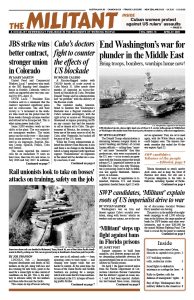
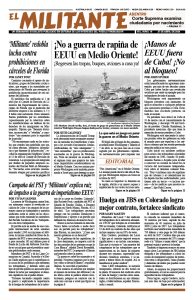
A Russian-flagged tanker with 730,000 barrels of crude arrived in Cuba March 31. After nearly three months of imposing an across-the-board oil blockade on Cuba, President Donald Trump said his administration had “no problem” with the delivery of the Russian crude.
The capitalist media, however, failed to mention that Washington’s blockade was a flagrant violation of Cuba’s national sovereignty, with the right to buy or receive oil. Washington threatened to impose punishing tariffs on any country that had the temerity to sell or donate oil to Cuba. The government of Mexico, for instance, has been one of the main sources of oil for Cuba, after Venezuela, but backed off because of the U.S. threat.
While the Trump administration allowed the delivery from Moscow, it also said there is no change in the blockade, which is being imposed with bipartisan support. “Humanitarian” oil shipments to the island will be decided on a case-by-case basis, it said.
The use of the term “humanitarian” provides cover for further U.S. intervention in Cuba’s internal affairs, and hides the primary cause for the lack of fuel and basic resources in Cuba: the U.S. rulers’ brutal assault on its economy. For over 60 years, Washington has waged this economic war against the Cuban people, with the goal of bringing down Cuba’s socialist revolution.
Cuban authorities have gone into high gear to process the crude, but it will not be ready for distribution until the second half of April. It will be used for “electricity generating plants and to produce liquefied petroleum gas for cooking in critical facilities, like hospitals and other in-patient facilities,” and “for some gasoline, to alleviate temporarily the strain we are confronting,” Irenaldo Pérez, deputy director of the Cuba Petroleum Union, said.
Washington’s oil blockade has crippled public services in the country, aggravated persistent blackouts and increased food shortages.
“Health care is one of the sectors most affected” by the U.S. assault, said Julio Guerra, Cuba’s deputy health minister, on the popular “Mesa Redonda” (Round table) television program March 27. He described the impact of Washington’s relentless financial and commercial war against Cuba. Directors of Cuba’s flagship medical institutions also spoke on the panel about the dire impact of the U.S. rulers’ punitive measures.
The damage is “tangible and objective,” said Guerra. Because of U.S. sanctions, Cuba’s medical system has faced severely restricted access to buying vitally needed medicines and products produced only by U.S. firms, including treatment for pediatric leukemia, specialized X-ray machines for detecting breast cancer, respirators and pacemakers. Cuba has to pay an estimated 30% more for medical products from outside the United States, with a 50% to 400% higher shipping cost than if they were bought 90 miles away in Florida.
The financial damage inflicted by the U.S. embargo in just 25 days is equivalent to the cost of producing a year’s supply of Cuba’s basic pharmaceutical products, he said. In less than a day, the damage from the sanctions is equivalent to the cost of buying a one-year supply of insulin to treat all of the country’s patients in need.
“It was already a challenge for Cuba’s public health system to function, because we have always had constraints with access to medications, equipment and replacement parts,” Eugenio Selman, director of the William Soler Pediatric Cardiology Hospital, said on Mesa Redonda. “All of that has worsened since January,” when the oil blockade went into effect.
Cuba is still standing
With the blockade bringing public transportation to a standstill, health authorities have organized for patients with chronic illnesses, on dialysis, and women expecting childbirth to stay in medical centers.
“We’re working very hard not to cancel visits or close hospital wards, and to keep beds open,” Guerra said.
“Imagine a hospital not only without electricity, but without water,” whose supply depends on the electrical grid, said Selman. Then the U.S. hypocritically says that Cuba is “a ‘failed state’” and is to blame.
The U.S. rulers portray the crisis in Cuba as a direct result of its socialist revolution and planned economy. They never explain that Cuba’s cradle-to-grave health care system — including the highest doctor-to-patient ratio in the world, as well as a life expectancy and infant mortality rate on par with the United States — is a conquest of that revolution. Nor that in Cuba health care is a right, not a commodity.
To face the effects of the oil blockade, the Cuban government is stepping up efforts to install solar panels in hospitals and clinics, but it’s far from covering the need today. When blackouts hit, hospitals rely on emergency generators, which sometimes can take a few crucial minutes to come online. Doctors and nurses have to dash to respirators to hand-pump air to keep babies breathing until the generators kick in. Outages sometimes hit in the middle of surgery, with equipment monitoring vital signs going dark and patients under anesthesia.
The determination and commitment of the Army of White Coats, as Cuban health workers are known, is inspiring. “We continue practicing medicine,” a surgeon at the Calixto García Hospital told the Militant, “even when we have to do surgery under the light of our cellphones, painstakingly charged at home during the few hours when we get electricity in the middle of the night.”
“The arrival of a ship with oil to Cuba is not what’s news,” Miguel Cruz, a journalist for the Cuban daily Granma wrote April 6. “What is news is that despite the extraterritorial laws, threats and persecution of the superpower, Cuba is still standing, exercising its right to exist.”
Claudia Kaiser-Lenoir in Boston contributed to this article.