

The Donald Trump administration is alternating between arrogant threats to restart bombing and flattery of current Iranian officials — calling them “smarter” and more “reasonable” than their predecessors, who were assassinated in the U.S. war — to try to reach an agreement with the Iranian regime that would advance U.S. imperialist interests in the Middle East. That’s also why Washington is pressuring Israel to halt its defensive war against Hezbollah, Tehran’s proxy, in Lebanon.
After 21 hours of negotiations in Islamabad, Pakistan, U.S. and Iranian negotiators headed home April 12 without an agreement. They are set to meet again, with the White House saying it could happen soon. The tenuous two-week ceasefire that ended the 40-day war expires April 22.
Tehran threatened to attack nearby Arab states and to keep the Strait of Hormuz shut down, but still sent a 70-person delegation to the talks in Pakistan, including Speaker of Parliament Mohammad Bagher Ghalibaf, Foreign Minister Abbas Araghchi and Ali Akbar Ahmadian, secretary of the Iranian Defense Council. This is an indication both of Tehran’s desire to reach an agreement and of divisions within the bourgeois-clerical regime.
The U.S. delegation was headed by Vice President JD Vance, along with Trump’s son-in-law Jared Kushner and Special Envoy Steve Witkoff.
Trump later told Fox News that “we got just about every point we needed except for the fact that they refuse to give up their nuclear ambition,” and to reopen the Strait of Hormuz.

An Iranian official reiterated Tehran’s oft-told lie that “Iran is not seeking to acquire nuclear weapons,” that it just wants “the right to nuclear energy for peaceful purposes.” In fact, until Israeli strikes set their program back, the reactionary capitalist regime in Iran had been enriching uranium to 60% purity, a level that has no use for electric generation.
The Trump administration says that Tehran “will never have” nuclear weapons. That “right” is reserved for the U.S. rulers who have more than 3,700, and other regimes that already have nuclear weapons.
According to the Wall Street Journal, Washington is demanding that Tehran agree to a 20-year “moratorium” on nuclear enrichment. In exchange, Washington would “unfreeze” hundreds of millions of dollars of Iranian funds and relax sanctions.
The U.S. attacks that started Feb. 28, accompanied by defensive strikes by Israel, likely destroyed more than 60% of Tehran’s missile launchers and at least 1,500 of the 2,500 ballistic missiles it had before the start of the war. U.S. strikes took out most of the ships in the Iranian navy, but not smaller speedboats capable of attacking ships as well as laying mines in the Strait of Hormuz.
U.S. and Iranian blockades of strait
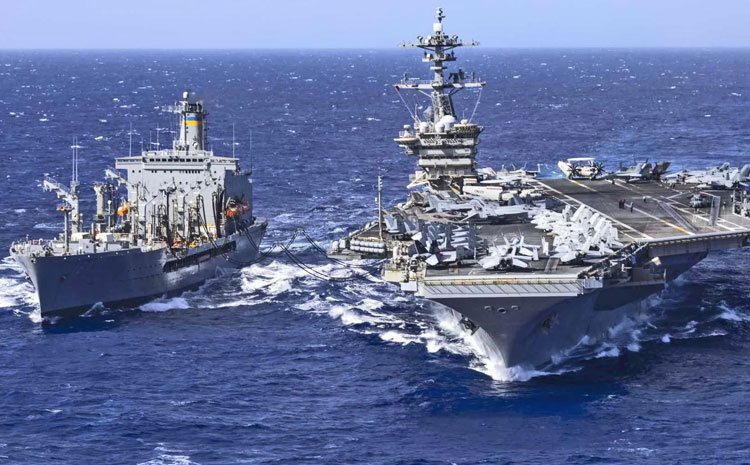
In response to Tehran’s threat to keep the strait closed unless ships pay hefty tolls to Iran in bitcoin, Trump began a U.S. blockade April 13 that will bar all ships from docking at Iranian ports. Tehran threatened to retaliate.
Since the ceasefire began, Washington has made no mention of earlier demands on Tehran to end production of ballistic missiles capable of wreaking destruction on Israel, and that Iran’s rulers stop financing, arming and training Hezbollah in Lebanon, Hamas in Gaza, the Houthis in Yemen and anti-Israel militias in Iraq.
It’s clear that nothing the U.S. government is doing is aimed at defending the existence of Israel as a refuge from Jew-hatred and pogroms or at aiding the working people of Iran to get the terror regime there off their back. The Trump administration’s goal is to advance the U.S. imperialist rulers’ plunder of the oil, gas and other resources in the region, while sidelining U.S. rivals.
Tehran’s expansionist course
Though militarily and economically battered, the bourgeois-clerical regime in Iran is determined to rebuild its military capability and its proxy forces throughout the region. That’s because this regime comes out of the counterrevolution that dealt serious blows to the popular revolution that overthrew the U.S.-backed dictatorship of the Shah of Iran in 1979. Its rule is threatened if it can’t extend its reactionary course outside Iran’s borders.
Its goal is to destroy Israel — and eliminate the Jews who live there. This is why Israel’s war — unlike Washington’s — is a defensive one aimed at not just eliminating Tehran’s ballistic missiles, but also the factories that produce the missiles and rocket launchers and its nuclear-processing facilities.
The biggest obstacle to Tehran
The biggest obstacle to Tehran’s reactionary course are the working people and oppressed nationalities in Iran.
Despite the massacre of 7,000 anti-regime protesters in early January, working people and students renewed public protests, from significant at-graveside actions of those gunned down to marches on university campuses. The opening of the war on Feb. 28 shut down the protest movement — for now.
To try to prevent a new rise of struggles by workers and oppressed nationalities — its biggest fear — the regime has restricted internet access to 1% of prewar levels, keeping most unions, student organizations and others from getting out more than an occasional message.
During the war, it brought in hundreds of thugs from the Popular Mobilization Forces, its proxy force in Iraq, and from the mostly Afghan Fatemiyoun Division of the Quds Force, which fought for the Bashar al-Assad regime in the civil war in Syria, to parade through the streets of Tehran and other cities to intimidate opponents of the regime.
According to human rights groups, in the past year the regime has executed more than 1,600 prisoners, the highest number since 1989. These executions continue daily.
But this has not prevented opponents of the regime from finding ways to continue to discuss, debate and look for new opportunities to organize.
The Coordinating Council of Iranian Teachers’ Unions reported April 10 that Manouchehr Aghabigi, a leader of the union in Kermanshah, was released on bail after three days in jail. While welcoming his release, the union called for “an immediate end to unlawful actions against teachers, the dismissal of court cases, and the recognition of the right to organize and engage in free union activity.” Aghabigi is just one of numerous arrests of union activists in the last several months.