LINCOLN, Neb. — Increasingly frequent derailments and deaths of rail workers on the job, along with less and less training for new hires, point to the need for a union fight to take control of conditions on the job. This is the only way to advance safety for rail workers and those who live near the tracks.
This comes on top of bosses reducing crew size in all railroad crafts — from operating crews to track repair — and running ever longer trains that are harder to control. At the same time, the bosses of the Union Pacific and Norfolk Southern are pushing for a merger, which will create the first transcontinental railroad in the U.S. in hopes of boosting profits further.
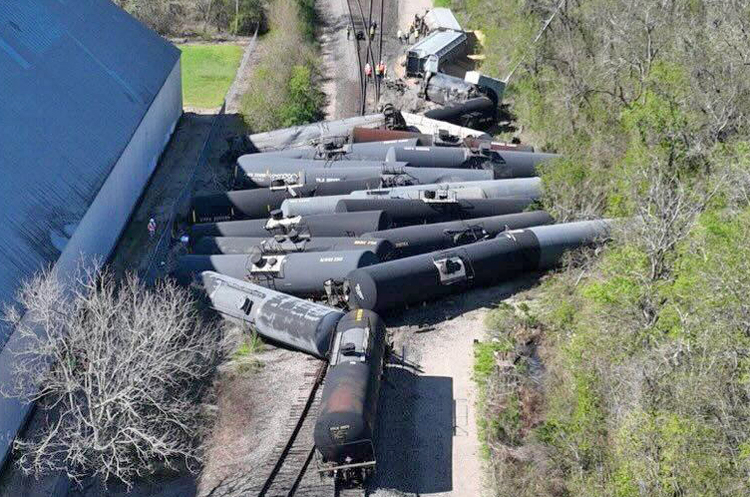
There were at least nine major derailments on the two railroads between Feb. 6 and April 9. They blocked highways, damaged an interstate bridge, and disrupted freight and passenger trains in seven states. A Union Pacific train that derailed in Arizona April 4 was 14,500 feet long — nearly 3 miles.
Three crew members were injured in an April 9 derailment in Franklin, Ohio. One of the cars that didn’t derail — a matter of luck — was filled with argon, a colorless, odorless gas that poses a major risk of asphyxiation by displacing oxygen in confined spaces.
The threat of what can happen in a serious derailment was shown in the disaster that befell the residents of East Palestine, Ohio, on Feb. 3, 2023. Fifty cars were put on the ground, including 20 containing hazardous material. Some cracked open, polluting area streams that flow into the Ohio River. In their drive to get profitable traffic moving again, Norfolk Southern bosses got government officials’ permission to pierce and set on fire five cars containing highly volatile vinyl chloride, which exploded and burned, sending toxic chemicals for miles around.
A year later, the Federal Railroad Administration ruled that railroads need to provide and train their employees to carry and use an emergency escape breathing apparatus if exposed to chlorine or other toxic inhalants following a derailment.
But rail workers told the Militant the apparatus only provides 15 minutes of protection and that the training they received consisted of watching one 30-minute video. When this worker-correspondent was in the military, I was trained for weeks in how to properly use a gas mask.
The railroad bosses are on a drive to increase income and payouts to their investors. Central to this course is reducing the number of workers, with the remainder forced to do more. The workforce on the six Class 1 railroads in North America was 13.7% lower in November 2025 than a year earlier. Overall rail employment is at its lowest point in decades. This, along with cuts in training, is a key cause of the increasing number of derailments.
On Feb. 23, Jeremy Charles, 39, an Amtrak maintenance worker and member of the Brotherhood of Maintenance of Way Employes Division, was killed when he was struck by a train near Lancaster, Pennsylvania. Charles’ union says he was using a jetpack to clear snow out of switches, which meant it was most likely he didn’t hear the approaching train.
“Before the bosses eliminated so many railroad workers, track maintenance crews were large enough to help keep each other out of harm’s way, to warn fellow workers of oncoming trains,” Paul Swanson, a retired track worker and union member in Colorado, told the Militant.
Dangerous cuts in training
A U.S. railroad conductor, who declined to give his name for fear of retaliation by bosses, told the Militant his recent engineer training class “lasted only three weeks, cut from five weeks, and classes so large, so short of simulators, that half the class had to share.”
By way of contrast, retired Amtrak engineer Jack Krueger, with over 40 year’s experience on freight and passenger trains in Iowa and Nebraska, told the Militant, “I was in a classroom for months learning the diesel and mechanical workings of a locomotive and then years of working with an experienced locomotive engineer to learn how to be aware of the train’s weight and speed, the track territory ascents and descents, speed on curves, signal systems, weather and many other factors, as any error can cause a derailment.”
Since the disaster in East Palestine, a discussion has continued among rail workers on what needs to be done to meet the attacks of the rail bosses and their deadly consequences. A bipartisan coalition of capitalist politicians is pushing for passage of a Railroad Safety Act, which would add more regulations on train operation.
On March 8, the liberal Washington Post ran an editorial against it. The paper’s editorial board says the act’s mandate for a railroad operating crew of two, adding sensors to detect overheated wheel bearings every 15 miles, and increased inspections of railcars by certified mechanics is too expensive to impose on the rail bosses.
What needs to be done
But the real question is deeper. Government regulations have proven to be ineffective in defending rail workers’ safety. They’re passed after some disaster, but under pressure from the rail bosses, fall into disuse as time passes.
“Working people and their unions do not need more laws and regulations that tie workers to a government that takes the side of the bosses, and where the next administration can overturn any laws,” Lance Anton, a SMART-TD conductor with 15 years’ experience here, told the Militant. “We need to use our union power to organize and fight for safe working conditions and to support working people like in East Palestine, where people are still fighting for guaranteed health care for life.”
“Our unions need to demand the bosses hire thousands of workers, with control over their jobs, to run the trains and maintain and inspect equipment and trackage safely,” Naomi Craine, a freight rail conductor who is the Socialist Workers Party candidate for U.S. Senate from Illinois, told the Militant. “Trains should have a maximum of 50 cars and a crew of four, two on the head-end and two on the rear. These demands would extend protection both to rail workers and to those living, working or driving near the tracks — all in the interest of the working class.”