
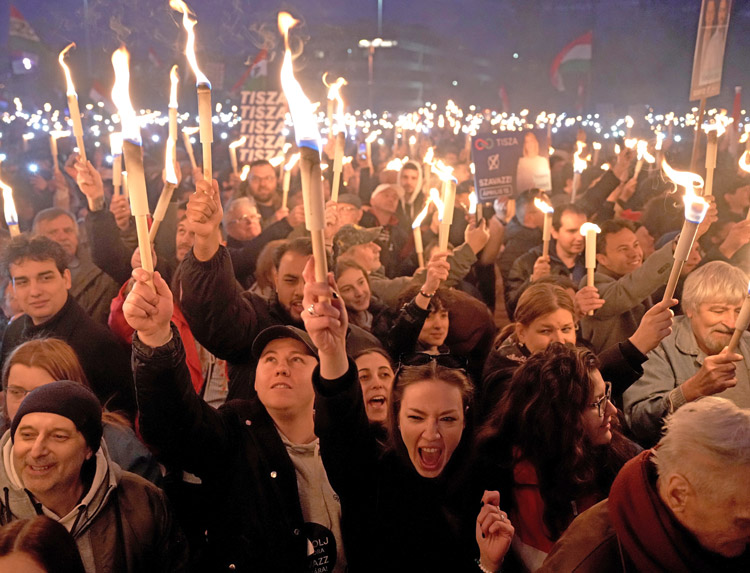
Hungarian Prime Minister Viktor Orban and his Fidesz party, in power for 16 years and backed by both the Kremlin and the Donald Trump White House, were heavily defeated in elections April 12. Peter Magyar’s moderate conservative Tisza party won over two-thirds of seats in parliament.
The vote reflects deepening opposition to Orban’s support for Moscow’s war against Ukraine and the worsening economic conditions faced by working people under his government as the crisis of capitalism deepens.
Magyar spoke to thousands of cheering supporters. The vote was a “choice between East and West,” he told the media, that is between the Vladimir Putin regime in Moscow or the bloc of capitalist governments in the European Union, dominated by the rulers of Germany and France. Hungary, a landlocked central European country, has a population of less than 10 million. Magyar pledges to replace Hungary’s currency with the euro by 2030.
“Everyone in Hungary knows that Ukraine is the victim in this war,” Magyar told a press conference the day after the elections. “I say to them what would you do if Russia invaded Hungary? What counties would you give up?” He said no one has the right to decide peace terms on behalf of Ukraine’s citizens, adding he would tell Putin “to end the killing after four years and end the war.”
During his 16 years in office Orban entrenched his power by tightening his party’s control of state and media institutions. He drew closer to Moscow as he sought access to cheap Russian petroleum.
Magyar, a former Orban insider, tapped into Hungarians’ discontent over soaring living costs, poor health care and the decline of other public services. Inflation hit 17% in 2023, with food price hikes outstripping those faced by workers in other countries in Europe. Magyar targeted corruption and patronage under Orban, which, he said, enabled “a few families to own half the country.”
Magyar’s victory was hailed by leaders of most governments in the EU, relieved that Orban’s attempt to obstruct their policies is over. Orban blocked EU loans to Ukraine after Moscow’s invasion and stalled EU sanctions on Russia.
Trump, Putin backed Orban
Both the White House and the Kremlin openly tried to influence the elections. Just days before the polls, Vice President JD Vance visited Budapest to campaign with Orban.
Magyar says Hungary will continue to be reliant on Russian energy “for some time.”
For years, Orban relied on support from people in rural areas to consolidate his grip on power. Party supporters handed out pre-election gifts of food or even cash, helping cement four electoral victories.
A recent documentary, “The Price of a Vote,” revealed how hundreds of thousands of impoverished Hungarians took up money-for-vote schemes, like offers of government jobs and access to everything from firewood to health care and prescription medicines, all dependent on voting for the Fidesz party.
But as conditions worsened the bribes had less effect.
“They hand it out so we vote for Fidesz,” retired factory worker Ibolya Csiki told the Financial Times three days before the polls. She lives on $140 a month and was headed to a truck giving out food parcels to get a packet of ham, bread and Easter staples. “In 16 years Orban could not help me,” she added.
Asked about whether she would allow a Fidesz “helper” to accompany her to the booth on voting day, she responded, “No way. My vote is mine alone.”
“Russians go home!” Tisza supporters chanted during Magyar’s victory celebrations.
Hungary won its independence from Austria during the uprisings that swept Europe after World War I. Decades later the country was dominated by the Stalinist regime in Moscow, which crushed the 1956 Hungarian Revolution, the working-class uprising against the Stalin-backed regime in Budapest.
Today working people of Hungary are being drawn more deeply into world politics as they look for ways to defend themselves.