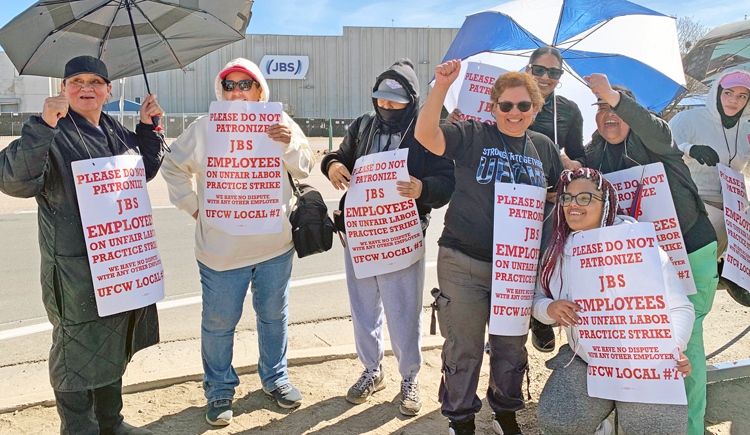
United Food and Commercial Workers Local 7 members who work at the JBS flagship beef slaughterhouse in Greeley, Colorado, voted to ratify an improved new two-year contract by 93% April 12.
UFCW Local 7 President Kim Cordova said in a statement that the contract registered significant gains and no concessions. She said their victory is “a testament to the workers who stood on the picket lines for three weeks through extreme weather and refused to be disrespected. This is what union power looks like.”
Some 3,800 workers work on two shifts at the plant. The vast majority are immigrant workers. The union notice on the strike vote — like many local union materials — was distributed in six languages, English, Haitian Creole, Spanish, French, Urdu and Somali.
The union reported the contract calls for an immediate 70 cents an hour raise, then two 40-cent raises, in July 2026 and July 2027. In addition, workers will get an immediate $750 bonus and another $500 payout in April 2027. Cordova said this adds up to a 33% larger gain than bosses had insisted on in their “last, best, final” offer that provoked the strike.
Important gains were won on another key strike issue. JBS bosses had forced workers to pay for required worn-out or broken protective equipment — like mesh gloves and aprons that can cost hundreds of dollars. If workers didn’t pay, the cost was taken out of their paychecks.
The new contract ends this. The company will now provide without cost the equipment that is crucial for workers’ safety.
Other gains, Cordova said, include more sick time, longer bereavement leave, a capped health care contribution to the company’s 401(k) plan, and only two years to get back to the bargaining table.
Leticia Avalos, a worker at JBS, told Denver’s TV 7 how bosses showed their disdain for employees with personal protective equipment. “I see a lot, members that they get equipment, sometimes it’s already used and it’s not new,” she said. “The company sometimes charges them the full price, like if it was brand new.”
“The strike worked,” Cordova said. “Had we not struck, they never would have replaced that unsafe equipment. It was a life or death situation.”
The company tried to dismiss the extent of the gains workers won. “The company expressed disappointment that UFCW Local 7 leadership chose to eliminate the historic pension benefit that was part of the national agreement negotiated last year.”
But Cordova pointed out this simply wasn’t true. There has never been a pension in the Greeley plant. And workers there had decided not to opt into it, because it was a worse plan than the 401(k) they already have, to which bosses are required to contribute.
The victory at JBS helped make the union there more united and stronger. The strike in Greeley was watched closely by packinghouse workers across the country, as well as defenders of the rights of immigrant workers. Packinghouse and other unionists came from JBS plants and other places in Colorado and across the country to show their solidarity.
Cordova said the outpouring of support was felt every day on the picket line.
Some 2,500 Teamster-organized workers at the Cargill packinghouse in Fort Morgan, Colorado, 50 miles east of Greeley, are in negotiations over a new contact today.