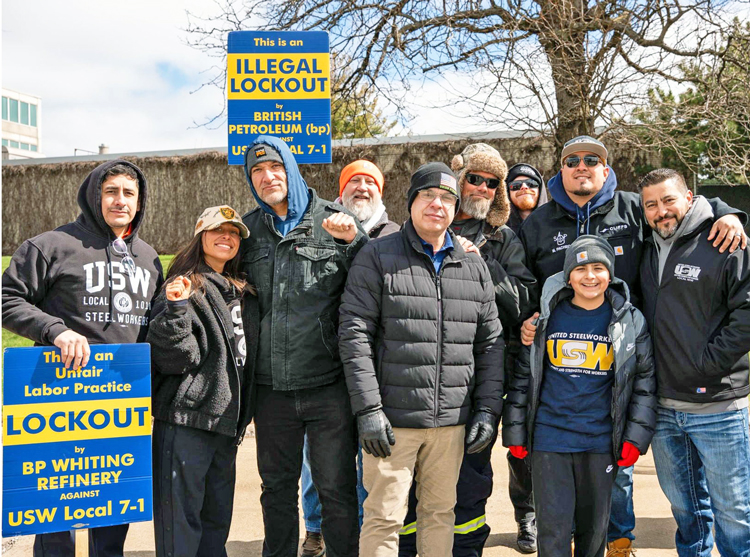
WHITING, Ind. — Bitter boss lockouts of workers at both the British Petroleum oil refinery here and the Northern Indiana Public Services Company across the northern part of the state continue.
United Steelworkers Local 7-1 leaders say the main concerns at BP are over safety and staffing. The union is fighting to keep the company from cutting union jobs, given the frequency of leaks and fires at the BP refinery, which was built in 1898. They say the bosses’ push to increase the number of outside contractors will make conditions even more unsafe.
The USW says it has lost 300 union jobs since the 2015 strike because the bosses don’t replace union workers who retire. Instead, they hire more outside contractors, who aren’t familiar with the refinery or how to operate the equipment safely or handle the almost weekly breakdowns that occur.
In a video shown to workers, refinery Manager Chris DellaFranco said the picture painted by the union is untrue. “Safety is our top priority,” he claimed. At the same time, he admitted BP initially proposed eliminating 200 union jobs at the refinery when contract talks kicked off in January. The company is now proposing to eliminate 65 union jobs, DellaFranco said. “Those employees impacted would receive a generous lump-sum payment, in many cases equivalent up to a year’s salary. Our proposal is to shift select work from BP employees to our third-party contractors who can provide better training and more efficiently deliver that work.”
The union explains this is a serious safety question. “Fires are common enough at the refinery, where flammable substances are everywhere all the time, that it has its own fire department so it does not have to rely on outside fire departments in Whiting and Hammond,” Eric Schultz, the president of United Steelworkers Local 7-1, said in a statement to the press. The BP Whiting Refinery has 70 to 80 firefighters, including 15 on full-time, who are specially trained and in a position at the refinery to respond faster than the city fire departments.
Safety, work demands at NIPSCO
The same key question of safety faces the over 1,600 members of USW Locals 12775 and 13796 locked out by NIPSCO. They do power and gas company repairs, installation and disconnection as well as clerical work.
At their picket line in Gary, a picket who works on the coal line in one of NIPSCO’s power generation plants spoke to the Militant. He asked that we not use his name for fear of boss retaliation. He said they work four 12-hour shifts, and the company is pushing to be able to force them to stay another four hours whenever needed, then come right back for their regular shift. “And they want us to take an additional 120 hours on callouts per quarter, outside our regular shifts.”
He said the issue of outside contractors is posed at NIPSCO also. “How much of our work will they take? NIPSCO won’t tell us how many they have.”
The overtime makes it impossible for workers to have a balanced life, Paul Noveroske, a lineman for 25 years, told us at the union hall. “As a lineman, I’m going to work long hours. I already work at least 30% of the overtime they call for,” he said. “But now I have a newborn. How are you going to tell me I have to stay when I need to leave?”
“The narrative NIPSCO wants to give is that it’s about money, that we’re greedy,” Jon Grimley, Local 12775’s financial secretary who works as a dispatcher, said. “But money isn’t the issue. It’s the mandatory overtime and the holdovers. They don’t have enough people. There are just 14 linemen for the entire Gary district. There used to be 30.”
BP refuses negotiation
BP hasn’t negotiated with the union since the day the membership rejected by 94% the company’s “last, best, and final” offer.
Locked-out oil workers on the picket line say the company wants to gut the union. This is clear from their “offer” — a six-year contract outside the industry-wide pattern, cutting more than 100 jobs, slashing pay across most job classifications and giving up their bargaining and seniority rights.
Community support for the union continues to grow. When Militant correspondents got to the USW Local 7-1 union hall we were greeted by two locked-out operators who were setting up a huge smoker in the parking lot. They were smoking brisket, pulled pork, hamburgers, hot dogs and sausages to feed hungry pickets. Every day there is a big spread of lunch and dinner for pickets and their families. Signs supporting the union are everywhere, in area storefronts and home windows.
The union told the Chicago Tribune that BP security guards had provoked clashes on the picket lines that left union members injured, and they had filed reports with the East Chicago Police Department.
The union said a company security guard had “forearm-checked” a union member into a moving vehicle, and another picket was struck by a vehicle entering a gate to the refinery.
“Each of these violent incidents has left our members injured. That’s unacceptable,” a USW statement said.
A BP representative said the company is “unaware of the incidents” reported by the union.
While there have been no negotiations between the oil workers and BP, the unions at NIPSCO held two days of bargaining last week that led to a contract proposal.
The situation at NIPSCO remains tough. “They keep cutting the manpower,” USW Local 12775 Vice President Vern Beck told the Times of North West Indiana. “In Gary, we went from 30 linemen to 14 linemen. We have half as many workers but the same amount of work. Plus, now we have 70,000 more customers.”
The union says it will organize discussion sessions on the offer next week. Beck said the union agreed to company insistence they pull their pickets down until a vote is taken.