
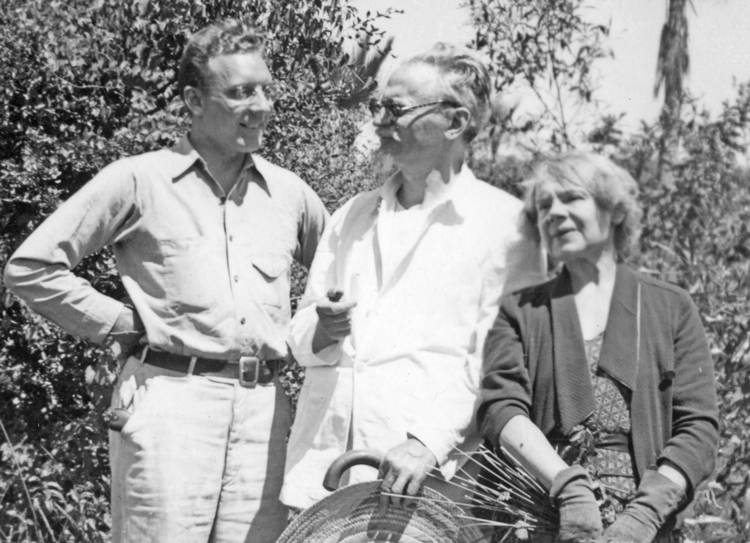
Leon Trotsky’s My Life is one of Pathfinder’s Books of the Month for April. Trotsky was a central leader of the 1917 October Revolution in Russia, second only to V.I. Lenin. Written during his first year of exile in Turkey in 1929, it documents his political life, including his fight to defend Lenin’s internationalist course against the bureaucratic counterrevolution led by Joseph Stalin. The selection is from the introduction, “With Trotsky in Coyoacán,” by Joseph Hansen, a young leader of the Socialist Workers Party and Trotsky’s secretary from 1937 until his assassination by Stalin’s secret police in 1940. Copyright © 1970 by Pathfinder Press. Printed by permission.
Working with Trotsky was a serious matter — he was no dabbler in politics and he found dabbling intolerable in others; but it was also an extraordinary school for the young comrades on his staff. The way he responded to the March, 1938, Moscow trial served as a model demonstration of the importance of timing in meeting a deadly challenge and converting it into an opportunity. It meant pushing everything else aside with the utmost decisiveness, rising above personal problems, concentrating on the work at hand with maximum energy and every resource available. It was a rare opportunity for those of us then in our twenties to see Trotsky in action as a political fighter in a very acute battle. …
[Hansen quotes Trotsky:] “I think that the work in which I am engaged now, despite its extremely insufficient and fragmentary nature, is the most important work of my life — more important than 1917, more important than the period of the Civil War or any other.
“For the sake of clarity I would put it this way. Had I not been present in 1917 in Petersburg, the October Revolution would still have taken place — on the condition that Lenin was present and in command. If neither Lenin nor I had been present in Petersburg, there would have been no October Revolution: the leadership of the Bolshevik Party would have prevented it from occurring — of this I have not the slightest doubt! If Lenin had not been in Petersburg, I doubt whether I could have managed to overcome the resistance of the Bolshevik leaders. The struggle with ‘Trotskyism’ (i.e., with the proletarian revolution) would have commenced in May, 1917, and the outcome of the revolution would have been in question. But I repeat, granted the presence of Lenin the October Revolution would have been victorious anyway. The same could by and large be said of the Civil War. …
“Thus I cannot speak of the ‘indispensability’ of my work, even about the period from 1917 to 1921. But now my work is ‘indispensable’ in the full sense of the word. There is no arrogance in this claim at all. The collapse of the two Internationals has posed a problem which none of the leaders of these Internationals is at all equipped to solve. The vicissitudes of my personal fate have confronted me with this problem and armed me with important experience in dealing with it. There is now no one except me to carry out the mission of arming a new generation with the revolutionary method over the heads of the leaders of the Second and Third International. … I need at least about five more years of uninterrupted work to ensure the succession.”
“It is a question of measures to restore to the proletariat, under new and onerous conditions, its historical leadership.”
—Leon Trotsky
Trotsky had just five more years to live, but it was not uninterrupted. During those five years he lived in constant insecurity, the target of reaction ranging from the Norwegian fascists to the implacable killers of Stalin’s GPU. Nevertheless Trotsky did what he could to pass on as much as possible of his experience.
Among the youngest of us who came to live with him and Natalia in the final years of their exile, L.D. did not speak directly of this problem. We felt it, however. Day in and day out, the life of the household was an engagement in building the Fourth International. The importance of continuity in program, in method, in succession of cadres, became part of our elementary thinking. All of us were committed, dedicated even, to this work as essential preparation for the coming revolutionary opportunities that history was certain to provide. Everything Trotsky himself did was directed toward this goal.
If a certain romanticism may be thought to attach to this, the impression is mistaken. In practice it amounted to hard work, learning how to handle details, following through efficiently without ever losing sight of the great ultimate objective. What separates this kind of party building from any other sustained and difficult enterprise is its purpose and goal which is to assure the survival of mankind and to make possible the expansion of civilization on a truly human basis.
In a short article on Rosa Luxemburg and the Fourth International, written in June 1935, Trotsky, arguing against the theory of the spontaneity of the masses and for the necessity of a Leninist party, put it like this: “Without the slightest exaggeration it may be said: The whole world situation is determined by the crisis of the proletarian leadership.”
This crisis, he continued, “cannot, of course, be overcome by means of an abstract formula. It is a question of an extremely humdrum process. But not of a purely ‘historical’ process, that is, of the objective premises of conscious activity, but of an uninterrupted chain of ideological, political and organizational measures for the purpose of fusing together the best, most conscious elements of the world proletariat beneath a spotless banner, elements whose number and self-confidence must be constantly strengthened, whose connections with wider sections of the proletariat must be developed and deepened — in a word: to restore to the proletariat, under new and highly difficult and onerous conditions, its historical leadership.”