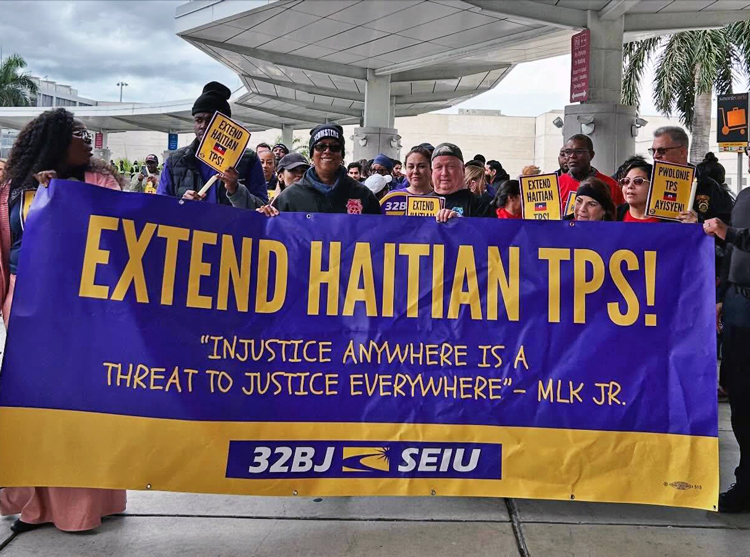
Support is building for a rally outside the Supreme Court in Washington, D.C., April 29, to demand a halt to the administration’s drive to end Temporary Protected Status for some 350,000 Haitians and 7,000 Syrians. Elimination of this legal status and the right to work it provides would both lead to deportations and swell the number of workers in the U.S. who live and work in fear of being expelled.
The rally will take place as the Supreme Court is hearing arguments in a case where a federal judge had paused the decision ending TPS for Haitians.
The U.S. rulers offer TPS to toilers from countries who face brutal regimes, wars or social calamities. It can last for up to 18 months, before a government extension needs to be considered. The program offers no path toward a green card. It covers some 1.3 million immigrants from 17 different countries today.
“Haitians in Springfield are workers in medical institutions, the school district, factory and warehouse workers and business owners,” Viles Dorsainvil, executive director of the Haitian Community Help and Support Center in Springfield, Ohio, told the Militant by phone. “If TPS is taken away, every single person will be affected — relatives, friends and co-workers.” Dorsainvil will be joining the April 29 rally.
TPS for Haitian immigrants was granted in 2010 after a devastating earthquake caused more than 200,000 deaths and widespread damage.
Since then conditions on the island have gotten worse. Criminal gangs have seized control of large areas of the capital, Port-au Prince, and beyond, terrorizing working people. At least a million people have fled their homes. In the first 11 months of last year alone, more than 8,000 people were slaughtered in gang-related violence.
Despite this, the Department of Homeland Security in November claimed, “There are no extraordinary and temporary conditions in Haiti that prevent Haitian nationals … from returning in safety.”
Yet the State Department urges U.S. citizens not to travel to Haiti! Last year Washington backed the deployment of a 5,550-strong, armed Gang Suppression Force there, an admission of the fact that stable capitalist rule has broken down on the island. The force is just beginning to be deployed.
On Feb. 2, U.S. District Judge Ana Reyes in Washington, D.C., indefinitely suspended the DHS decision to end TPS for Haitians, calling the order “arbitrary and capricious.” Reyes says the DHS failed to adequately consult with other government departments about conditions in Haiti, as it was obliged to do, before issuing the termination.
If the Supreme Court overturns Reyes’ ruling, Haitians would be subject to immediate deportation even as other legal challenges work their way through the courts.
The administration contends the DHS order ending TPS was carried out at the bidding of President Donald Trump, and the court ruling suspending it is an attack on the president’s executive authority. U.S. Solicitor General John Sauer claims the administration has the right to make rulings on TPS without being subject to any court review. He insisted the DHS has free rein to abolish protections contained in a program that was established by Congress.
Pits workers against one another
In her Nov. 28 order ending TPS for Haitians, Kristi Noem, then head of the Department of Homeland Security, tried to pit native-born workers against immigrants. She claimed Haitian visa overstayers “place an added strain on local communities by increasing demand for public resources, contributing to housing and health care pressures, and competing in an already limited job market.”
Her comments aim to divert workers away from the actual source of the problems we face — the drive by the bosses to offload the capitalist crisis onto our backs — and to scapegoat immigrants instead.
The Trump administration has terminated TPS for every country whose designation comes up for review, attempting to remove protection from deportation for some 1 million people. Many of its decisions on TPS face legal challenges. If the administration overcomes these court cases, the only countries remaining under the TPS program will be El Salvador, Lebanon, Sudan and Ukraine. And their designations are set to expire later this year.
The April 29 rally and protests leading up to it are organized by the National TPS Alliance and other groups. Planned events and activities are listed on the Alliance’s website.
Betsy Farley in Cincinnati contributed to this article.