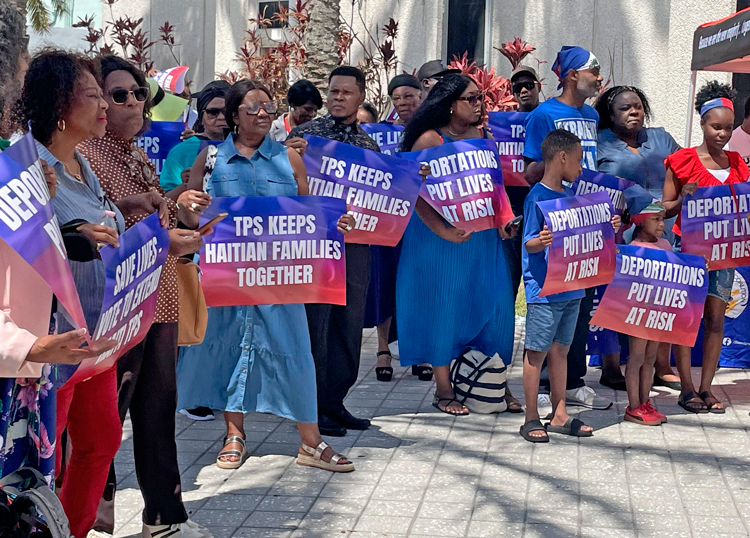
WASHINGTON — Several hundred defenders of the rights of immigrants, trade unionists and others rallied outside the U.S. Supreme Court here April 29, protesting moves by the federal government to terminate Temporary Protected Status for immigrants from Haiti and Syria. Under this program, immigrants can work and live in the U.S. However, they are subject to periodic review by the Department of Homeland Security.
The court heard oral arguments in two combined cases — one concerning some 350,000 Haitian immigrants and the other for about 6,000 Syrians. Appeals courts had earlier ruled against the government in both cases, and the Department of Justice had asked the Supreme Court to hold an expedited hearing to argue those rulings should be overturned.
In ruling against the government Feb. 2 U.S. District Judge Ana C. Reyes said, “Kristi Noem [then DHS head] has a First Amendment right to call immigrants killers, leeches, entitlement junkies, and any other inapt name she wants. Secretary Noem, however, is constrained by both our Constitution and the APA [Administrative Procedure Act] to apply faithfully the facts to the law in implementing the TPS program. The record to-date shows she has yet to do that.”
The rally was called by the National TPS Alliance, and backed by the Northern Virginia AFL-CIO, Casa de Maryland, African Communities Together, and Rebirth Inc., a Haitian group based in Salisbury, Maryland. Several unions sent delegations.
Keisha Holder, a member of Service Employees International Union Local 1199 who works at Brooklyn Hospital, said she came with 43 others on a bus from New York. “I am American born, bred and fed,” she said, noting she is African American. “But I am here because I have Haitian co-workers, fellow hospital and healthcare workers, who have been here for years. Why can’t that be permanent?”
“I was a teacher and trade union leader in Cameroon, and in 2016 teachers and lawyers organized strikes opposing the forced assimilation of the English-speaking western part of the country,” Austin Asaahtong, an organizer with CASA de Maryland, told the Militant. “Workers and students joined the protests, and the military responded with brute force and arrests. I spent three months in a U.S. detention center before I was released and then I joined the fight for TPS. Cameroonians received TPS status in 2022.”
“Whatever they decide will also affect all 17 countries under TPS,” Arnoldo Díaz, a coordinator of the National TPS Alliance, told the Militant. “Most cases seeking to defend TPS have been denied so far.”
Immigrants from Syria won protection under TPS due to the murderous war carried out by the Bashar al-Assad regime there. Haitians had fled a series of disastrous storms, outbreaks of disease, and rampant and uncontrolled gang violence and social breakdowns that make living in Haiti dangerous.
The State Department says people from the U.S. shouldn’t travel to Haiti because of “crime, terrorism, kidnapping, unrest and limited health care.”
Those who sat through the hearing, including reporters for both the New York Times and Wall Street Journal, said it appears the decision will be a close one.
The government argues the DHS head has total authority over the decision, and it cannot be challenged in court. But if this is true, why was the Supreme Court holding a hearing at all?
Justice Amy Coney Barrett seemed open to arguments by Ahilan Arulanantham, an attorney for the Syrians, who said, “The bottom line is the secretary can terminate TPS but he must turn square corners and follow the rules Congress has set.” The lawyers defending TPS say then DHS Secretary Noem was pursuing a political agenda and did not perform the required reviews of the situation in the two countries required to make a fair decision.
Chief Justice John Roberts, the Journal reported, also “seemed more skeptical of the government’s claims.”
A decision is expected in late June or early July.
* * *
The Department of Homeland Security, which had moved to cancel that protection, is fighting a legal challenge filed by five Haitians covered by TPS on behalf of all those threatened with deportation.
There are large concentrations of Haitians in Florida, New York and Boston, as well as smaller communities, like Springfield, Ohio, and Greeley, Colorado.
“It is cruel to threaten to deport those protected by TPS to Haiti, which is in an extremely uncertain situation right now where their lives would be at risk,” Paul Namphy, the lead organizer of the Family Action Network Movement, the primary sponsor of the protest, told the crowd.
Namphy recognized several area politicians, immigrant rights organization leaders, as well as UNITE HERE and the Service Employees International Union for their support to the fight to extend TPS for Haitians.
* * *
In February the Federal Court of Appeals for the Ninth Circuit ruled the U.S. government could proceed with ending TPS for people from Honduras and Nicaragua, even though the legal challenge to that will proceed. This means they could lose their work permits and face deportation.
“We have been here working hard, raising a family and paying taxes,” Brenda Munoz told the rally. “That’s why we are here fighting.” Several speakers said they are nearing retirement and will lose their retirement benefits if they’re deported. Kevin Cruz described how his father, a construction worker, had been stopped for a minor traffic violation and deported. “We’re fighting to keep families together,” he said.
Jacques Laurent of the Haitian American Chamber of Commerce spoke on behalf of Caribbean Georgia Votes. “Keeping TPS is a matter of humanity. We are asking the Supreme Court to see this is a question of saving lives.”