HAVANA — I first met Eulogio Rodríguez Millares in 2008 when he was Cuba’s consul in Monterrey, Mexico. He was accompanying Armando Hart, one of the historic leaders of the Cuban Revolution, on a weeklong speaking tour. Hart addressed hundreds of people at several meetings in Monterrey and Zacatecas.
In between events I had the privilege of spending some time with Rodríguez. I learned that, in addition to representing Cuba as a diplomat in several countries over the decades, his political activity goes back to the beginning of the revolution. His life is an example of how millions of working people in Cuba became different human beings in the battle to overturn capitalist rule and make a socialist revolution, while extending solidarity to freedom struggles around the world.
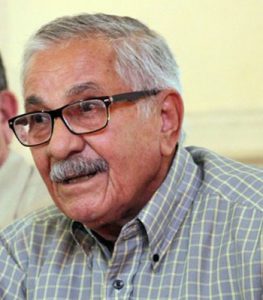
Last February I had an opportunity to meet up with Rodríguez during a trip to Havana. He agreed to sit down and tell me more about his life.
Rodríguez grew up in the 1940s and ’50s in the rural town of Güira de Melena, a center of the sugar industry southwest of Havana. “My father was an agricultural worker. He worked cutting cane or harvesting potatoes and other crops — wherever he could get a job. My mother was a washerwoman,” he said. “I started working in the fields when I was 8.”
In 1953, when he was 13, Rodríguez joined the revolutionary struggle against the Batista dictatorship.
What led him to join? “It wasn’t ideas,” he said. “It was because I was tired of being hungry. I was tired of discrimination because we were poor. I didn’t like seeing my mother unable to get medicine for her asthma.
“It was only later I understood why we needed a social revolution.”
Cuba had been ruled by a U.S.-backed dictatorship since 1952, when military strongman Fulgencio Batista overthrew the elected government of Carlos Prío. In response to the coup, Fidel Castro, who had graduated from law school two years earlier, set out to organize a movement to overturn the hated regime. On July 26, 1953, he led 160 young revolutionaries in an attack on the army garrisons in the eastern cities of Santiago de Cuba and Bayamo.
Although it was brutally put down, the attack had an electrifying impact on working people and youth across the island. It was the beginning of a revolutionary war that cost 20,000 lives — most killed by Batista’s thugs — and triumphed with the overthrow of the tyranny on Jan. 1, 1959.
In the revolutionary underground
In Güira de Melena, supporters of what became the July 26 Movement had become active after Batista’s coup. Rodríguez would sometimes be assigned as a lookout for their clandestine meetings. “The police paid no attention to me. They saw me as just a boy playing in the street,” he said.
He eventually got a job as a pharmacist’s assistant and was able to supplement the family income, especially during the long months between sugarcane harvests — the “dead season” — when there was no work. But soon Batista’s thugs arrested him for “subversive” activity.
“Fortunately, members of my Masonic lodge, who also were part of the revolutionary movement, helped get me out of prison,” he said. He had joined the Masonic youth when he was 13. They approached one of the landowners on whose farms Rodríguez’s father worked who happened to be a Freemason. “He was part of the bourgeois elite in the town,” and used his connections to get Rodríguez sprung.
“When the warden came to my cell and told me to go with him, I was sure they were going to kill me,” he recounted. “I told a cousin who was locked up with me, ‘If I disappear, get out the word that I’ve been murdered.’ To my surprise, I found the landlord waiting for me, and he told me to get into his fancy car.
“He asked, ‘Are you OK?’ He didn’t even notice I could barely walk from the torture that had left my testicles all swollen up.”
The landlord turned Rodríguez over to his parents. The next day, he returned and handed him a brand-new passport along with a one-way plane ticket to Venezuela.
“Look, I know you’re going to end up in jail again, and that’s going to create problems for me,” the landlord said. “So you’d better get out of the country now.”
Rodríguez said nothing, but thought to himself, “I’m the son of a guajiro [rural worker]. I’m 15. What am I going to do in Venezuela? So I went underground and continued my work with the July 26 Movement in Güira.”
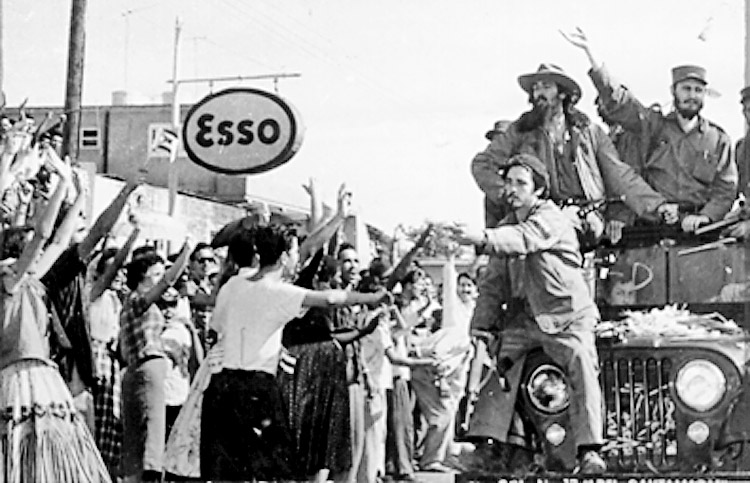
By the end of 1958, under Castro’s leadership, the Rebel Army and the July 26 Movement had defeated the dictatorship’s army. As Batista fled the country, millions responded to their call for a revolutionary general strike and popular insurrection on Jan. 1, 1959.
The July 26 Movement led working people to take control of Güira de Melena, as they did in towns and cities across the island. Rodríguez was one of the rebels who took over the barracks of the army’s Rural Guard.
After the Jan. 1 victory, he became part of the local leadership of the July 26 Movement. He joined the popular militias that were created to defend the new revolutionary government. He helped organize participation in the 1961 campaign in which more than 100,000 young volunteer teachers across the island wiped out illiteracy within a year.
Defending Che Guevara
In 1960 Rodríguez was elected to the leadership of the Association of Young Rebels, a fusion of the youth groups of the July 26 Movement, the student-based Revolutionary Directorate, and the pro-Moscow Popular Socialist Party (PSP). The organization subsequently became the Union of Young Communists (UJC).
A few years later the UJC leadership asked him to take an assignment in the World Federation of Democratic Youth (WFDY), made up of Communist Party youth affiliates and national liberation groups. He served as one of the WFDY vice presidents in the organization’s headquarters in Budapest, Hungary.
Rodríguez was one of three WFDY delegates to the 1966 Tricontinental Conference in Havana. The following year he participated in the Organization of Latin American Solidarity (OLAS) conference, also in Havana. These initiatives were part of the Cuban revolutionary leadership’s efforts to support struggles against colonialism and imperialism around the world.
The debates unfolding then within the international workers movement and national liberation forces were deeply marked by the sharpening Sino-Soviet split, as Moscow and Beijing each fought for predominance.
In addition, Rodríguez explained, the pro-Moscow CPs leading WFDY opposed the Cuban leadership’s revolutionary internationalist course, and instead pursued “peaceful coexistence” with imperialism and a “peaceful road to socialism,” a goal to be reached far in the future.
For example, he said, “the Bolivian Communist Party leadership betrayed Che.” He was referring to the fact that they sabotaged the efforts of the guerrilla forces in Bolivia led by Cuban revolutionary leader Ernesto Che Guevara that were battling the military dictatorship there. In October 1967 Guevara was captured and murdered by the Bolivian regime with the assistance of Washington’s CIA.
Rodríguez took part in the debates in the WFDY leadership and in gatherings they organized. “I remember when, one day, a representative of the Argentine CP youth walked into my office in the WFDY headquarters. He began bad-mouthing Che, calling him an ‘adventurer.’ I finally lost my cool and punched the Argentine down the stairs. Later I apologized. But I got no more nasty comments about Che,” Rodríguez said with a smile.
1965 world youth festival
As WFDY vice president, Rodríguez spent six months in Algiers as part of the International Preparatory Committee organizing the Ninth World Youth Festival scheduled for the summer of 1965. However, just weeks before the festival was to begin a military coup overthrew the revolutionary workers and farmers government in Algeria headed by Ahmed Ben Bella. The festival was postponed. It was then planned for Accra, Ghana, but was canceled once again after the government of Kwame Nkrumah was overthrown in a 1966 coup.
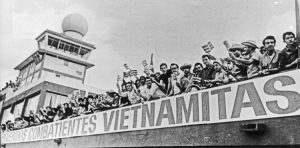
“Then, at Fidel’s initiative, the UJC leadership proposed the youth festival be held in Hanoi, because the heroic struggle of the Vietnamese people needed to be the axis of anti-imperialist solidarity worldwide,” Rodríguez said. The Vietnamese were fighting against Washington’s war of occupation and for the reunification of their country.
“The UJC assigned me to make that proposal at the meeting in Prague of the International Preparatory Committee. It was like a bomb dropped in the room,” Rodríguez said. Representatives of pro-Moscow Communist Party youth groups “said it was too dangerous to hold the festival in Hanoi in the midst of the war.” But their real political objection was opposition to the Cuban leadership’s campaign to make active solidarity with the Vietnamese struggle — not just words — the central priority. In the end, the world youth festival was held in 1968 in Sofia, Bulgaria, on the basis it was a more “stable” location.
Support to Guinea-Bissau struggle
Another sharp controversy took place at an April 1967 WFDY-sponsored youth conference in Conakry, Guinea. Its theme was solidarity with the independence struggles in Portugal’s African colonies.
On behalf of the Cuban youth delegation, Rodríguez said, “I spoke in favor of a resolution supporting the liberation war in Guinea-Bissau against Portuguese colonialism” led by the African Party for the Independence of Guinea and Cape Verde (PAIGC), headed by Amílcar Cabral.
“The resolution was adopted with the support of all the African delegates,” he said. “The only delegate voting against it was the WFDY president,” a leader of the Italian CP youth. He opposed a paragraph in the document declaring that armed struggle was “the only road to liberation.” The WFDY leadership couldn’t overturn the vote, so “they simply shelved the resolution as though it had never been adopted.”
In response, the PAIGC leadership canceled a planned visit by a WFDY delegation to the liberated areas of “Portuguese” Guinea. Instead, the PAIGC invited the Cuban delegation — Rodríguez and Jesús Pérez Othon of the UJC — to visit the Southern Front.
“On the way there, we stopped in the border town of Boké, Guinea, where the PAIGC had its rearguard base,” Rodríguez said. “There Amílcar Cabral invited us for lunch, and he thanked us for Cuba’s support.
“We spent a few weeks with the PAIGC guerrillas. They gave us each a rifle and took us from village to village, walking for hours through the jungle and rivers. It gave us an idea of what life was like during the war.”
During that 1967 trip, Rodríguez met Víctor Dreke, then head of the Cuban internationalist volunteers fighting alongside the PAIGC guerrillas.
Nearly six decades later, Rodríguez, now retired, joined a well-attended meeting this past February at Casa de África, a cultural center in Old Havana. The event launched a new book by Dreke, Cuba and the Independence War in Guinea-Bissau and Cape Verde: The Fall of the Last Colonial Empire in Africa.
Rodríguez felt right at home. “I was very happy to see Dreke again, along with so many other combatants,” he said. “It’s important for people to hear the story he tells.”
The same can be said about Eulogio Rodríguez’s story.