One of the most important developments for working people in the U.S. over the last 75 years was the rise of the Black-led working-class mass movement that exploded across the South in the 1950s and ’60s and succeeded in overthrowing decades of murderous Jim Crow segregation. This victory transformed and mightily strengthened the working class in the U.S., opening the door for united class struggle. It can only be rolled back by a bloody counterrevolution.
But woke middle-class academics and others on the left of bourgeois politics have stepped forward today to deny the powerful gains won by this Black-led working-class struggle and insist nothing fundamental has changed. Examples like The 1619 Project, a highly profitable joint venture by Nikole Hannah-Jones and the New York Times, make their way onto best-seller lists and are used to denigrate the working class as a whole. Similar arguments filled liberal media recently, claiming a narrow Supreme Court ruling on gerrymandering guts the Voting Rights Act.
Getting out the truth about the historic conquests in the fight to overturn decades of Jim Crow segregation helps working people learn more about what they accomplished. It arms us to see our capacity to come together and fight confidently against the bosses’ drive to put the capitalist crisis on our backs and to prepare for more wars. This article is the first in a series to recapture the historic gains won by the civil rights struggle in the U.S.
The Second American Revolution — the Civil War against slavery and a decade of reconstruction defending Black rights afterward — opened the door to Black rights and working-class unity against the increasing class tyranny of emboldened capitalist bosses.
But, in their chase for power and profits, the expanding capitalist ruling class consented to the overthrow of reconstruction in the late 1870s. It was replaced with Jim Crow segregation in the South — the most serious defeat ever suffered by the U.S. working class. Black rights were systematically crushed by Southern bosses and planters using the Ku Klux Klan and other thugs. African Americans were driven into second-class status at all levels, denied land to farm, excluded from many jobs and blocked from exercising the right to vote.
The federal and state governments upheld this setup, along with both the Democratic and Republican parties, the cops and courts.
New winds began to blow with the rise of the CIO in the 1930s, along with Blacks’ experiences in the fight to desegregate the U.S. army in World War II. Black rights fighters drew inspiration from a wave of colonial independence struggles in Africa and elsewhere following the war.
At the same time, large numbers of Blacks in the U.S. migrated from relative isolation in rural areas of the South to northern cities, becoming part of the working class there and its struggles.
Beginning in the mid 1950s, courageous and disciplined struggles by Blacks across the South erupted against Jim Crow. They were backed by workers all across the country. This social revolution changed the attitudes of working people of all colors and nationalities toward one another.
The story of this historic struggle has largely been buried — or grossly distorted — by recent revisionist “scholarship.”
Hidden history of civil rights battle
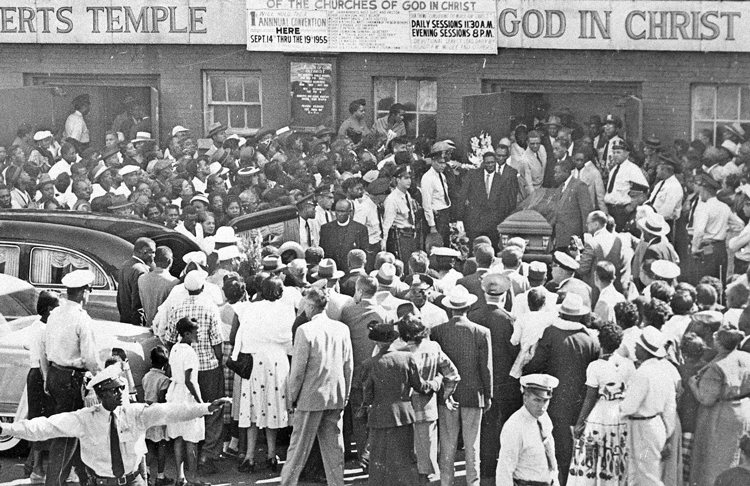
One of the first expressions of the determination to end the murderous violence needed to enforce Jim Crow was the response in Chicago to the gruesome mutilation and murder of 14-year-old Emmett Till in Money, Mississippi, in 1955. His lynching was part of a wave of racist terror that swept the South following the Supreme Court’s 1954 decision outlawing public school segregation.
When Till’s body was returned to Chicago, his mother, Mamie Till, insisted the coffin be left opened. “Let the people see what I’ve seen,” she said. More than 100,000 people filed past the casket over four days. At her urging, Jet magazine ran a photograph of Till’s body seen by millions. This led to protests of thousands coast to coast, backed by the NAACP, the United Steelworkers, other unions and the Jewish Labor Committee.
But the heart of the fight to dismantle Jim Crow would unfold in the South. It erupted with the momentous boycott in Montgomery, Alabama, that desegregated the city’s buses. Then with battles to desegregate public schools in Little Rock, Arkansas; Clinton, Tennessee; and elsewhere. These courageous struggles showed in practice the power of the Black-led working-class movement.
How the fight in Montgomery was led to victory and other key battles that brought down Jim Crow will be the subject of articles in future issues.