One of Pathfinder’s Books of the Month for June is Out Now! A Participant’s Account of the Movement in the United States Against the Vietnam War by Fred Halstead, a leader of the anti-Vietnam War movement from the early 1960s to the U.S. withdrawal in 1975. By refuting U.S. government lies about the war, mobilizing growing numbers in protest and defending anti-war GIs, it deeply affected the working class in the U.S. The anti-war movement gained momentum from the fight for Black rights and helped spur other struggles for social justice. With the perseverance of the peoples of Indochina, it helped force Washington to withdraw its troops from Vietnam, changing the political face of the U.S. The excerpt is from the Afterword. Copyright © 1991 by Pathfinder Press. Reprinted by permission.
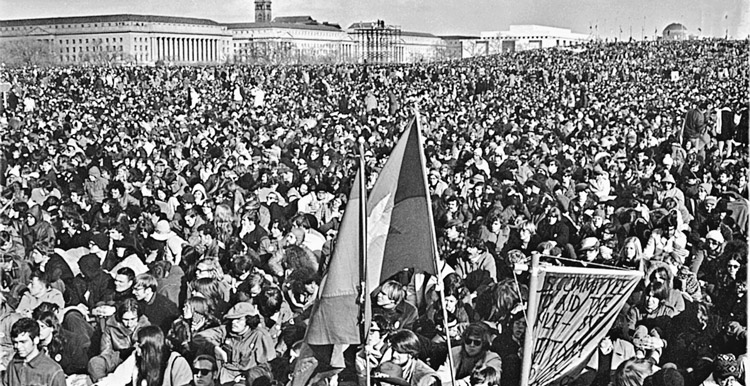
The Second Indochina War was the first in the epoch of American imperialism in which the United States went down to defeat. After emerging victorious from the Spanish-American War and two world wars, then encountering a stalemate in Korea, the Pentagon’s military machine was ignominiously evicted from Vietnam, thanks to the persevering struggle of the Indochinese plus the antiwar resistance of the American people. This was the most sustained and, except for Russia in 1905 and 1917, the most effective antiwar movement within any big power while the shooting was going on. …
U.S. intervention had a thoroughly imperialistic character. The colossus of world capitalism hurled its military might without provocation against a small and divided colonial nation thousands of miles away struggling for self-determination and unification. A series of American presidents sought to do what King George III’s empire failed to do against the rebel patriots of 1776.
On one side was a state armed to the teeth promoting the strategic aims and material interests of the corporate rich on the global arena; on the other was a worker and peasant uprising heading toward the overthrow of capitalist power and property, despite the limited political program of its leadership. …
The antiwar movement began with people who were already radicalized: pacifists, socialists, communists, rebellious students, and a scattering of morally outraged individuals. At the start these were a small minority, convinced of the justness of their cause and ready to face unpopularity for their stand. …
Beyond their agreement in opposing the war, the initiators of the movement held discordant views on many matters and advocated different, and even conflicting, methods. At every point along the road they had to thrash out their principled strategic and tactical differences in order to arrive at unified and concerted action. This was rarely easy and not always possible. …
In the beginning, the movement came to grips with three internal policy problems that were interconnected: red-baiting, nonexclusion, and democratic decision-making.
Red-baiting had to be cleared away so that Marxists and revolutionaries of any persuasion would not be barred from openly participating on an equal footing in all the movement’s activities and on its leading bodies. …
The policy of nonexclusion came into effect along with the rejection of red-baiting. No “loyalty oaths” were demanded or restrictions imposed on anyone opposed to the war on any grounds. The sole requirement was a readiness to protest and act against the war. …
The procedure of democratic decision-making was best exemplified at the periodic national and regional antiwar conferences, open to all. There the issues were publicly debated and reported. …
The SWP was no newcomer. Among its older cadres were individuals who had been in the Socialist Party of Debs’s time and in the Industrial Workers of the World and who had been founders and leaders of the Communist Party until their expulsion for their anti-Stalinist ideas in 1928. SWP members had experience in opposing the three previous major imperialist wars, in countless labor struggles, and in party organization. Its younger cadres were educated in these traditions and in the revolutionary principles developed and practiced by Marx, Engels, Lenin, and Trotsky. …
On only two brief occasions — October 15, 1969, and early May 1970 — did the mobilizations attain the level of active participation by several millions, close to a mass force capable of vying for power. However, those millions were not reaching out for state power — the vast majority of them still considered themselves Democrats or Republicans. They were protesting the war.
A social and political revolution in the United States will necessarily involve a deepgoing break with the two-party system. It will no less require the active participation on a sustained basis of tens upon tens of millions of working people, not just challenging one or another government policy but democratically determining policies in mass organizations of their own while changing the basic structure of society.