Nat’l Nurses United union: ‘We will not remain silent!’
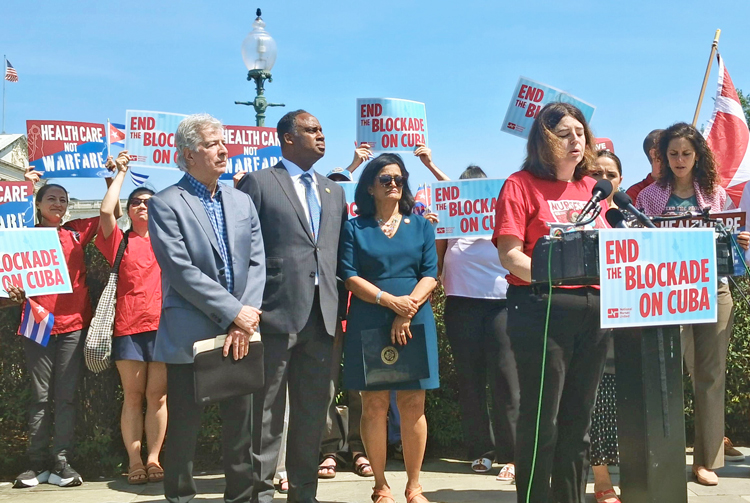
WASHINGTON — Setting an important example for the entire labor movement, National Nurses United — the largest union of registered nurses in the U.S. — organized a press conference here June 30 to call for the U.S. government to end its punishing oil blockade against the people of Cuba.
The nurses’ union called the public action along with Global Health Partners, an organization that has raised millions of dollars in medical supplies to donate to Cuba’s hospitals, including syringes, pacemakers and sutures. Also participating were a number of members of Congress and representatives of other groups.
This act of solidarity builds on a statement the union issued earlier this year calling on “the administration and Congress to end the blockade and allow full delivery of oil resources and other aid for the Cuban people.”
Jamie Brown, president of Nurses United and herself an intensive care unit nurse, opened the press conference. She explained why her union opposes the U.S. government’s policy of blockading vital healthcare supplies, fuel and food to try and impose its will on another country. “Tens of thousands of Cubans are affected by these policies, including older Cubans, cancer patients, pregnant women and infants. We’re here to call on the U.S. government to normalize relations with Cuba.”
In fact, Brown said, Cuba is an example, “a bastion of public health and international solidarity in healthcare.” She highlighted how during the COVID pandemic, Cuban medical volunteers treated over 1 million patients in 40 different countries. “The example of Cuba shows what is possible when healthcare is treated like a human right over a commodity.”
U.S. Reps. Delia Ramirez, Pramila Jayapal and Jonathan Jackson also spoke at the press conference. Jayapal and Jackson, a member of the Congressional Black Caucus, both described what they learned on a recent trip to Cuba. Jayapal pointed to how Washington’s oil blockade is the latest in a decadeslong series of attacks against the Cuban people. “The economic sanctions have been going on for decades and amount to the economic bombing of the infrastructure of Cuba,” she said.
She described visiting a hospital there and seeing a room full of broken incubators and ventilators. When the effects of the oil blockade cause electricity surges, they blow out this life-saving medical equipment. Then the U.S. sanctions prevent Cuba from getting the parts they need to repair them. Despite these real challenges, “Cuba shows what a universal healthcare system looks like.”
The speakers thanked the National Nurses United union for its leadership in organizing the press conference. Others participating included Congressman Ro Khanna and Code Pink.
The conference concluded with remarks from Bob Schwartz, executive director of Global Health Partners. “The infant mortality rate in Cuba is a good indicator of the healthcare crisis there. Before the Cuban Revolution it was 70 for every 1,000 births. After the revolution, it was five for 1,000,” he said. “Today it has doubled, and it will continue to increase.”
He announced a new initiative by Global Health Partners to work with Cuba’s Ministry of Health to take steps to reverse the rising infant mortality rate. They’re raising funds to launch a neonatal and maternal healthcare pilot project with two hospitals in Havana that treat the most complex pregnancies and neonatal cases.
“When I stand up, I have 225,000 members who stand behind me in solidarity with the Cuban people,” Jamie Brown told the Militant after the press conference. “We should be supporting Cuba — supporting all people, including those in the United States. We don’t have universal healthcare here, instead the kind of care you get is tied to your job. Cuba shows what’s possible with universal healthcare.”
To donate money to send urgently needed medical supplies to Cuba, go to the Global Health Partners website at https://ghpartners.org/cuba-2026 or mail checks payable to “Global Health Partners,” writing “Maternal and Newborn Initiative” on the memo line, to 39 Broadway, Suite 1540, New York, NY 10006.