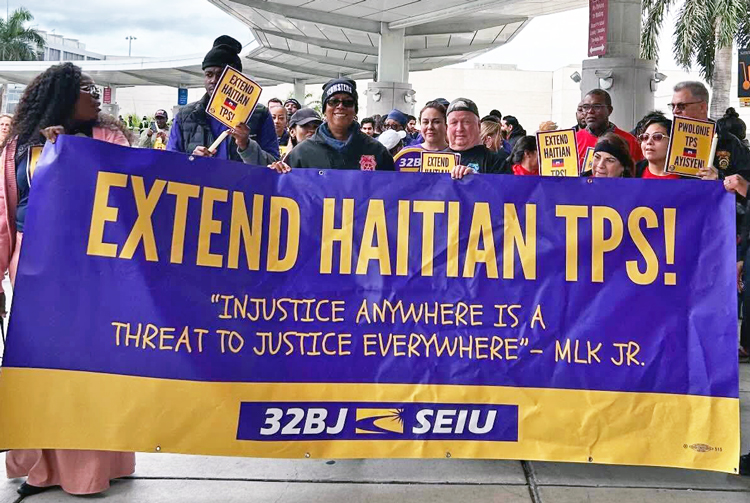
Hundreds demonstrated in defense of continuing Temporary Protected Status for refugees from Haiti in Springfield, Ohio, and other cities following a U.S. Supreme Court ruling June 25.
The decision says President Donald Trump’s administration has the right, as the executive branch of the government, to overturn TPS protection from 350,000 Haitian and 6,100 Syrian immigrants, and from others in the future. It ends their right to live and work here and makes them liable to deportation. More protests are planned.
The 6-3 ruling by the court will affect “thousands of our union members from Boston to Miami who maintain everything from airports to downtown offices, plus countless others working in senior care, childcare, construction, food service and more,” Manny Pastreich, president of Service Employees International Union 32BJ, told a rally outside the Massachusetts State House.
“It’s deplorable that this country, which calls itself ‘the land of the free,’ treats people who come here for support in the manner they do,” Sonya Munday, president of Local 57 of the Bakery, Confectionery, Tobacco Workers and Grain Millers union, told the Militant after the ruling. The local organizes workers at Klosterman Baking in Springfield.
In recent years, Springfield’s 60,000 residents have included more than 10,000 Haitians. They work at Honda’s engine assembly plant, at the Amazon warehouse and in many other jobs in the area. A “Springfield Stands With Immigrants Rally” will be held at City Hall, 76 E. High Street on July 3, from 6 p.m. to 7:30 p.m.
Discussions about how to organize to meet this new challenge are taking place across the country, especially in cities with large numbers of Haitians, from Miami, Florida, to Greeley, Colorado, where hundreds work in packinghouses.
TPS allows the Department of Homeland Security to determine if wars, natural disasters or other circumstances call for allowing citizens from affected countries to live and work in the U.S. The department reviews whether to renew the status every 18 months. Today 1.3 million immigrants from 17 countries live in the U.S. under the program.
As part of its drive to limit immigration, the Trump administration has cancelled the program for all 13 countries whose TPS has come up for renewal, including 600,000 from Venezuela. Many of these decisions have been challenged in federal court.
Writing for the Supreme Court minority, Justice Elena Kagan says the decision not to renew the program for Haitians is a result of racism, pointing to Trump’s bigoted comments during the 2024 presidential election about Haitians eating neighbors’ pets in Springfield. The court majority argued the decision isn’t driven by racism.
The ruling isn’t centered on this charge. The court majority says that according to the law that established TPS, the courts have no power to review whether or not the executive branch of the government can renew the program. The Supreme Court ruling now prevents immigrants from the 13 countries whose TPS has been abolished from challenging the move.
“The T in TPS stands for TEMPORARY, yet many of these designations became de facto amnesty,” James Percival, the Department of Homeland Security’s chief attorney, claimed after the ruling. Far from granting an amnesty, however, TPS never provided a road toward gaining a green card, only further insecurity.
Moreover, the conditions that led previous administrations to offer and renew TPS for Haitians and Syrians have been far from “temporary.” TPS was granted to Haitians in 2010 after a disastrous earthquake wrecked havoc there. Haiti is one of the world’s most impoverished countries, with limited political rights under governments imposed by Washington to advance the U.S. rulers’ plunder and domination.
Over the past 10 years criminal gangs have extended their control over growing swathes of territory in Haiti, including 80% of Port-au-Prince, the capital. They terrorize working people, with some 18,000 forced to flee their homes in the city’s Cite Soleil neighborhood in May. Nearly 1.5 million people are currently displaced across the country.
“The gangs just take over and the police are part of this much of the time,” Michele, a nurse from Haiti now living in northern New Jersey, told the Militant. “When you don’t have proper papers here you work under the table and you’re subject to abuse.”
Syrians got TPS in 2011 as a result of the bloody civil war there. While that conflict has ended, thugs loyal to the U.S.-backed government of President Ahmad al-Sharaa have carried out assaults and massacres of religious and national minorities, including Kurds, Alawites and Druze over the past 18 months.
“For many Haitian TPS holders, the United States is home,” a statement by the Sant La Haitian Neighborhood Center in Miami said after the ruling. TPS recipients from some countries have worked legally in the U.S. for decades, forming families and building their lives here.
What’s needed is a union-led fight for amnesty for all immigrants without papers in the U.S., to remove their pariah status and the fear of deportation, and to advance the road toward working-class unity.
Betsy Farley in Cincinnati contributed to this article.