By the mid-1950s growing numbers of African Americans were stepping forward to fight to overturn the widespread denial of voting rights and the racial segregation of public services, like city bus lines and schools across the South.
Significant changes coming out of the second imperialist world war — especially the rise of struggles for independence sweeping Africa, Latin America and Asia — were having an impact on Blacks and other workers in the U.S. This came on top of the experiences that workers, Black and Caucasian, went through building industrial trade unions in the 1930s.
Thousands of courageous youth were ready to take action to challenge the Jim Crow setup.
These political developments were a wake-up call to some in the capitalist ruling class who began to consider they needed to make some adjustments to defend their profit-driven system.
In 1954 the U.S. Supreme Court held school segregation unconstitutional in its Brown v. Board of Education ruling.
The court combined five cases against school segregation, including one that arose from a walkout by the entire student body at Moton High School, in Farmville, Virginia, in 1951 to protest conditions at the all-Black school. The unanimous 1954 decision reversed the notorious 1896 Plessey v. Ferguson Supreme Court ruling that justified the “separate but equal” policy that was used to impose racial segregation. One year later, in 1955, the court ordered state governments to carry out desegregation “with all deliberate speed.”
The court’s decision was met with defiance by segregationist state and local authorities across the South, backed by the Ku Klux Klan and other racist thugs. At the same time, demands grew from working people for the federal government to use its armed might to intervene to enforce equal rights. It would take a mass movement — a historic watershed in U.S. history — over the next two decades to make school desegregation a reality.
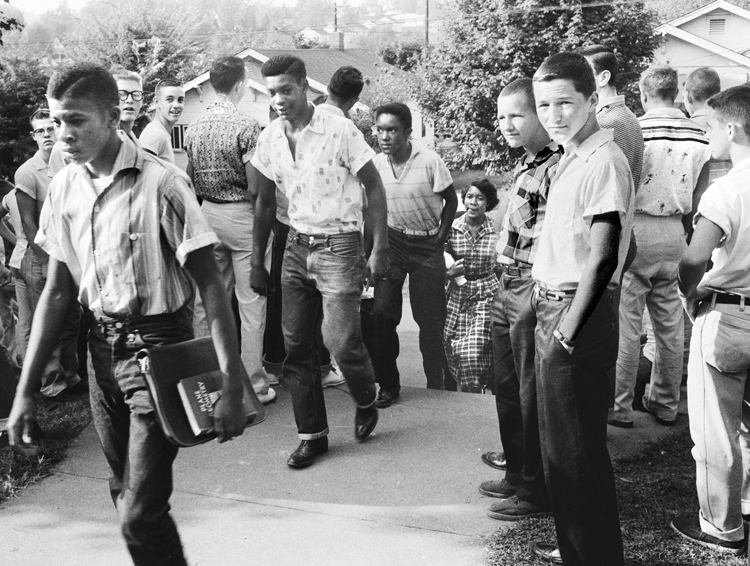
On Aug. 26, 1956, 12 Black students were admitted to the high school in Clinton, Tennessee, the first Blacks in an integrated school anywhere in the South since the decadelong Reconstruction Era after the overthrow of slavery in the Civil War.
But they faced a systematic effort to drive them out. Each day a mob outside chanted racial slurs. Inside the Black students faced violent assaults.
But they also won support. Principal D.J. Brittain Jr., who disagreed with desegregation, decided it was now the law of the land and he would try to protect the Black students. Jo Ann Allen Boyce was one of the 12 Black students. On their first day in high school, “one young lady nominated me to be vice president of my homeroom,” she wrote later.
A number of Caucasian students on the football team patrolled the hall to protect Black students. On one occasion team members pulled three Black students from a mob that had chased and beaten them.
Over the Sept. 1-2 weekend, an anti-Black riot erupted in the town. Cars were overturned, windows smashed and African Americans threatened. Dynamite was thrown into the Black neighborhood.
“The Ku Klux Klan would drive through and intimidate everyone,” Boyce recalled in a 2023 radio interview. So “the Black men in the neighborhood set up their own sort of, ‘Let’s keep us safe,’” she said, organizing armed self-defense and patrolling Black neighborhoods. Faced with the willingness of African Americans to defend themselves, Gov. Frank G. Clement decided he had to take steps to halt the violence and called in the National Guard.
But violent assaults targeting the students and their supporters continued. Crosses were burned on lawns and shots fired at the homes of the Black students. Rev. Paul Turner, a Baptist minister, along with two other courageous Caucasians, volunteered to escort the students. Within hours of taking the students to school, Turner was severely beaten by a segregationist mob.
In response, authorities closed the school for a week, but a federal judge reaffirmed a court order backing school desegregation.
The Black students and the allies they won prevailed. In May 1957 Bobby Cain graduated from Clinton High School, the first African American to advance from an integrated school in the South. In retaliation, the school was firebombed and largely destroyed in October 1958, but by then a movement to end segregation had taken root.
Battle of Little Rock
During the 1956 presidential election both the Democratic challenger, Adlai Stevenson, and Republican incumbent Dwight D. Eisenhower vowed never to use federal authority to enforce the Brown v. Board of Education ruling. Only Farrell Dobbs, the Socialist Workers Party candidate who had been active in the Montgomery bus boycott, called for full and speedy federal enforcement of school desegregation, including the use of federal troops.
Months after the election, some 27,000 people from across the country mobilized for a Prayer Pilgrimage for Freedom to Washington D.C., one of the first national mass actions of the civil rights movement. A large crowd gathered in Montgomery, Alabama — where the groundbreaking bus boycott was solid and winning nationwide support — to send off a delegation to join the action.
As the movement to end Jim Crow school segregation grew, Eisenhower reluctantly deployed federal troops to defend nine Black students who were being blocked by racist mobs from attending Central High School in Little Rock, Arkansas, Sept. 25, 1957.
The NAACP there had recruited the nine and prepared them for the intimidation they’d face. NAACP leader Daisy Bates organized eight of the nine students to march together to the school on their first day, where they were turned away by the National Guard deployed by Gov. Orval Faubus.
The ninth Black student, Elizabeth Eckford, arrived alone later and was surrounded by a screaming mob of segregationists. Passerby Grace Lorch fought her way through the crowd, shouting at them, “Leave this child alone.” She escorted Eckford onto a bus and home to safety.
For three weeks Faubus defied a federal desegregation order, before Eisenhower decided he had no choice but to deploy the 101st Airborne to Little Rock. The federal troops escorted the students each day. In the fall of 1958, Faubus closed all four Little Rock high schools, until the Supreme Court ruled his order unconstitutional. In 1959 the schools reopened, enrolling both African American and Caucasian students.
The battle at Little Rock was widely covered in the national media and watched by working people around the country, providing inspiration for struggles to desegregate schools in Louisiana, Mississippi and across the South — and in some northern cities, like Boston — in the years that followed.