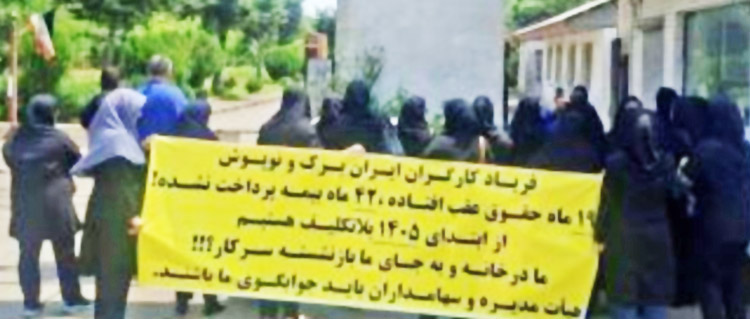
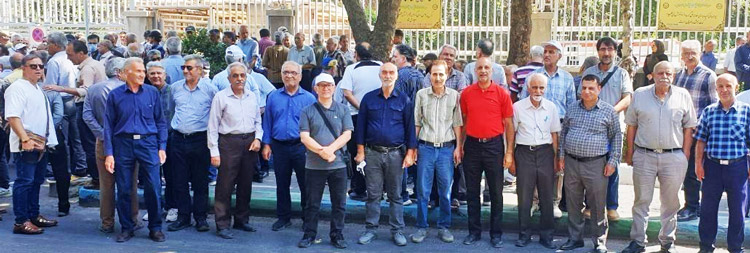
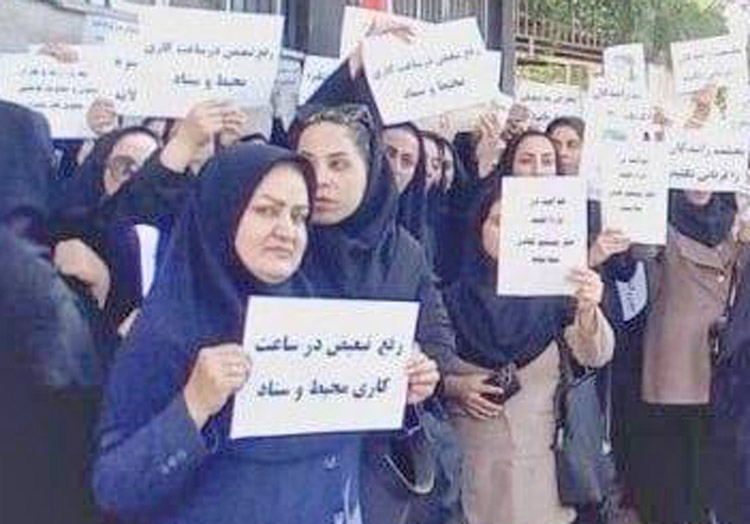
“Inflation, high prices, no to war and destruction,” chanted dozens of retired workers in Shush in Iran’s Khuzestan province. “Livelihood and dignity are our undeniable rights.” Their action was just one of more than a dozen protests or strikes across the country on July 12 and 13 by retirees, coal miners, railroad workers, truck drivers, bakers, nurses and medical students.
New protests are taking place every day. While most raise economic demands, many include calls for freeing union and political prisoners and an end to the death penalty. The fact that the protests and strikes take place during the U.S. war and an increase in government repression, shows the depth of opposition among workers to the reactionary regime.
Retirees at the July 12 action in Gilan chanted, “Imprisoned workers must be freed,” “No to executions,” and “Oppression and injustice have driven us to the streets.”
Hundreds of truck drivers marched through the streets of Tehran July 12 to protest having paid thousands of dollars for new trucks that were never delivered. They have continued their protest every day since, even sleeping overnight on the sidewalk, vowing, “We will not leave until we get our rights.”
The protesters stood their ground after they were attacked by police wielding nightsticks and pepper spray July 15. During the clash the truckers yelled at the cops, “Bisharaf!” — an insult meaning you are shameless and have no honor.
“We condemn any attack or assault against drivers under any pretext,” said a statement by the Nationwide Drivers Coordinating Committee. “Protesting is not a crime, it is the legal right of citizens.”
Coal miners at the Tazareh mine in Damghan, in Semnan province, went on strike July 12 to protest unpaid wages, unpaid insurance contributions and disregard for their rights.
These actions reflect growing opposition to the regime’s wars, its attacks on Israel, its actions that give U.S. imperialism a pretext for its assaults and its use of working people and oppressed nationalities in Iran as cannon fodder.
“Why should uranium be enriched?” asks a post on the Bazaar Civil Protest website. “Is the goal to build a bomb — a bomb that could ultimately endanger the lives of innocent people, including women and children and bring destruction?”
Opposition to the regime’s stepped-up use of the death penalty against both those accused of criminal offenses and political prisoners is growing.
On July 13, hundreds of prisoners at the Ghezel Hesar Prison in Karaj, near Tehran, began a hunger strike to protest the move of six inmates — sentenced to death on drug charges — to solitary confinement, a prelude to their execution. The prisoners released a video of hundreds of hunger strikers sitting in the cell-block hallways calling for abolishing the death penalty.
Opposition to the regime forcing workers to pay the cost of its military adventures and provocations is even reflected in the pro-regime media. The government-funded Iranian Labour News Agency ran an article July 14 that described how the bosses have used the war to accelerate their attacks on workers’ wages, conditions and rights, claiming they’re forced to do so by circumstances beyond their control.
“Before the war, Iranian workers were struggling on a silent battlefield with temporary contracts, inadequate wages, etc.,” the article noted. Layoffs and wage cuts “placed the heaviest cost on the labor force.”
The article pointed out that even “before the first missiles were fired” workers were fighting to keep from falling below the poverty line.
“But the outbreak of the recent war turned the tide,” the article says. “The employers turned the crisis into an opportunity to evade their minimum legal obligations.” Workers were told that “defense of national security” meant that “any work stoppage was prohibited.”
Iranian Labour News counseled workers to protest but not go on strike. Fewer workers today are willing to accept that advice.