LOS ANGELES — The putrid odor hangs in the air with no relief, Idefonso Flores Aguilar, told the Militant 11 days after a fire broke out at the massive Lineage food storage warehouse in the Boyle Heights area here. “I went to the hospital three days ago. I had problems with my lungs. It was difficult to breathe. I had a cough, headaches and a bloody nose.” He said his sister lives in Montebello, more than 5 miles away, and says she can smell the smoke.
In addition to Lineage leasing the warehouse, Altus Power operates more than 300,000 square feet of solar panels on its roof.
When the fire broke out June 17 in this mostly Latino working-class area on the east side of Los Angeles, portions of the roof collapsed, making it unsafe for firefighters to enter. The 85 million pounds of frozen food inside included a good deal of meat, which is now rotting.
“I have to take naps with a mask on because I get sleepy from the smoke,” Seabreeze Dominguez, a manager for a nonprofit who lives on a block next to Lineage, said. “My mother has burning in her sinuses. You can’t use an air conditioner.” She and other neighbors said they were concerned about rats they see coming out of the warehouse.
It took the city government until July 1 to say it was going to set up some mobile clinics in the area.
Elisa lives less than one block from the plant and has three children. “My sister lives with us and has asthma. With the smell, she has headaches, coughs, can’t breathe and has cold and hot spells. So she is now living somewhere else with our parents. My 14-year-old son is affected worse also because of his asthma.” The fire burned for a week.
Kelvin Vasquez lives so close to the warehouse, he said he could watch the fire burn from inside his home. Vasquez’s health issues aren’t what worry him now, he said, it’s what will become of the tens of millions of pounds of food that have sat unrefrigerated for over a week. “It pretty much smells something like a dead body,” he said.
It took millions of gallons of water to fight the fire, creating a polluted stream carrying all kinds of debris and spoiled food out of the building.
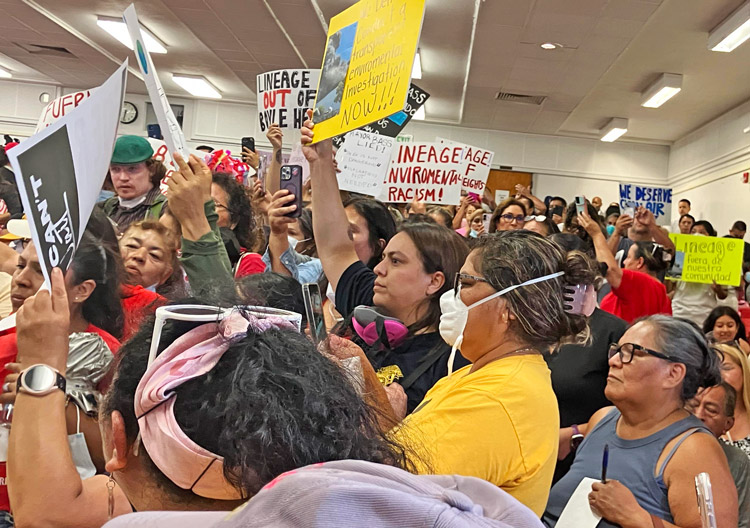
Rosa Samaniego joined 50 neighbors who held a protest a block from the plant July 2 demanding the city get the area cleaned up faster. Many also demanded the warehouse not be allowed to reopen.
She said they want to be compensated for having to relocate. Her family got the Red Cross to pay for five nights in a hotel, but it’s not enough. Her husband is disabled. “I was the one who had to move everything,” she said, and we had to leave quickly.
“When the fire broke out and black smoke poured out over the area, the city issued a shelter-in-place order, but many workers had to keep working in the area,” Laura Garza, a railroad conductor and the Socialist Workers Party candidate for Los Angeles mayor, told people as she campaigned there. “This included rail workers and those who load and unload containers onto the rail cars.” Two major rail yards lay just south of the warehouse.
“We support the residents here who are demanding the government provide funds to be compensated for what they lost, and to be relocated.”
Another disaster one month earlier
This fire came on the heels of another industrial crisis May 21 in Garden Grove, 30 miles south of here. A chemical spill from a giant tank at GKN Aerospace threatened a catastrophe, as the compromised tank contained methyl methacrylate, a highly flammable industrial chemical used in plastics and aerospace manufacturing. It began overheating and venting dangerous vapors into the air, looking increasingly like it would either burst, loosing a serious flow of the toxic chemical, or explode.
Some 50,000 people in the area were evacuated and it was cordoned off for five days. Luckily, a crack in the tank reduced the pressure and temperature inside it without an explosion.
UK-based GKN Aerospace is one of the world’s largest aerospace suppliers, operating 32 manufacturing sites across 12 countries with about 16,000 workers.
Cleanup of the site, scheduled to start June 4, was delayed due to what authorities called “unavailable resources.”
Working people bore the brunt of the financial repercussions, having to evacuate and pay for emergency hotel stays, meals and other necessities.
GKN Aerospace announced it gave $3 million to the United Way to help area business owners and residents. But after just a week, the United Way said, “Due to the volume of applications received, and funding available, we are no longer accepting new applications.” It only covered costs up to $500 per household.
“Both of these disasters show the bosses and their government protect big business, while showing disdain for the working class,” Garza said. “The Socialist Workers Party calls for workers control of production and safety,” she said. “We need to strengthen the unions to fight for our class interests. And we need to chart a course to take political power into our own hands to place the health and well-being of the working class front and center.”