Hundreds of Mexican long-haul truck drivers organized protests on their side of the U.S.-Mexico border Sept. 3-7. Drivers used their semis and other means to block the commercial crossings between Mexicali, in Baja California, Mexico, and Calexico, just across the U.S. border in California. They also protested in San Luis Río Colorado in Sonora, Mexico, across the border from San Luis, Arizona. They threatened to continue the protests, including extending it into vegetable harvesting season, and to expand them to Tijuana’s Otay Mesa crossing and others.
The truckers are being accused by the U.S. Citizenship and Immigration Services of “cabotage.” Government agents have begun revoking the drivers’ B-1 visas needed to haul freight across the border. Under this temporary business visitor visa, cabotage — hauling freight between two places in one country by a carrier based in a different country — is illegal.
The truckers say that there is no evidence of cabotage, and the Mexican National Chamber of Freight Transportation is investigating the charges. Mexican news reports that at least 17 drivers have had their visas revoked. According to AFN News of Tijuana, “The protesters claim that the visas of many truck drivers have been withdrawn without sufficient explanation, and that no part of the Mexican government has attempted to help affected truck drivers.”
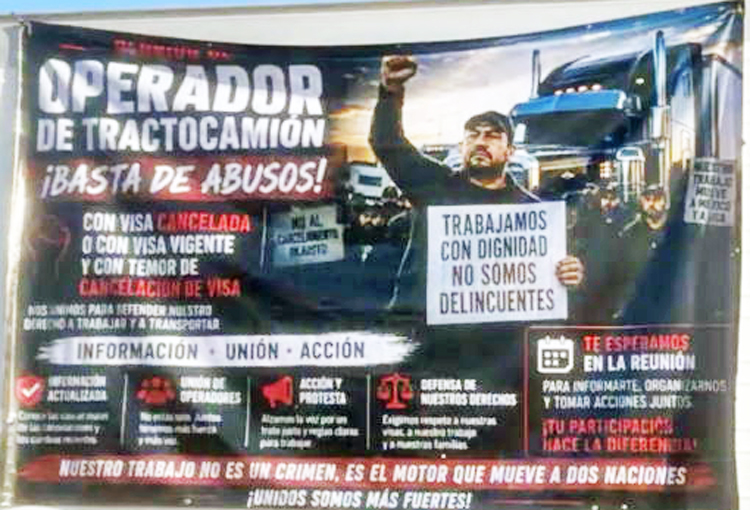
Above, banner on truck at protest reads, “We work with dignity. We are not criminals.”
“What they’re doing to the truck drivers is a witch hunt; they’re treating them like criminals,” Alan Verdugo, a driver at the Mexicali protest told KYMA-TV. “Everyone is asking if ICE agents are at the border crossing.”
Another trucker, Conrado Marron Valencia, told the press that Immigration and Customs Enforcement agents have threatened to detain the drivers and revoke the visas of their family members if they refuse to admit the cabotage charges. One protester told La Jornada that truckers have had visas revoked because a trip lasted more than four days, or they stopped at a Walmart.
Marcus Gonzalez, a truck driver in Las Vegas, Nevada, told the media he was struck by the generosity of the protesters who had given him food and helped him fix his truck. “These are hard-working people with families, and they’re being treated like animals,” he said.
The protests were temporarily suspended Sept. 7 when a task force of U.S. and Mexican government officials began discussion on how to resolve the dispute with the truckers.