The growing lack of safe drinking water in Cuba today is a product of the U.S. government’s ever-tightening oil blockade and punishing sanctions against the import of energy and other resources. This means a much greater risk of serious health problems, food safety issues and harder living conditions for Cuban working people.
On Sept. 4, the U.S. Embassy in Havana cynically issued a “health alert” aimed at foreign visitors to the island warning of a “significant increase in diarrheal illness across Cuba. Recent cases have included E. coli, norovirus, Shigella, and other gastrointestinal pathogens.”
The advisory warned visitors to avoid foods “that may have been inadequately stored” and to stay hydrated with water “known to be safe.” It urged them to bring their own medicine, saying antibiotics and over-the-counter medicines “are frequently unavailable.”
Of course, Washington’s “advisory” ignored the fact it is the U.S. rulers’ own decades-long sanctions and other attacks on Cuba, accelerating today, that is responsible for the crisis. Nor do they offer any aid to alleviate the situation.
The urgency of the alert to travelers also puts into greater focus what the Cuban people themselves face every day. Cuba’s state-run National Institute of Water Resources reports that nearly 3 million on the island are experiencing difficulty accessing water. The water system strains to operate, having only 37% of the fuel required. Only one major oil tanker has been allowed by Washington to dock in Cuba in the last seven months.
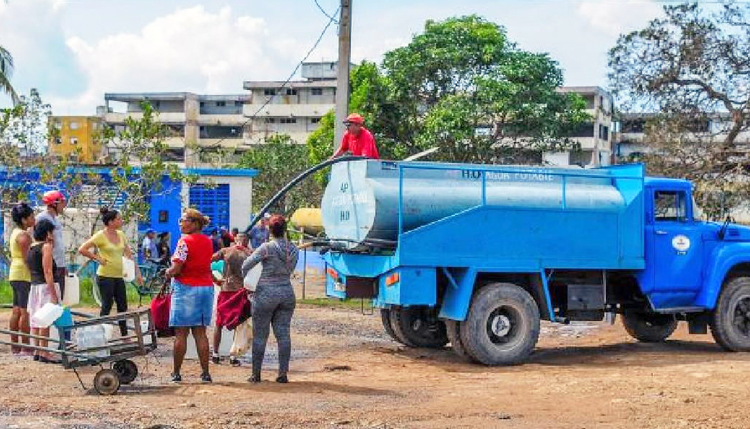
Because the water pumping stations are short on fuel, at best there is just a trickle of tap water. To have water for drinking, cooking, bathing and cleaning, many workers must fill and carry buckets of water from storage tanks, pumping stations or tanker trucks.
The UN News said seven months ago that about 10% of the population — nearly 1 million people — were getting their drinking water from the tanker trucks, a number that has increased since. But there are fewer and fewer of these trucks, known in Cuba as “pipas,” on the road as lack of fuel and parts take a toll. Sometimes this means people need to walk long distances to fill their buckets.
Some workers volunteer, or hire themselves out, to collect and bring water to others. “Demand keeps growing. Every week we have to fetch water from farther away, and we never know whether the pumping station will still be working tomorrow,” Juan Miguel Reyes, a former intensive care doctor, told the Guardian in July. “People often thank us because many are too old to collect water themselves. Here, without neighbors, nobody would make it.”
In addition, the pumping stations and water have been deteriorating, with no parts and machinery to repair them, a result of Washington’s decades-long embargo. Up to 70% of Havana’s water is lost through leaks in the system, the water institute said. Leaks increase the possibility tap water will be contaminated with sewage and other contaminates.
Mosquito-transmitted viruses, like dengue fever, Zika and chikungunya, are spreading. The mosquitos thrive in stagnant water, which has increased from leaking pipes. There’s a shortage of fever-reducing and analgesic drugs needed in acute cases because Washington’s sanctions have slashed supplies. Hospitals and clinics also face water shortages.
This is why efforts such as those organized by Global Health Partners in the U.S. to gather medications and supplies for hospitals and clinics in Cuba are a crucial lifeline. To learn more about their efforts or to help, contact ghpartners.org.
Cubans come together to help
An article in the Sept. 4 digital newspaper Victoria, produced on the Isle of Youth in Cuba, wrote, “Public health forces and other agencies together with neighbors, neighborhoods and work groups here have developed actions against arboviruses in the face of the increase in people with feverish symptoms.”
In the town of La Fe, they’re organizing to fix leaks and clean septic tanks. Some 40 members of the Revolutionary Armed Forces are working with healthcare workers “who are intensifying preventive care and treatment for the sick.”
“Screening and fumigation drives are continuing house to house and door to door,” the paper said.
In May, Antonio Rodríguez, president of the National Institute of Water Resources, told Associated Press, “not only does water pumping consume electricity, but all the agency’s essential activities require fuel — from unclogging pipes and cleaning septic tanks to repairing leaks. Chemical supplies are also needed, and their import is currently paralyzed.”
Rodríguez added, “complicating matters are aging infrastructure and oversaturated pumping stations, especially in large cities such as Havana, Santiago de Cuba and Matanzas.”
The institute reported that most of the country’s pumping stations need to operate 18 to 24 hours a day to guarantee water supply, but now some can only operate for two hours.
In response to the sanctimonious “health alert” issued by the U.S. Embassy, Cuban Foreign Minister Bruno Rodríguez Parrilla said, “Collective punishment is a crime. So, too, is inflicting suffering on an entire population through measures coldly calculated to trigger a humanitarian crisis.
“Enough with the abuse. Put an end to the blockade once and for all and allow Cuba to live in peace.”