Below is the introduction by Mary-Alice Waters to the new book Cuba and the Independence War in Guinea-Bissau and Cape Verde: The Fall of the Last Colonial Empire in Africa by Víctor Dreke. Waters is the editor of the book along with Martín Koppel, a Pathfinder editor. She is the president of Pathfinder and a member of the National Committee of the Socialist Workers Party. Copyright © 2025 by Pathfinder Press. Reprinted by permission.
Cuba and the Independence War in Guinea-Bissau and Cape Verde: The Fall of the Last Colonial Empire in Africa brings to life one of the most important chapters in the vast wave of anticolonial, anti-imperialist struggles that swept the globe during and in the aftermath of World War II.
It is a chapter rich in political lessons for the toilers. And a chapter that is also among the least known.
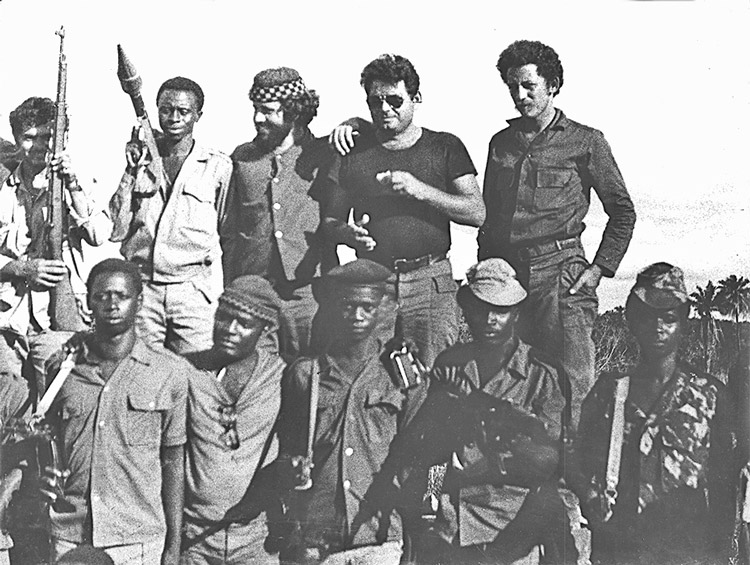
This is a firsthand account of that historic struggle by Víctor Dreke Cruz. As a young but already seasoned commander of Cuba’s Revolutionary Armed Forces, in 1967–68 Dreke led Cuba’s internationalist military mission in the West African countries of Guinea-Bissau and Guinea-Conakry.
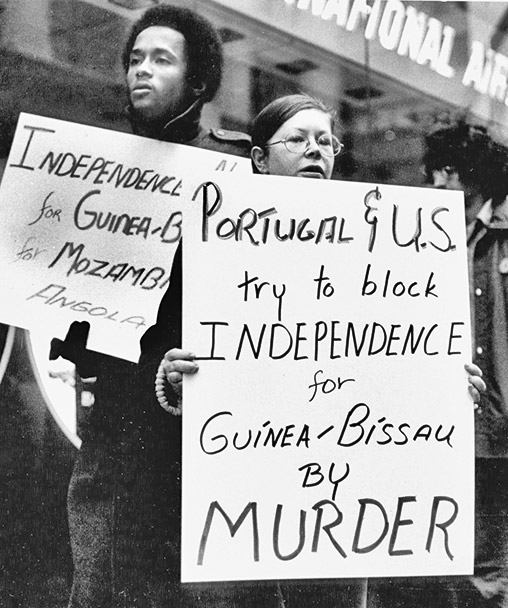
Initiated by Cuban leaders Fidel Castro and Ernesto Che Guevara, the mission provided both military training and medical help to the cadres of the African Party for the Independence of Guinea and Cape Verde (PAIGC) led by Amílcar Cabral. The PAIGC combatants fought to put an end to five hundred years of Portuguese colonial exploitation and domination. The triumph of the Guinean people over that regime triggered the collapse of the last colonial empire in Africa, bringing independence not only for Guinea-Bissau in 1974 but, a year later, for Cape Verde, Angola, Mozambique, and São Tomé and Príncipe.
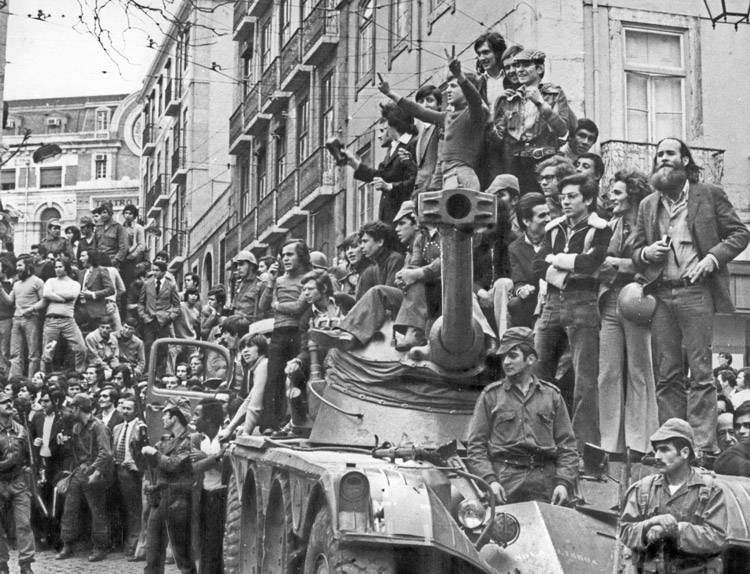
It also brought down the decayed fascist regime in Portugal itself.
Víctor Dreke’s account of that turning point is not a dry “history.” What comes to life in these pages is the pride and confidence of a previously subjugated and exploited people fighting not only for their own freedom but, as Cabral expressed it, coming to see themselves as part of “humanity’s soldiers” and acting accordingly.
Alongside them you will also meet revolutionary Cuba’s internationalist volunteers, who showed the world the kind of human solidarity that men and women transformed by making a genuine socialist revolution are capable of.
* * *
In the 1950s and 1960s a tsunami of anticolonial and anti-imperialist movements swept across Asia and the Pacific, Africa, the Middle East, and the Caribbean. It was a byproduct of World War II itself. The second inter-imperialist slaughter of the twentieth century was waged by rival world powers for redivision and plunder of the earth’s markets and natural resources. The deadliest war in human history, it ended an estimated seventy to eighty-five million lives. Most were civilians.

To understand the class character of that war, we must add that the overwhelming majority of those deaths, civilian and military alike, were of workers, peasants, small traders. The oppressed and exploited humanity of all races and nationalities.
From the ashes of World War II, US capitalism emerged as the dominant economic and military power. More important, the imperialist world order, born in the closing years of the nineteenth century, had been vastly weakened. In a few short years the colonial empires built (some over centuries) by Portugal, Spain, France, England, the Netherlands, Italy, Belgium, Germany, Japan, and the United States crumbled in face of victorious national liberation struggles the world over.
The relationship of forces on an international scale was changed.
The impact of that revolutionary upsurge reached inside the imperialist centers too. It inspired battles for rights, jobs, and human dignity by oppressed nationalities from Ireland and Quebec, to Australia, New Zealand, the Pacific Islands, and beyond.
Above all, the anticolonial movements in Africa helped fuel the historic battle that exploded in the United States itself, as working-class men and women who were Black, with growing confidence and pride, stood up to the most formidable imperialist ruling class on earth. Over a decade of increasingly powerful mobilizations, they brought down the entire capitalist structure of “Jim Crow” segregation that for three quarters of a century had dominated—and retarded—social relations across the North American continent. Their example, demonstrating what the working class in action is capable of achieving, brought to political life an entire generation of youth of all races. It opened the door to the racial integration of the modern labor movement and forever changed race and class relations throughout the United States.
This anti-imperialist and anticapitalist tide reached its highest political level with the opening of the Cuban Revolution on Washington’s doorstep. The movement of Cuban working people forged under Fidel Castro’s leadership toppled the US-backed Batista dictatorship in 1959 and opened the first socialist revolution in the Americas. For the US ruling class, that was a “crime” the owners of capital and their government will never forgive nor forget.
In 1960 alone, seventeen new African nations established their independence, and another fifteen did so before the end of the decade. By 1970 the only colonial empire still standing was the oldest: Portugal’s.
How the Portuguese empire’s underestimated subjects brought it down is the subject of this book.
* * *
Two things especially stand out in the account by Víctor Dreke, which is supplemented in the last chapter by the reflections of several other Cuban volunteers who also put their lives on the line in “Portuguese Guinea” or were part of leading that eight-year internationalist mission.
The first is the political importance and detailed attention Fidel Castro, Che Guevara, and other leaders of the Cuban Revolution gave to the national liberation struggles sweeping Africa. And the importance those struggles had for educating the people of Cuba about their own history and the realities of capitalist exploitation.
As Fidel often reiterated, the Cuban people’s internationalist aid to those struggles was “paying our debt to humanity.” Their course of action—from Algeria to the Congo, Guinea-Bissau, Ethiopia, Angola, and beyond—was not only an act of solidarity, however. It strengthened Cuban working people and their revolution as well.
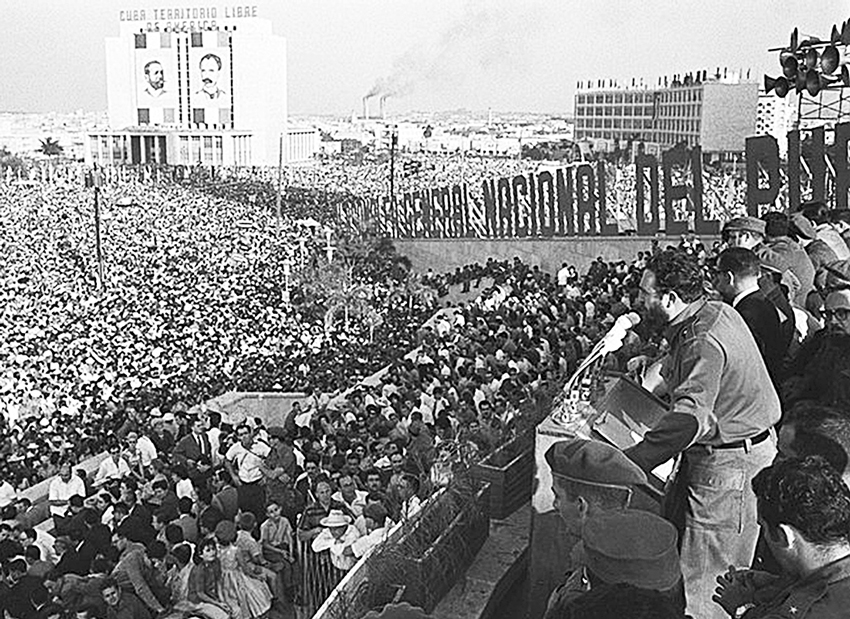
The best known example is Cuba’s contribution to defending the newly independent Angola from multiple invasions by apartheid South Africa. That internationalist mission spanned sixteen years, from 1975 to 1991. Its importance for all of Africa—and the world—was singled out by South African hero Nelson Mandela shortly after he was freed in 1990 after more than twenty-seven years in the prisons of the apartheid regime.
Speaking to a crowd of tens of thousands in Matanzas, Cuba, on July 26 that same year, Mandela thanked the Cuban people for their decisive aid, including the 425,000 volunteers who served in Angola, more than two thousand of whom gave their lives there. He underscored the “truly historic significance of their presence and reinforcement” in the 1988 battle of Cuito Cuanavale in southern Angola.
“The crushing defeat of the racist army at Cuito Cuanavale was a victory for the whole of Africa!” Mandela told the world. It has been “a turning point in the struggle to free the continent and our country from the scourge of apartheid.”
Equally important was the impact inside Cuba of these internationalist missions. The hundreds of thousands of Cuban men and women who took part in one or more of Cuba’s twenty-four missions in Africa over more than three decades came back as changed human beings. They had “broadened their scope,” to use a favorite phrase of Malcolm X.
The generations of Cubans who were born and grew up after the triumph of the Cuban Revolution knew of capitalist exploitation only from books and the stories of their parents and grandparents. For them, living and fighting side by side with the people of Congo, Guinea-Bissau, Ethiopia, Angola, and elsewhere was an unforgettable education in the barbarism of capitalism. It deepened their understanding of what Cuba’s socialist revolution had accomplished, what it had opened.
Raúl Castro, then minister of the Revolutionary Armed Forces, expressed this in the clearest possible way in May 1991 as he welcomed home the last Cuban volunteer troops to leave Angola. Operation Carlota, as the Cuban military mission to Angola was named, was now completed, he said. And Raúl underscored its importance with these words:
“When we face new and unexpected challenges, we will always be able to recall the epic of Angola with gratitude. Because without Angola we would not be as strong as we are today,” Raúl emphasized. “If our people know themselves better, if all of us know much better what we are capable of achieving,” he said, “that, too, is thanks to Angola.”
* * *
The second thing that stands out in Víctor Dreke’s account is the programmatic clarity, as well as the leadership capacities and conduct, of Amílcar Cabral, the central leader of the independence struggle in Guinea-Bissau and Cape Verde.
Cabral was assassinated in January 1973 in an operation organized by Portuguese intelligence forces. He didn’t live to see the day in April 1974 when the eroded fascist regime in Portugal was overthrown by a military coup, a coup accelerated by spreading demoralization in the ranks and officer corps of the armed forces due to the defeats it was suffering in Guinea.
The PAIGC, and the liberation struggle its cadres led, survived Cabral’s loss. More than anything, that was due to the fact that the political course Cabral led had won not only the support but the active participation of decisive numbers of Guineans and Cape Verdeans.
“We’re not militarists,” he insisted, addressing party cadres in 1966. “We’re armed militants,” political militants above all.
“Maybe I disappoint people, but I’m not a great defender of armed struggle,” he told a US audience in 1972. “I am very conscious of the sacrifices demanded by armed struggle. It is violence even against our own people.” If it “were possible to solve this problem without armed struggle, why not?” But a liberation war “is not our invention,” he said. “It is the requirement of history.”
Cabral had expressed himself even more simply and clearly when he spoke in 1966 to villagers who had joined the guerrilla army on the northern front of Guinean territory. “The armed struggle is very important, but the most important thing of all is an understanding of our people’s situation,” he told them.
“Our people support the armed struggle. We must assure them that those who bear arms are sons of the people and that arms are no better than the tools of labor,” Cabral said. “Between one man carrying a gun and another carrying a tool, the more important of the two is the man with the tool. We’ve taken up arms to defeat the Portuguese, but the whole point of driving out the Portuguese is to defend the man with the tool.”
Speaking in Dar es Salaam, Tanzania, at a 1965 conference of leaders of the liberation struggles in the Portuguese colonies, Cabral again explained the political cornerstone of the struggle in Guinea Bissau and Cape Verde:
“We are not fighting simply to hoist a flag and to have a national anthem.” We are fighting, he said, “so that our peoples may never more be exploited by imperialists, not only Europeans, not only people with white skins, because we do not confuse exploitation or exploiters with the color of men’s skins.
“Who is this enemy who dominates us?” Cabral asked. “This enemy is not the Portuguese people, nor even Portugal itself.” It’s not even Portugal’s fascist dictator, António Salazar, he said. “The enemy is Portuguese colonialism.”
Portugal, Cabral emphasized, “is an economically backward country, in which about 50 percent of the population is illiterate.” The fact that Portugal was (and still is) a class-divided society meant that Portuguese soldiers captured by the PAIGC forces were often illiterate themselves.
Portuguese prisoners of war were not brutalized or humiliated by the liberation fighters but treated with dignity and respect. They sometimes mixed freely in the camps with the liberation forces, sharing in daily tasks such as collecting firewood and carrying water. They were turned over to the Red Cross when the opportunity arose, not to the Portuguese army. There is even a photo in this book of them playing a soccer match with each other!
The armed struggle for independence had been launched in 1963. It was begun only after the PAIGC had established—through experience since their clandestine founding in 1956, including bloody colonial repression of strikes and public protests—that they had no alternative.
In a country with no industry and virtually no working class, they decided they first needed to go into the bush, village by village, and win support among people of all tribes. That’s what they did over the course of two years, at the same time organizing clandestine cells in the towns. They sent young cadres to work with the rural villagers and learn the conditions of their lives. They fought to counter tribal antagonisms the Portuguese fostered and took advantage of in order to sharpen divisions.
They organized schools for children and adults—illiteracy in Guinea-Bissau was more than 99 percent. They established clinics, health brigades, militias, village administrative councils, and judicial structures. They drew women into these activities; they opened the door for women to lead. And much more that readers will discover in this account.
“We decided to mobilize the population in the bush,” Cabral explained. “A lot of people think we came to this decision by applying the theories of Mao Zedong or whoever, but at the time we didn’t even know who Mao Zedong was. The needs of our land led us to make this decision,” Cabral said, “and our own missteps showed us the way.”
Cabral’s watchword guiding the PAIGC cadres was: “Hide nothing from the masses of our people. Tell no lies. Expose lies whenever they are told. Mask no difficulties, mistakes, failures. Claim no easy victories.” The admonition conveys the same confidence in the exploited and oppressed as the spirit that guided the men and women of the Rebel Army in Cuba’s Sierra Maestra mountains.
In September 1973, more than six months before the fall of the Portuguese regime, the PAIGC was strong enough to organize a national assembly of representatives from the administrative bodies of villages across the liberated territories. The delegates elected from these areas declared Guinea-Bissau an independent country. Even before formal independence had been recognized by Portugal, these liberated zones already covered two-thirds of the country.
It’s evident from what Amílcar Cabral did and what he said that he was a conscious materialist, a dialectical, historical materialist. He was comfortable with and had internalized what he had read of Marx and Engels. In a country still marked in many regions by pre-class social relations, Cabral understood and explained in a clear and simple way to audiences of all kinds that the history and evolution of humanity is based on the development of productive forces. History doesn’t begin with the birth of class divisions and oppression. The social and economic antagonisms of capitalist society are therefore not eternal, but can be transformed by revolutionary action of the toilers.
Cabral urged young people, irrespective of religious convictions, to study science, to overcome traditional fears of nature. To study and learn from contact with other societies. He insisted that, whatever the similarities among national liberation struggles, the leaderships of each one must begin by understanding the uniqueness of the history and economic development of their people.
To those who condemned all things Portuguese, Cabral explained that capitalism in Europe and worldwide had played a huge and irreplaceable role in the evolution of human society and improvement of people’s lives. Capitalism had once been the most productive force on earth. But that had changed fundamentally with the dawn of the imperialist epoch.
“While we get rid of colonial culture and negative aspects of our own culture,” Cabral told the people of Guinea-Bissau and Cape Verde, “we have to create a new culture, also based on our traditions, but respecting everything that the world today has conquered for the service of mankind.”
A person’s “patriotism or sincerity cannot be measured by the color of their skin, their name, or the way they dress,” Cabral explained. “Some among us think that if their name is N’Tan Passa, Keita, or Bubacar, or whatever, then for that reason alone they’re more Guinean than someone called Lourenço Marques or Lúcio Vieira, which are white names. This isn’t true. A name doesn’t make someone more of a child of their land, more entitled to the land, more a friend of the people.
“A person’s name or the color of their skin isn’t what matters. What matters is what that person has in his head and in his heart. It’s the work he does each and every day that makes him a true child of the land.”
Speaking with a group of Black rights fighters during an October 1972 trip to the United States, Cabral answered a question by an American supporter about the status of women. “Yes, we have made great achievements, but not enough,” he answered. “We are very far from what we want to do. But this is not a problem that can be solved by Cabral signing a decree. It is all part of the process of changing the material conditions of our people.”
Cabral also responded to a question on Pan-Africanism during that US trip. “Pan-Africanism is a very nice idea, but we have to work for it,” he said. He reminded his audience that in many newly independent African countries, “they only replaced a white man for a black man, but for the people it’s the same.” In an earlier speech he explained, “We are for African unity in favor of the African peoples. We consider unity to be a means, not an end. [It] must not betray the end. That is why we are not in such a great hurry to achieve African unity.”
Speaking at the 1965 Dar es Salaam conference of liberation movements in the Portuguese colonies, Cabral emphasized that “our armed struggle is only one aspect of the general struggle of the oppressed peoples against imperialism, of man’s struggle for dignity, freedom, and progress. In the vast front of struggle in Africa today, we should consider ourselves as soldiers, often anonymous, but soldiers of humanity.”
Given the materialist foundation and class clarity guiding Cabral’s political course, it is no surprise he was sometimes asked if he was a Marxist. His reply to such a question at a 1971 public meeting in London is a pleasure to read.
“Is Marxism a religion?” Cabral asked the questioner. “I am a freedom fighter in my country. You must judge from what I do in practice. If you decide it’s Marxism, tell everyone it’s Marxism. If you decide it’s not Marxism, tell them it’s not Marxism. But the labels are your affair; we don’t like those kinds of labels.
“People here are very preoccupied with the questions: are you Marxist or not Marxist?,” he added. “Please, just ask me whether we are doing well in the field. Are we really liberating our people, the human beings in our country, from all forms of oppression?
“Ask me simply this, and draw your own conclusions.”
* * *
Cabral not only welcomed the internationalist aid the liberation movement received from the government and people of Cuba. He was attracted to the political example of the Cuban Revolution and its leadership.
“If any of us came to Cuba with doubts in our mind about the deep-rooted character, strength, maturity, and vitality of the Cuban Revolution,” Cabral said in a speech in Havana in January 1966, “such doubts were dispelled by what we have already been able to see.” He was presenting one of the keynote talks at the Tricontinental Conference, which had attracted some five hundred delegates from more than eighty countries around the world.
“The vanguard of the Cuban Revolution has mobilized, organized, and politically educated the people,” Cabral continued. It has “kept them permanently informed about national and international questions that affect their lives,” enabling them “to take an active part in addressing those problems.
“This constitutes a lesson for us, especially for the national liberation movements, and specifically for those who want their national revolution to be a true revolution.”
As shown by these few examples and by others throughout Víctor Dreke’s account, what marked the character and political course of Amílcar Cabral’s leadership of the PAIGC was confidence in the revolutionary capacities of the exploited and oppressed. No wonder Fidel and Che recognized in Cabral a kindred soul and sent some of the best and most experienced cadres of the Cuban Revolution to aid them. To fight alongside them, as Cabral insisted, not for them.
Over the eight years of the war for independence, some four hundred Cuban internationalist volunteers at one time or another fought at the side of the liberation forces of Guinea and Cape Verde. They lived to the fullest Fidel’s call to action:
“Those not willing to fight for the freedom of others will never be able to fight for their own.”
September 30, 2025