Cuban people, gov’t organize to defend their revolution
Since late January, when Washington imposed a blockade on Cuba’s access to imported oil, the U.S. rulers have stepped up their drive to deal further economic and political blows to the Cuban people and their government. Workers and farmers on the island are organizing to try to limit the extensive impact of the blockade as they defend the conquests of their socialist revolution.
“Farmers have truly responded to the call to keep production going,” Idia Ruiz, director of Revista ANAP, the paper of the National Association of Small Farmers, told the Militant. “They are using organic fertilizers, natural pesticides and animals to pull farm equipment,” she said. “But it’s difficult to plant all their land because they don’t have the fuel or inputs they need.”
The shortage of fuel caused by the U.S. rulers’ blockade affects every aspect of production and life in Cuba. Being able to use tractors to plow, to irrigate during the short hours when there is electricity, and getting produce to markets are daily challenges for farmers.
Using U.S. imperialism’s economic domination, President Donald Trump issued an executive order Jan. 29 threatening to impose punishing tariffs on any country that sells or provides oil to Cuba. So far, the threat has proved effective with no oil shipments arriving since Jan. 9. Cubans now face even longer daily blackouts, water shortages, scarcities and increased prices for food and transportation.
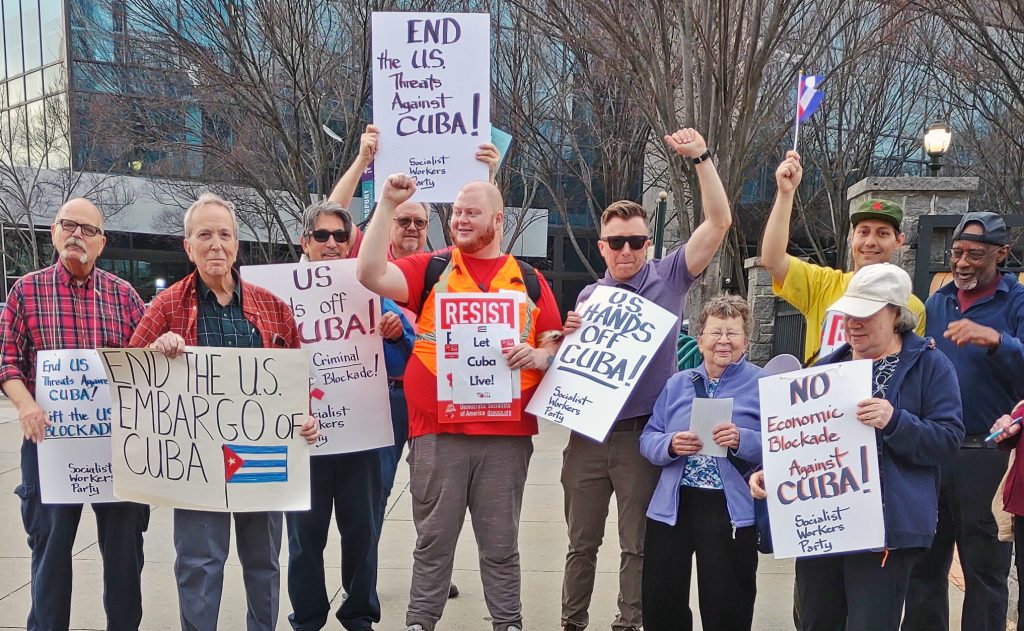
“The economic suffocation of Cuba has been a central component of U.S. policy toward Cuba, with the aim of limiting the Cuban people’s right to exercise their sovereignty,” Yuri Gala López, Cuba’s ambassador to the United Nations, told a webinar sponsored by the coalition organizing the Action Conference for US-Cuba Normalization, scheduled for March 14-15 in New York City.
‘U.S. rulers can’t forgive Cubans’
“It bothers them that they can’t bring us down. They can’t forgive us for our defiance just 90 miles away from their coast,” Yasmani Toirac Laffita, a farmer and member of the Waldo Díaz Agricultural Production Cooperative in Güira de Melena, in Artemisa province, told the Mexican daily La Jornada. “They are haters, but we are people who extend solidarity to others. We send doctors, not bombs to other countries.”
Toirac Laffita and other members of the cooperative belong to ANAP. Since its creation in 1961, ANAP has played a central role in organizing small farmers to defend the socialist revolution carried out by millions of Cuban workers and peasants following the Jan. 1, 1959, overthrow of the U.S.-backed dictatorship of Fulgencio Batista.
They overturned capitalist exploitation and oppression, and used state power to serve the interests of working people, not the former capitalist rulers. This is what the U.S. rulers aim to reverse when they talk about “regime change” in Cuba.
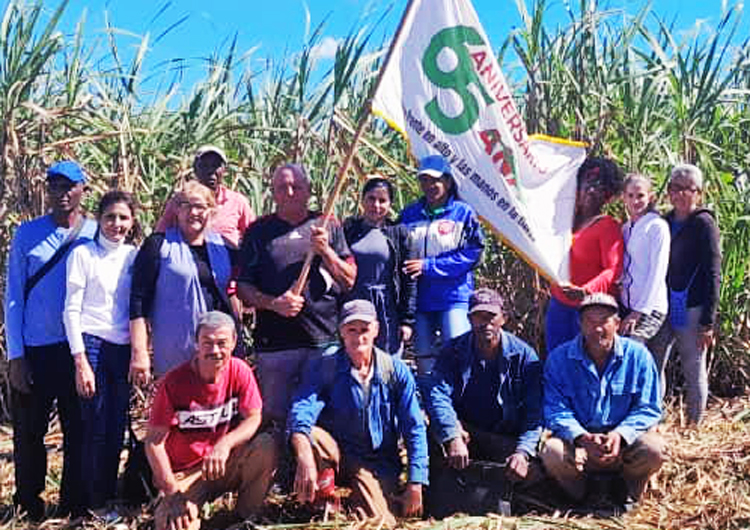
As part of its 65th anniversary celebrations, ANAP members are organizing events at farms, local schools and medical clinics to recognize their contributions to the community, Ruiz said. Farm cooperatives regularly donate produce to institutions such as child care centers, homes for the elderly and maternity homes, helping to protect the most vulnerable from the growing impact of Washington’s blockade. This orientation is a proud hallmark of Cuba’s socialist revolution.
ANAP was born two years after Cuba’s First Agrarian Reform Law was passed in 1959. The law nationalized millions of acres of large plantations owned by foreign and Cuban capitalists, and granted land titles to landless peasant families. It guaranteed farmers the right to their land, access to cheap credit, and prices to provide a livable income. The revolution also extended access to education, health care, child care and other rights to workers in the countryside.
At the Aniceto Pérez Cooperative, La Jornada reporters encountered farmers who took part in internationalist missions as soldiers, teachers and doctors, to aid national liberation movements and other struggles around the world. There are hundreds of thousands of Cuban men and women who have done so.
“Trump is seeking to provoke a popular uprising against the government,” Amelia González, president of the Aniceto Pérez Cooperative in Artemisa, told La Jornada.
“I was in Angola” in the late 1980s, said Lázaro González, one of the 14 cooperative members who fought in Africa. The victory of Cuban and Angolan forces there defeated the invading South African army and precipitated the fall of the apartheid regime itself. “That experience strengthened the Cuban Revolution and its defense,” he said.
“This has to make [the imperialists] think. This is not just any other people,” he added, and “we have real combat experience. Every people has to be able to defend itself.”
Imperialist rulers step up assaults
Since the Jan. 29 executive order, the U.S. rulers have stepped up their economic and political war against the Cuban Revolution. Airline bosses from Canada joined the assault by suspending all flights to the island. The decision strikes a blow to Cuba’s tourist industry, a major source of foreign currency that’s needed to cover purchases of basic necessities.
Bowing to the Trump administration, the government of Guatemala announced Feb. 10 that it will begin phasing out a program that has provided Cuban medical professionals for the country’s health care system for nearly three decades. The U.S. government falsely claims the medical program exploits Cuban medical workers through forced labor and deprives the Cuban people of essential medical care.
Nothing could be further from the truth. Since the early years of Cuba’s socialist revolution, Cuban doctors and nurses have taken part in volunteer internationalist missions throughout Latin America, Africa and the Pacific, bringing vital treatment to people in the most remote rural regions or poorest urban neighborhoods. Cuba has also trained free of charge thousands of medical professionals from these countries to make health care more accessible to underserved populations.
Public health is one of the social conquests of the revolution hardest hit by the nearly seven-decade-long economic war Washington has waged against the Cuban people. The recent tightening of sanctions has posed new challenges for caring for patients, keeping electricity running in hospitals and clinics and staff transportation. The cancellation of commercial flights will aggravate medicine shortages as the freight costs of importing medications increase.
To mitigate the situation, health and transportation authorities are joining efforts with local taxi cooperatives, which are volunteering to bring patients in need of critical care, such as dialysis, for their daily treatment. Wherever possible, the ministry of health is assigning doctors and nurses closer to where they live, and deploying medical brigades to remote areas.