LOS ANGELES — The strike by some 31,000 members of the United Nurses Associations of California/Union of Health Care Professionals at hospitals and clinics in California and Hawaii entered its fourth week Feb. 16. Spirited strike lines of nurses and other health care workers continue. At the west Los Angeles Kaiser hospital here Feb. 13, drivers and passengers passing by in cars and trucks honked in support.
Some 3,000 pharmacy technicians, members of United Food and Commercial Workers Local 770, had walked out and joined the picket lines in solidarity for three days. They went back to work Feb. 12. The local said more Alliance of Health Care Unions will be issuing 10-day strike notices soon.
Founded in 2018, the Alliance is a federation of 23 local unions representing over 60,000 Kaiser Permanente employees who work in hundreds of job classifications everywhere Kaiser has a presence.
Kaiser is California’s largest private employer, with close to 19,000 physicians and more than 180,000 employees overall. It also has a major presence in Washington, Colorado, Georgia and other states.
One of the central issues is the hospital bosses’ refusal to hire enough staff. When asked what this means for health care workers, Jenny, a relief charge nurse for 12 years at Kaiser, told the Militant, “I don’t know where to begin. It’s very stressful. You want to do a good job but you get your resources taken away from you. It’s not just patients but their families. Lack of staffing, not enough equipment, computers shut down, thermometers missing.”
“I’ve been a nurse for 10 years and at Kaiser for three years,” added Dawn, a registered nurse. “You are constantly doing more than one job. That’s the main issue. You see the camaraderie on the job and on the picket line. It’s not about the money. It’s the lack of resources. There are not enough certified nursing assistants to work with patients and their families. We work as fast as we can. Sometimes we don’t get to take any breaks on a 12-hour shift.”
Kaiser strikers need your support! Go to the union website — at UNAC/UHCP Home — and click on “Take Action!” You’ll find information on the strike and time and locations for joining the picketing.
* * *
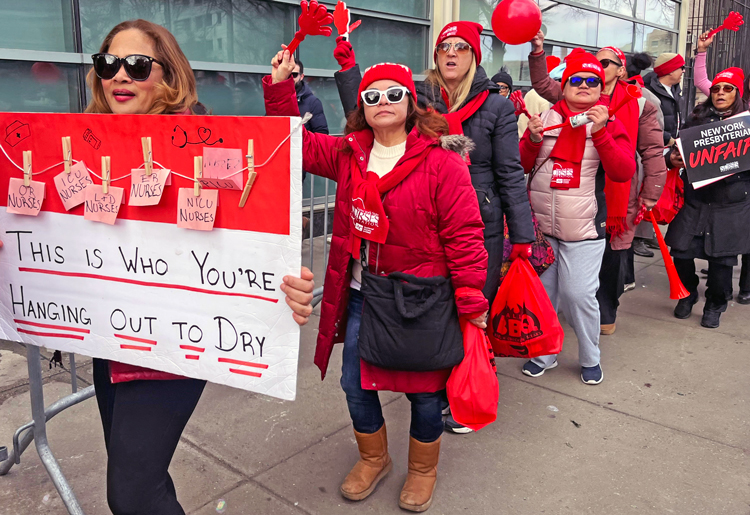
NEW YORK — “The most important issue we’re fighting around is safe and enforceable staffing levels,” labor and delivery nurse Kimberly McCoy told the Militant Feb. 14. McCoy was on the picket line outside New York-Presbyterian Hospital as nurses there began their second month on strike.
“The Neonatal Intensive Care Unit is always overfilled. This is dangerous for both the babies and the nurses,” she said. One of the handmade signs carried by another striker said, “Closets are for clothes, not babies,” referring to the hospital’s practice of putting cribs for sick infants in closets when space in the unit fills up.
Nurses at three hospital systems here — New York-Presbyterian, Mount Sinai and Montefiore — went on strike Jan. 12. Mount Sinai and Montefiore nurses approved new contracts that met their key demands and returned to work Feb. 14. More than 4,200 nurses at New York-Presbyterian overwhelmingly rejected a worse contract and continue to maintain energetic picket lines.
When this Militant correspondent was there a DJ was playing dance music, several carts of donated barbecue had just been delivered, virtually every car and city bus that drove by honked in support and an overhead drone took photos as strikers and their supporters waved and applauded.
As a result of a strike in 2023, nurses at Mount Sinai and Montefiore had won enforceable nurse-patient ratios. This time around they successfully beat back attempts by those hospitals to cut those clauses from the contract, as well as keeping their current medical insurance plan and pensions, and winning modest pay raises, said Carol McGowan, a Mount Sinai nurse for 37 years who currently works in the neurosurgical ICU. She had come to join the picketing and show solidarity with the New York-Presbyterian nurses before she returned to work Feb. 16.
“At NYP we didn’t win the enforcement language three years ago,” McCoy said. “And the contract we voted on last week didn’t include it. That’s why we voted it down.”
“It’s not just nurses,” Marie Berguin-Francois, who currently works in postpartum and has been at New York-Presbyterian for 34 years, said. “They don’t bring in enough cleaners, transport, and so on. So the nurses end up having to do some of that work as well.”
Bobby Ancog has worked there for 28 years. He’s an operating room nurse. “When there’s a pause between cases in the OR, they try to force us to other units where we’re not actually trained,” he said. “First they threatened to cut our medical benefits and pensions. When they gave up on that, they acted like we owed them a favor” and should give up on fighting for adequate staffing.
Last year New York-Presbyterian laid off 2% of its workforce, about 1,000 workers in all.
Eloisa Principe, a nurse with 18 years at this hospital, came to the picket line with her husband Alexander and their two children. “The patients can’t get the good care they deserve if there aren’t enough nurses,” she said. “I tell her, ‘don’t back down. You have to keep fighting,’” Alexander said.
To join their fight, go to the New York State Nurses Association website for more information, including on picket sites at New York-Presbyterian’s three locations.