HAVANA — “This book is especially important right now,” said Cuban revolutionary leader Víctor Dreke. “It reminds us of the struggle in Guinea-Bissau and Cape Verde — small countries,” he emphasized, whose victory brought down the entire Portuguese empire in Africa in the mid-1970s.
And it reminds us, he said, of the Cuban internationalist fighters who joined them, including “those of you sitting in this room today.”
Some 90 people filled the courtyard at Casa de África Feb. 18 for the launching of Cuba and the Independence War in Guinea-Bissau and Cape Verde: The Fall of the Last Colonial Empire in Africa. This firsthand account by Dreke was recently published in English and Spanish by Pathfinder.
The event drew an audience eager to hear from participants about a chapter in the Cuban Revolution’s proud history of aiding liberation struggles around the world.
Alberto Granado, director of Casa de África, one of the event’s sponsors, welcomed the many in attendance who themselves had been combatants in one or more of Cuba’s 23 military missions in Africa, including in the Congo, Angola, Ethiopia and Guinea-Bissau itself. Also present were many local residents who frequent the beautiful museum and cultural center in Old Havana that highlights Cuba’s African heritage.
The book presentation, Granado said, took place at a time when the U.S. government has sharply escalated its decadeslong economic war against Cuba’s socialist revolution. Three weeks earlier, he noted, after Washington imposed an oil blockade on the island, the annual Havana International Book Fair had to be postponed as one of a series of emergency measures to conserve fuel.
‘The enemy will never understand us’
“We were determined not to cancel this event,” Granado said. Because of the extremely limited bus transportation, “many people here got up very early and came here on foot.” Militant reporters talked with a few who had traveled four hours from outlying neighborhoods.
“The enemy will never understand us,” Granado said, referring to how the U.S. rulers continue to underestimate the capacities and consciousness of Cuba’s working people.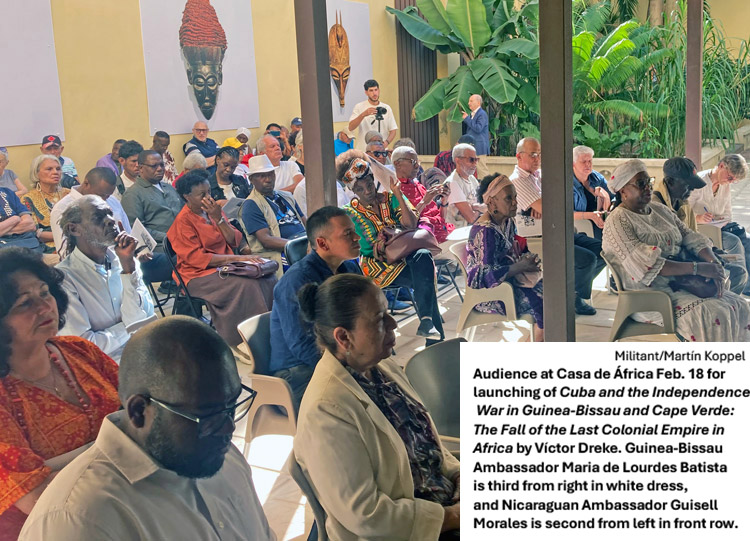
Many came to the meeting because they wanted to hear Dreke, whose lifelong record goes back to his participation in the revolutionary war, led by Fidel Castro, that overthrew the U.S.-backed Fulgencio Batista tyranny in 1959 and opened the first socialist revolution in the Americas. Dreke commanded the military campaign in Cuba’s Escambray Mountains in the early 1960s that defeated U.S.-sponsored counterrevolutionary bands there.
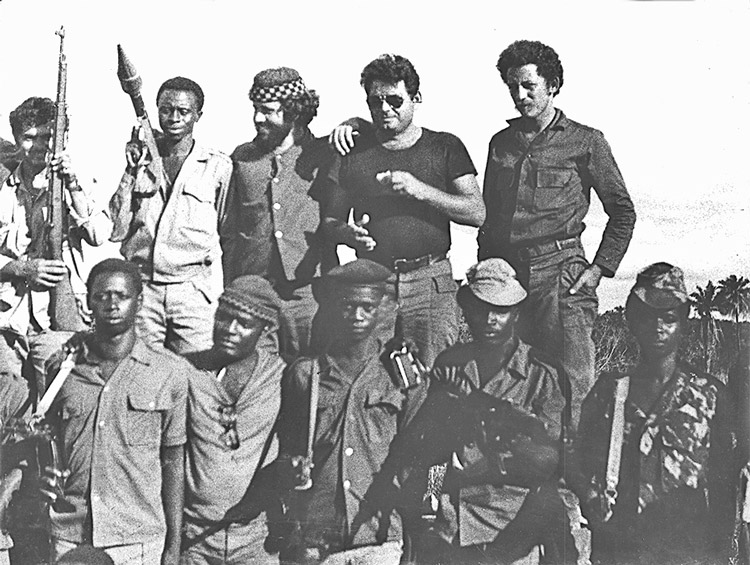
In 1965 Dreke was second-in-command under Ernesto Che Guevara of 130 Cuban combatants who fought alongside national liberation fighters in the Congo.
Much less known, however, is Cuba’s decisive role in the war that won independence from Portuguese colonial rule in Guinea-Bissau and Cape Verde in 1974-75. Dreke headed Cuba’s combat mission there in 1967-68. He worked closely with the central leader of that struggle, Amílcar Cabral, and his African Party for the Independence of Guinea and Cape Verde (PAIGC). Today Dreke — still popularly known as Commander Moja, the Swahili nom de guerre given him by Che in the Congo — is president of the Cuba-Africa Friendship Association.
Chairing the presentation, Ana Morales, program director at Casa de África, introduced prominent guests in the audience. They included Maria de Lourdes Batista and Guisell Morales, ambassadors of Guinea-Bissau and Nicaragua, respectively. She welcomed Antonio Guerrero, one of five revolutionaries who spent up to 16 years in U.S. prisons for helping defend Cuba from violent attacks by Cuban American counterrevolutionary groups.
In addition to Dreke, the speakers panel included Col. René Hernández Gattorno and Lt. Col. Alfonso Pérez Morales, both volunteer combatants in the Guinea-Bissau independence war, and Oscar Oramas, Cuba’s ambassador in neighboring Guinea-Conakry at that time. Ana Morales recognized in the audience Lt. Eduardo Torres Ferrer, known by his comrades as “Coqui,” who also took part in the Guinea-Bissau mission, and who like the others is now retired from active duty.
Gattorno, Pérez Morales, Torres Ferrer and Oramas are interviewed in the final chapter of the new book. Ana Morales herself led the Cuban medical mission and the founding of the medical school in Guinea-Bissau in 1986, after it won its independence.
Also on the panel was Mary-Alice Waters, co-editor of the book and president of Pathfinder, as well as a leader of the Socialist Workers Party.
What bothers the U.S. rulers
“This is an important moment,” Dreke told the audience. He condemned Washington’s assault on Venezuela and singled out the internationalist example of “our 32 Cuban compañeros who fell in combat there defending President Nicolás Maduro.”
“The U.S. imperialists are now threatening us and we face a difficult situation,” Dreke added. “Our people struggle day by day. The enemy attacks us with shameless methods,” with a blockade “that seeks to starve us into submission.” If the imperialists ever take control of Cuba, “they will try to wipe us out, as they’ve tried to do to the Palestinian people. But they won’t be able to defeat us.
“They say they’ll decide who is the president of Cuba. But their dispute is with the Cuban people. They’re not going to be able to overthrow the Cuban people.”
What bothers the U.S. rulers, Dreke said, “isn’t just President Miguel Díaz-Canel. It isn’t just Raúl Castro. What bothers them is Cuba’s dignity. Cuba’s courage in never giving up.”
We value the solidarity we receive from people in other countries,” Dreke said.
Pointing to Waters and other members of the communist movement in the U.S., Canada, and the United Kingdom attending the event, he said, “These compañeros are here today not because of this book, but because of what we are confronting in Cuba. They are saying, ‘We are here with you.’”
Cuba and the Independence War in Guinea-Bissau and Cape Verde, Dreke said, tells the story not only of the Cuban internationalists who aided that struggle, but of the outstanding leadership of Amílcar Cabral and the movement he forged.
Dreke noted that Che Guevara, who met Cabral in 1965, “said that if there was one anti-imperialist organization in Africa with the potential of being victorious, it was the compañeros of the PAIGC.”
Cabral united independence fighters from Guinea-Bissau and Cape Verde into a disciplined organization. As part of that, Dreke said, “a group of Cape Verdeans came to Cuba to receive military training and went back to fight in Guinea-Bissau.”
One of Cabral’s leadership qualities was his active promotion of women’s participation in the liberation struggle, he said. “In Guinea-Bissau, we would see women with a basket on her head, a child on one shoulder, and a rifle on the other.”
‘We cannot forget this history’
Dreke paid tribute to the example of the more than 400 Cuban volunteers, both combatants and doctors, who over nearly a decade took part in the clandestine Cuban mission aiding the independence war in Guinea-Bissau. The new book is a contribution to ensure “that this history is not forgotten,” he said.
Oramas, who over the years was Cuba’s ambassador in several African countries, explained, “Support to the struggles of African peoples was intrinsic to the Cuban Revolution from the beginning.” As early as 1961, he said, Cuba sent a shipload of weapons for the Algerian independence movement against French colonial rule.
Wherever Cuban internationalists aided liberation struggles, “Fidel told us that we were not going to dictate what we think but to cooperate as equals,” Oramas said. “That’s what we did in Guinea-Bissau and Cape Verde.”
By 1974, fighters in Guinea-Bissau were dealing decisive blows to the colonial army “and the Portuguese saw they could not win,” Oramas said. “Lower-level military officers rebelled” against the increasingly hated dictatorship in Lisbon. “That was the origin of the Carnation Revolution,” the military coup that overthrew the regime and set off a revolutionary upsurge by working people in Portugal.
Pérez Morales, also known as Pina, his nom de guerre, said, “Little has been written about the Cuban mission in Guinea-Bissau,” and the new book is an important contribution to telling that history.
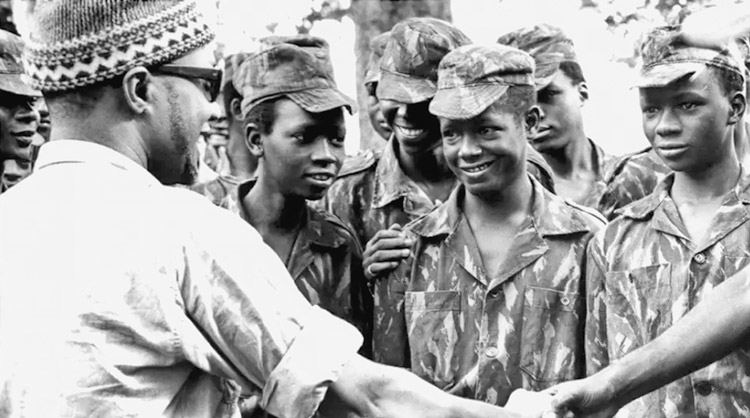
Pina, who was head of the Cuban combatants in the northern front of the guerrilla war, remarked that the Cuban fighters “lived alongside the Guineans. We ate together from the same pots in the guerrilla camps. We became brothers. They protected us at the risk of their own lives during the battles. I came to feel Guinean myself, and I still do.”
Cabral taught the liberation fighters that their enemy was not the people of Portugal but Portuguese colonialism. “The soldiers we captured were treated with dignity,” Pina said. Although the colonial army was brutal toward the Guinean population, “there were no feelings of revenge against the Portuguese soldiers. In that sense, it was a very humane struggle.”
Gattorno vividly described highlights of the decisive battle against the Portuguese garrison at Guiledje, in which he took part. “It was an enormous, heavily fortified base,” he said. The Guinean and Cuban forces carried out a joint ambush followed by a massive mortar attack that routed the Portuguese forces.
“The Portuguese soldiers we captured were sons of peasants. Many were illiterate. They would beg us to turn them over to the Red Cross, not to the Portuguese army,” Gattorno said. Portuguese imperialism, he noted, committed crimes against both African peoples and the Portuguese working people they used as cannon fodder.
“Young people in Cuba and around the world need to know these facts. That’s what imperialism is. That’s what capitalism is. They need to know that in face of this enemy, we must fight, and it’s better to die standing than to live on our knees.”
The audience was riveted by the combatants’ firsthand accounts. Most had never heard much about that liberation war and its broader impact in the world.
Waters, the opening speaker on the panel, told the audience that Cuba and the Independence War in Guinea-Bissau and Cape Verde conveys “the heart and soul — the lessons — of the Cuban Revolution, lessons that are so badly needed in today’s world.”
She noted that today Washington is escalating its threats and actions to deny the Cuban people the most basic necessities of life because “you had the audacity to open the socialist revolution in the Americas.”
Dreke’s account not only highlights Fidel Castro’s course as a leader of working people, Waters said. It “begins the rescue of the real Cabral, the political leader of Guinean and Cape Verdean working people, the Cabral whose qualities Che and Fidel recognized and identified with.”
Waters concluded by describing the initial positive reception Dreke’s book has already received among working people and others in the United States. And, she added, “the book has already reached Africa, where friends of Pathfinder in Burkina Faso are working with us to rapidly finish translation to French.”
The launching of Dreke’s book was followed by a presentation of Breve historia política de Sudáfrica (Brief political history of South Africa), by Ángel Dalmau, who was Cuba’s first ambassador to South Africa after the end of the apartheid regime. He highlighted points in the book, including on revolutionary Cuba’s unstinting support to the struggle that ended white-supremacy rule in South Africa.
A second presentation
A few days later, Dreke presented Cuba and the Independence War in Guinea-Bissau and Cape Verde at a community meeting in the Atabey neighborhood on the outskirts of Havana where he lives. He spoke together with Waters and Martín Koppel, the co-editors of the book. The event, attended by some 30 people, was introduced by Ana Morales, who is the elected delegate to the local government, known as People’s Power, here.
Dreke is well known by residents of Atabey. But some of those at the meeting said they didn’t know much about the history of the independence struggle in Guinea-Bissau and Cape Verde and the exemplary role of Cuban internationalists in it.
One of the participants remarked, “Hearing about that history reminded us of who we are as revolutionaries.”