

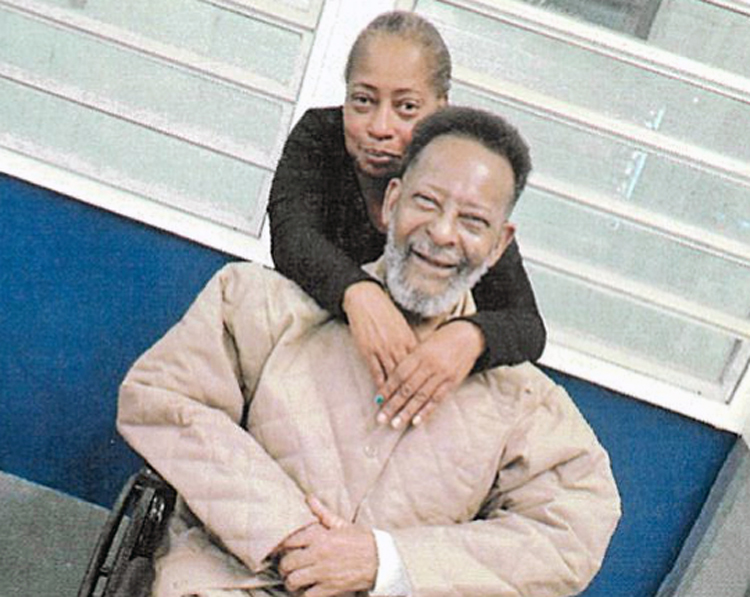
After strong support from working people, jurors from his trial, family members of the man killed and opponents of the death penalty, Alabama Gov. Kay Ivey commuted the death sentence of Sonny Burton March 10, two days before he was to be executed.
He is now sentenced to serve life in prison with no chance of parole. Only days before, Ivey had said she would not commute Burton’s sentence. It is only the second commutation in Ivey’s two terms. She has presided over 25 executions, the most of any governor since the death penalty was reinstated in 1976.
Burton was to be killed under an Alabama law permitting accomplices of some crimes to be executed despite the fact that they didn’t kill anyone.
Burton, 75, has been at the Holman Correctional Facility in Atmore for more than three decades. Now suffering from debilitating rheumatoid arthritis, he is in a wheelchair and wears a protective helmet as he frequently falls.
In 1991 Burton was one of six men who robbed an AutoZone store in Talladega, Alabama. After Burton left the store and was sitting in the car outside, robber Derrick DeBruce killed a shopper, Doug Battle. Burton didn’t even know Battle had been shot.
“I was so angry at him [DeBruce],” Burton told Newsweek March 5. “If I had been there I’d have tried to stop it.”
DeBruce was given the death penalty, but the sentence was reduced to life in prison after an appeals court ruled that his attorney had been “inadequate.” Two of the other six men were sentenced to life without parole and another two got 25-year sentences.
A lead witness in Burton’s trial was co-defendant LaJuan McCants, who accepted a plea deal in exchange for testifying against Burton. He has since recanted his testimony, stating that he never thought Burton intended violence.
In a clemency petition six of the eight living jury members said they have no objection to Burton getting life without parole. One of them, Priscilla Townsend, told The Associated Press, “You don’t execute someone who did not pull the trigger.”
A petition by the U.S. Campaign to End the Death Penalty calling for a halt to the execution with over 67,000 signatures was delivered March 9 to Ivey’s office by a group that included two of Burton’s daughters.
Battle’s daughter, Tori Battle, was 9 years old at the time of the robbery and supports the call for clemency. “No one from the state has ever sat with me to explain why Alabama believes it must execute a man who did not kill my father,” she wrote in the Montgomery Advertiser last December.
“My love for my father does not require another death, especially one that defies reason.”
In a letter to Alabama Department of Corrections Commissioner John Hamm, Gov. Ivey wrote, “I cannot proceed in good conscious with the execution of Mr. Burton under such disparate circumstances.
“I believe it would be unjust for one participant in this crime to be executed while the participant who pulled the trigger was not.”
Burton was to be executed using nitrogen hypoxia, or suffocation while conscious. Even the American Veterinary Medical Association has deemed nitrogen hypoxia inappropriate for euthanizing most animals.
In 2024 Alabama became the first state to use this form of execution, killing prisoner Kenneth Smith, who struggled on the gurney for 22 minutes fighting to breathe. Last fall, Anthony Boyd, another death row prisoner at Holman, was executed by nitrogen gas. “Witnesses described seeing Mr. Boyd convulse and heave for about 15 minutes before being pronounced dead,” the New York Times wrote.